
 Worksheets
2025 HONORS World History Review: Unit 7- Ideas Change the World
Total questions: 50
Worksheet time: 25mins
Which factor contributed most to the development of the Renaissance in Italy?
A) City-states in Italy had become wealthy from trade.
B) Nobles in Italy had been military leaders in the Crusades.
C) The Catholic Church provided political stability to the region.
D) The region had become politically unified under one Italian king.
A new theological doctrine that emerged from the Protestant Reformation included the idea of —
good works
salvation by grace
sacramental traditions
indulgences as forgiveness
The most immediate cause of the Reformation included —
Erasmus’ publishing of The Praise of Folly
Martin Luther’s posting of the Ninety-five Theses
John Calvin's establishment of a theocracy in Geneva
Henry the VIII's plea to Pope Clement VII for an annulment
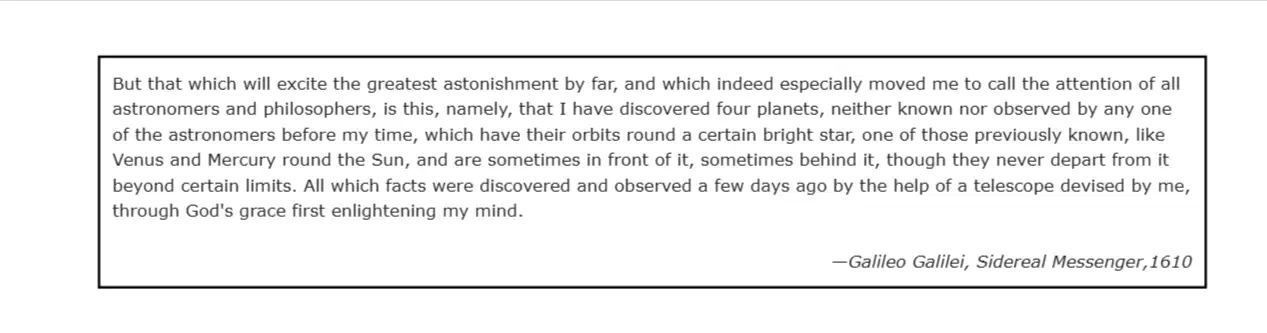
Which new approach to scientific thought is illustrated in the excerpt?
Rejecting religious teachings about the physical world
Employing laboratories to confirm the results of theories
Using direct observation instead of relying on previous beliefs
Adhering to the practices passed down by the Greeks and Romans
The Crusades helped to contribute to the beginning of the European Renaissance by —
introducing the Europeans to Islamic art
destroying the libraries of Muslim scholars
facilitating the revival of trade with the East
inciting a rebellion against the Catholic Church
The changing social views that emphasized the growing individualism and secularism emerging during the European Renaissance came to be known as —
enlightenment
humanism
rebirth
reformation
What economic change in Europe during the Renaissance facilitated the flourishing of art that characterized the time period?
Introduction of paper currency that was in higher demand by artists
Creation of a barter system that allowed artists to trade more easily
Growth of a merchant class with additional income used to patron the arts
Development of government programs that paid for the education of artists
How did the Reformation change the political composition of Europe?
The Pope became the political advisor to many European monarchs.
Eastern Europe became vulnerable to the advances of the Ottomans.
Monarchies were overthrown and Protestant theocracies were created.
Nobles aligned with either Catholic or Protestant traditions and went to war.
How did the Catholic Church respond to the religious changes brought about by the Reformation?
It allowed Catholic priests to marry.
It launched a Counter-Reformation.
It replaced the Pope with a new leader.
It issued an English translation of the Bible.
The Act of Supremacy of 1534 changed the religious patterns in England by —
protecting the monasteries in England from Papal abuses
allowing for the spread of the Lutheran religion to England
making the monarch the head of the Christian church in England
installing the Archbishop of Canterbury as the spiritual leader of England
In his work Summa Theologica, Thomas Aquinas attempted to answer questions about matters of faith and doctrine in Catholicism by —
using satire and comedy to provide memorable explanations of complex theological ideas
creating a panel of legal and religious scholars to decide major questions of Church theology
developing a system of Church law based on family and religious customs of the Roman Empire
combining ideas of Greek and Church philosophers to explain that faith and reason do not conflict
Which description best reflects the relationship between religion and the secular world during the Renaissance?
Protestant emphasis on the individual’s personal relationship with God was reflected in the size of new churches being built.
Renewed interest in the Classical Greek and Roman texts led to closer ties between the Catholic Church and secular institutions.
The relationship between politics and religion became strained, and the political influence of the Catholic Church weakened.
Humanist writers and philosophers whose ideas fostered individual expression and intellectual freedom supported the Catholic Church.
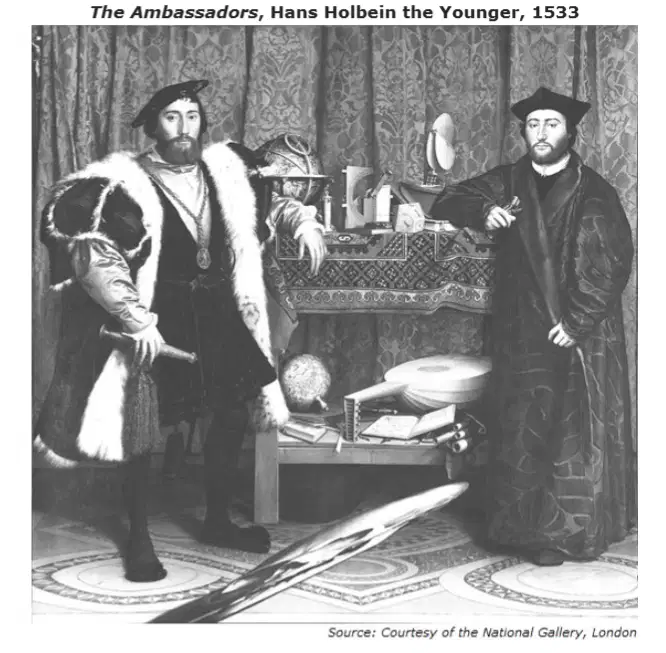
In what way does the painting illustrate advances that were being made during the Renaissance?
The subjects are both trained navigators.
Many pictured items were discovered in the Americas.
Two globes and navigational instruments are pictured.
Influences from Greek and Roman architecture can be seen.
Many of the literary works of the Renaissance, such as The Book of the Courtier, reflect the cultural changes taking place during that time by —
arguing to end the enslavement of people
criticizing the power of the Catholic Church
emphasizing the importance of the individual
elevating women characters to equal status with men
Which sixteenth century Italian literary work is still studied today for its insights on political power?
The Prince
Julius Caesar
Canterbury Tales
The Praise of Folly
How did Gutenberg's invention of the printing press contribute to the Reformation?
Maps could be updated and printed more regularly to improve navigation.
Universities used printing presses to create huge libraries.
The Bible was printed in vernacular languages leading to greater criticism of the Church.
The Catholic Church printed messages from the Pope encouraging missionaries to travel and gain converts.
Which action most contributed to the onset of the Scientific Revolution in sixteenth-century Europe?
Invention of the new methods of accounting
Creation of a navigation school by Prince Henry
Introduction of new products from the Americas
Publication/collaboration of new theories related to astronomy
Which sixteenth century scientist proposed the heliocentric theory which was later supported by Galileo?
Robert Boyle
Nicolaus Copernicus
Isaac Newton
Eli Whitney
Which scientist applied reason and rationality to devise his laws of motion?
Robert Boyle
Albert Einstein
Isaac Newton
James Watt

Which conclusion can be reached from the events on this timeline?
The plague primarily affected China.
The interaction of people through trade spread the plague.
Port cities were relatively untouched by the plague.
The plague started in Western Europe.

In what ways did Renaissance architecture differ from the architecture of the Middle Ages?
Renaissance architecture had stained glass windows.
Medieval architecture used columns and circular arches.
Medieval architecture often featured a dome-like roof.
Renaissance architecture borrowed more from classical styles.
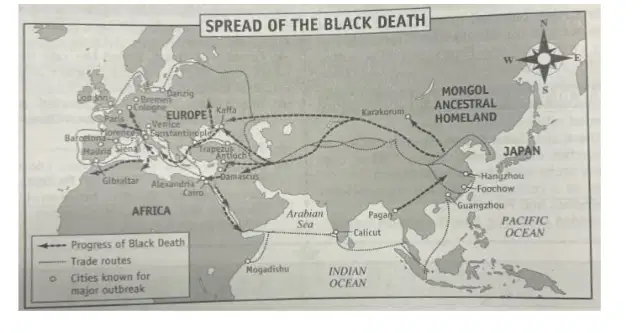
The information in the map suggests that the Black Death spread to Europe as a result of contact with:
merchants from West Africa
explorers from the Americas
traders coming from Asia
barbarians from Scandinavia
"Kings and Princes coin money only out of metals, but the Pope coins money out of everything - indulgences, ceremonies, dispensations, pardons; all fish come to his net."
- Martin Luther, 1519
The ideas presented in this passage by Luther contributed directly to the —
Mandate of Heaven
Protestant Reformation
Glorious Revolution
Scientific Revolution
Which statement best describes a contribution of the works of Nicolas Copernicus and Galileo Galilei?
They renewed interest in Greek and Roman drama.
They strengthened acceptance of traditional Church beliefs.
They demonstrated Earth was not the center of the universe.
They explained the laws of gravity on heavenly bodies.
A major reason that the Renaissance began in Italy was that —
Few European scholars had migrated to this area
Italian merchants benefited from trade with the Americas
Italian city-states had grown wealthy from trade between Europe and Asia
Italian farmers produced great agricultural surpluses on vast plains
One way in which the writers of the Renaissance were influenced by the writers of ancient Greece was that Renaissance writers -
emphasized the power of human reason
showed little interest in secular affairs
produced few new scientific ideas
promoted the religious doctrines of the Roman Catholic Church
Which individual's work had the greatest impact on the spread of Martin Luther's ideas?
Galileo Galilei
Niccolò Machiavelli
William Shakespeare
Johann Gutenberg
Which innovation had the greatest impact on the Protestant Reformation?
establishment of a movable-type printing press
introduction of porcelain
use of a magnetic compass
construction of a triangular sail
Which statement expresses a belief shared by most renaissance philosophers?
People should study secular subjects as well as sacred matters.
Governments should establish overseas empires.
People should withdraw from the world to worship God.
Scholars should follow Church teachings without question.
Sale of indulgences authorized by Pope Leo X to raise money to build St. Peter's Basilica in Rome (1515) Ninety-five Theses posted (1517)
Hearing held at Worms, Germany (1521)
These events are most closely associated with -
the Crusades and the control of the Holy Land
Martin Luther and the Protestant Reformation
Leonardo da Vinci and the Renaissance
Copernicus and his theory that the Earth rotated around the sun
The major goal of the Counter-Reformation was to —
reinstate the power of the Roman Catholic Church
reduce the authority of absolute monarchs
encourage new ideas in science and philosophy
reach a compromise with European Protestants

In this passage, Boccaccio was most likely describing the —
power of special courts during the Inquisition
effects of the barbarian invasions after the fall of Rome
treatment of native peoples in Latin American nations
breakdown of social order during the bubonic plague

What is the most likely source of this quotation?
Machiavelli's recommendations to rulers in The Prince.
Da Vinci's description of his new painting style in works like the Mona Lisa.
Luther's failure to submit to the Pope's demands at the Diet of Worms.
Arguments of Galileo at his trial for accepting the views of Copernicus.
One major characteristic of the Renaissance was that the —
manor became the main center of economic activity
Catholic Church lost all its influence in Europe
classical cultures of Greece and Rome were studied and imitated
major language of the common people was Latin
Which change to Christian church practices was suggested by Martin Luther?
increasing the sale of indulgences
installing statues of saints in churches
Saying the mass in Latin so the faithful would hear it
printing the Bible in the vernacular so all could understand it
What was an important effect of the Hundred Years' War?
England established permanent control over much of France.
The Black Death spread from France to England.
England and France failed to benefit from Renaissance culture.
A greater reliance on new weapons reduced the importance of knights.
In 1517, Martin Luther was dissatisfied with the Catholic Church because he-
thought the Church lacked structure
disagreed with the sale of indulgences
blamed the Church for not curing people who had the plague
believed that kings should have more power to appoint clergy
In the 1500s, Martin Luther's Ninety-five Theses, Henry VIII's "Act of Supremacy," and John Calvin's Institutes of the Christian Religion contributed to -
a decline in the power of the Catholic Church
an increased sense of nationalism in Tudor England
the growing power of the feudal nobility in Europe
a major conflict with Eastern Orthodox Christians
The scientific research conducted by Robert Boyle during the 17th century most affected the field of -
medicine
Which of the following was NOT a cause of the Renaissance?
Humanism
Rediscovery of classical knowledge
Trade with Asia and Middle East
Increased military conquests
Which classical civilization was a major influence on Renaissance humanism?
Mesopotamian
Egyptian
Greek and Roman
Chinese
How did humanism influence the art of the Renaissance?
Artists focused more on abstract, non-representational forms
Art became more focused on religious themes
Artists emphasized realism, human emotion, and the human form
Art was used primarily for propaganda purposes
Who is considered the "Father of Humanism"?
Michelangelo
Leonardo da Vinci
Francesco Petrarch
Dante Alighieri
Which humanist ideals are evident in the works of Shakespeare?
Celebration of feudal values and divine monarchy
Emphasis on supernatural elements and fate
Exploration of human nature, ethics, and individual potential
Focus on religious redemption and the afterlife
What was the church's response to Luther's ideas?
Luther was excommunicated.
Luther was sainted.
Luther was stripped of his ministerial vestments.
Luther was put to death.
Which council was convened as a part of the Counter-Reformation to address issues of church doctrine and reform?
The Council of Nicaea
The Council of Trent
The First Vatican Council
The Council of Constance
During the Renaissance, which city was considered the cultural center of Europe, largely due to its influence in art, politics, and science?
Paris
London
Florence
Rome
Which of the following was a major political outcome of the Renaissance?
The establishment of widespread democratic governments
The consolidation of power by monarchies
The division of Europe into smaller city-states
The elimination of the caste system
Which of these changes occurred during the Renaissance and Reformation?
The Church was all-powerful.
The Church’s power declined.
Factories began using electricity.
Women gained equal rights with men.
What was the primary reason for the shift from feudalism to more centralized forms of governance during the Renaissance?
Increased military invasions
Economic prosperity and trade
The decline of religious authority
The discovery of new continents

