
 Worksheets
Unit 4 Review
Total questions: 10
Worksheet time: 14mins
After George completes his PhD in psychology, his former classmate Danielle congratulates him and tells him that he must be a very intelligent and conscientious student. When George asks why Danielle didn’t complete the degree, she tells him that she was too busy juggling her work and family responsibilities to have time for school.
Which psychological concept exemplifies Danielle’s explanation?
Actor-observer bias
Confirmation bias
Central route to persuasion
Self-serving bias
Dr. Alvarez is conducting an experiment to examine the extent to which people make attributions for the heroic actions of others. She obtains 150 participants from her college and has them read one of two fictitious news stories. Each story describes a man who rescued a child from a burning building. However, the characteristics of the man were different for each story. Participants were then asked to rate the likelihood that the man in the story had certain personal attributes from a list provided.
What should Dr. Alvarez do after obtaining her 150 participants?
Random sampling
Random assignment
Operationalize the dependent variable
Operationalize the independent variable
Patrick believes his basketball coach doesn’t like him and subsequently focuses on all the times the coach criticizes his playing and ignores all the times the coach praises his performance. Patrick’s behavior is best explained by the concept of
the Flynn effect
confirmation bias
retroactive interference
overregularization
While watching a children’s movie with her mother, Lily tells her mother that she can’t wait for the evil witch to be punished at the end because of how badly she treated the princess. Lily’s mother asks her how she knows the evil witch will be punished in the end of the movie and Lily replies, “Because that’s what happens to bad people.”
Which of the following concepts is demonstrated by Lily’s response?
Ethnocentrism
Fundamental Attribution Error
Just-world phenomenon
In-group bias
Researchers wanted to see if people who were arguing would get along if they were in a dangerous situation together. Randomly selected participants were asked to complete a “demographic survey.” Each participant was seated in a room with another person, a research confederate, who was also filling out the survey. The confederate engaged in conversation with the participant, and during the course of the conversation, was instructed to disagree with the participant. After the disagreement went on for a few minutes, researchers pumped smoke into the room through the air vents and timed how long it took before participants stopped arguing and tried to leave.
Which ethical consideration should the researchers follow at the conclusion of the study?
They should obtain informed consent.
They should compensate the participants.
They should debrief the participants.
They should obtain approval from the IRB.
A researcher wanted to know if ads that featured celebrities were more persuasive. They set up a table at a local shopping mall that displayed the products they were trying to sell. For three hours, they stopped people as they were shopping and gave them a flier with information about the facts and qualities of the products. Then, for an additional three hours, they had a local celebrity stand next to the table and stop people as they were shopping to tell them how much he likes the products. They kept track of how many products were sold during each three-hour period.
Which of the following ethical guidelines did the researchers fail to follow?
Debriefing after the use of deception
Obtaining informed consent
Protecting participants from harm
Operationally defining the dependent variable
Psychologists who adhere to the psychodynamic approach to personality often use projective tests to assess personality. Which of the following accurately depicts a limitation of that research method?
There is often a lack of controlling for confounding variables in such tests which leads to subjective interpretations.
That type of test typically requires subjects to answer hundreds of questions which makes the test unreliable.
The results of those tests give subjects a score on each of the Big Five personality traits which is an invalid measure of personality.
Projective tests require subjects to answer true or false to several scenarios and would not provide a true measure of personality.
A therapist who is an adherent of the humanistic personality theory would most likely focus on which of the following?
The underlying and consistent behavioral traits that differ across individuals
Unconscious motives guiding people’s behavior
The pursuit of self-actualization
The influence of the beliefs about the self on behavior
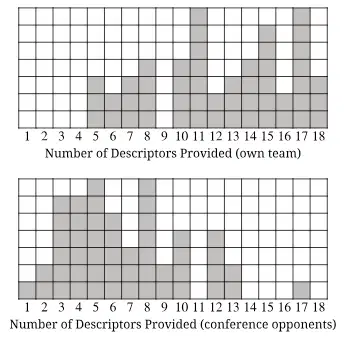
A social psychologist selects five high schools from a midwestern state. He then uses a sports team roster from each school to randomly select 10 players to participate in a study. Each selected player is first asked to list as many positive personality and athletic characteristics for the other players on her own team as they can. Then they are asked to list as many positive personality and athletic characteristics for the players on a rival team. Each player is given 15 minutes to complete each task. The distribution of scores is presented in the graphs.
What is the mode for the “own team” distribution?
11
5 and 8
11 and 17
9

An industrial-organizational (I/O) psychologist surveyed employees at a tire factory to gain an understanding of employee satisfaction. The factory manager is interested in differences between employees with less than 10 years’ experience and those with less than 10 years to go before retirement. The survey asked participants to rate their work environment using a scale from 1 (poor work environment) to 10 (excellent work environment).
Which of the following best describes how the I/O psychologist might interpret the difference in the standard deviations between the two groups?
There is very little variation in age for the less experienced group, while the ages of the more experienced group are mostly the same.
The scores of the less experienced group varied more widely from each other than the more experienced group.
The scores of the more experienced group were less alike than those from the less experienced group.
The more experienced group has higher employee satisfaction.

