
 Worksheets
Carbon and Nitrogen Cycle
Total questions: 15
Worksheet time: 10mins
Which statement is an example of how carbon moves through a food chain as part of the cycle?
Producers release carbon dioxide, and consumers take it it.
Producers take in carbon dioxide, and consumers release it.
Producers take in carbon from the soil, and they release it when they decompose.
Producers release carbon into the soil, and consumers take it in from the soil.
When organisms die, what process returns their carbon back into the atmosphere?
Respiration
Decomposition
Combustion
Erosion

Choose all the items made out of carbon
Food
Animals
Plants
Tennis Racket
Pretty much everything

What is causing global warming? (Choose All That Apply)
The earth is too close to the sun
There is too much carbon dioxide in the atmosphere
Because we're running out of water
Because we're cutting down all the trees and not planting more
Which of the following is an example of a decomposer that can help break down dead organisms & waste?
plant
horse
mushroom
cow
The constant movement of nitrogen through the biotic & abiotic parts of an ecosystem is known as the ______.
water cycle
nitrogen cycle
carbon cycle
life cycle
True or False...Bacteria play a very important role in the nitrogen cycle.
True
False
The process of bacteria in the soil changing extra nitrates back into atmospheric nitrogen so that it can reenter the atmosphere & continue the cycle is known as _____.
ammonification
nitrification
fixation
denitrification
The process of decomposers like fungi & bacteria breaking down dead organic matter & waste material and turning nitrogen into ammonia is known as ____.
ammonification
nitrification
fixation
denitrification
The process of bacteria in the soil changing atmospheric nitrogen to ammonia is known as ______.
nitrification
assimilation
fixation
denitrification
Organisms that need nitrogen to survive.
only plants
only animals
only bacteria
all living things
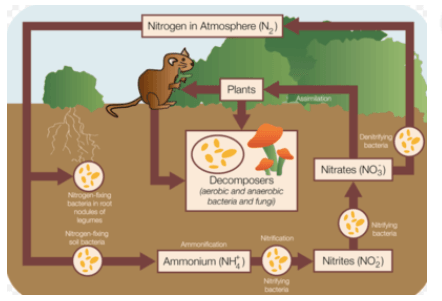
A correct path that nitrogen could take would be
air -> animals -> plants -> bacteria
animals -> air -> bacteria -> plants
bacteria -> air -> plants -> animals
air -> bacteria -> plants -> animals

