
 Worksheets
BENCHMARK REVIEW 24-25
Total questions: 45
Worksheet time: 33mins
Which phase of matter shows the greatest changes in volume with changes in temperature and/or pressure?
Gases
Liquids
Solids
It depends on the mass.
Which phase of matter is the least compressible?
Gases
Liquids
Solids
Plasma
Why are gases more compressible than liquids and solids?
Gas particles move slowly and this allows for them to be pushed together easily.
The lower kinetic energy of solid particles makes their particles closer and less compressible.
Since gas particles are spread so far apart, they are easily compressed.
All of the above
Students examined the properties of five different elements and recorded observations about their properties in the table. Based on the students' observations, classify each sample as a metal, nonmetal, or metalloid. Which of the following best describes the classification of elements?
All are metals
All are nonmetals
All are metalloids
A mix of metals, nonmetals, and metalloids
How could the materials BEST be classified?
X: Metal, Y: Metalloid, Z: Nonmetal
X: Nonmetal, Y: Metal, Z: Nonmetal
X: Metalloid, Y: Metal, Z: Nonmetal
X: Metalloid, Y: Metal, Z: Nonmetal
The chart shows properties of four elements. Based on these properties, which element is most likely a nonmetal?
Element 1
Element 2
Element 3
Element 4
A student conducted an investigation about density. The materials used were Water, Liquid 2, Object X, and Object Y. The results of the investigation are shown. Which option shows the correct order of the materials from lowest to highest density?
A) Object X, Object Y, Water, Liquid 2
B) Water, Liquid 2, Object X, Object Y
C) Water, Object X, Liquid 2, Object Y
D) Object X, Water, Object Y, Liquid 2
Students poured water and cooking oil into a beaker. The students then added a penny, a plastic paper clip, and a cork to the beaker and recorded their observations. Observations: The water was on the bottom, and the oil was on top of the water. The penny dropped to the bottom of the beaker. The plastic paper clip floated on the water but under the oil. The cork floated on top of the oil. Which list puts the items in order from most dense to least dense?
Cork, oil, plastic paper clip, water, penny
Water, penny, oil, plastic paper clip, cork
Penny, water, plastic paper clip, oil, cork
Oil, penny, cork, plastic paper clip, water
Which material is MOST LIKELY rubber?
Material W
Material X
Material Y
Material Z
A student has three blocks. Each block is made of iron, lead, or copper. All three blocks have equal masses and are the same color. Part A: How could the student determine whether any of the blocks are made of iron?
Place a magnet close to each of the blocks.
Record whether the blocks float or sink in water.
Try to dissolve the blocks in a beaker of water.
Drop the blocks from a certain height and record any cracks.
This question has two parts. First, answer Part A. Then answer Part B. A student has three blocks. Each block is made of iron, lead, or copper. All three blocks have equal masses and are the same color. Part B: Which explanation supports the answer to Part A?
A) Iron is denser than water and will therefore float.
B) Iron can break more easily than copper or lead.
C) Iron is magnetic and will be attracted to the magnet.
D) Iron dissolves in water but copper and lead do not.
Which of the following best describes a change in iron caused by a chemical reaction?
An iron nail looks shiny and silvery.
An iron nail rubbed with a magnet attracts iron powder.
An iron wire left outside turns a rusty orange color.
An iron wire attached to a battery becomes hot.
A drain cleaner consists of sodium hydroxide and aluminum. When the drain cleaner is added to water, bubbles of hydrogen are produced, and the solution becomes very hot. Which of these best describes what happens to form the bubbles when the cleaner is added to water?
A chemical reaction
Condensation
A physical change
Evaporation
Which statement BEST explains why baking a cake is evidence of a chemical reaction?
A. The state of matter of some of the ingredients changed while being cooked.
B. The total mass of the ingredients was the same before and after they were cooked.
C. The temperature of the ingredients increased as they absorbed thermal energy from the oven.
D. The ingredients formed a new substance after they were cooked in the oven.
Which of these observations is an indication that a chemical reaction has occurred?
Steam forms above boiling water.
A solid forms when a clear solution is frozen.
A solid forms when two clear solutions are mixed.
Sugar crystals form on the sides of a boiling pot of sugar water.
Which observation would indicate that a chemical reaction occurred?
The vinegar took the shape of the container in step 1.
The steel wool sank into the vinegar in step 3.
The temperature of the vinegar increased during step 4.
The steel wool changed shape during step 6.
Bubbles quickly appear and continue forming for 20 seconds and there are small amounts of the solid at the bottom of the liquid in the final observation.
physical change
chemical reaction

The image shows what happens when cold medicine tablets are placed in room-temperature water. What evidence would indicate that a new substance is produced?
The tablet dissolves in water
The water becomes cloudy
The water level increases slightly
Bubbles are given off
A student measures out 100 mL of two different clear liquids and then pours one into the other. The mixture, which has a volume of 200 mL, turns bright red, then begins to become quite cold. In this process, the first evidence that a new substance had formed was observed when the –
student measured the liquids
volume was seen to be 200 mL
color changed to bright red
temperature of the mixture decreased

The table records the observations that result from four different combinations. Which combination of substances shows evidence that a new substance was formed?
Baking soda and vinegar
Sodium chloride and water
Oil and water
Iron filings and sand

At what point does the roller coaster have the most potential energy?
Point A
Point B
Point C
None of the Points

On which hill would the roller coaster have more potential energy?
The first hill
The second hill
Both hills
Neither hill

An archer stands with the bow fully stretched back, ready to launch the arrow. What example of energy is this?
Potential Energy
Kinetic Energy
Conservation
Density

An apple falling from a tree is what type of energy?
Potential Energy
Kinetic Energy
Neither
Density

The direction transfer of heat between objects that touch is--
Radiation
Conduction
Convection
Heat Transfer
Define Potential Energy.
The ability to do work
A change from one form of energy to another
The energy stored in an object because of its position. Still, not moving.
The energy an object has that is moving or working.
Define Kinetic Energy.
The energy stored in an object because of its position.
The location of an object.
The energy of an object that is moving or working.
A law of science that states that energy cannot be created or destroyed, but only changes from one form into another or transferred from one object to another.


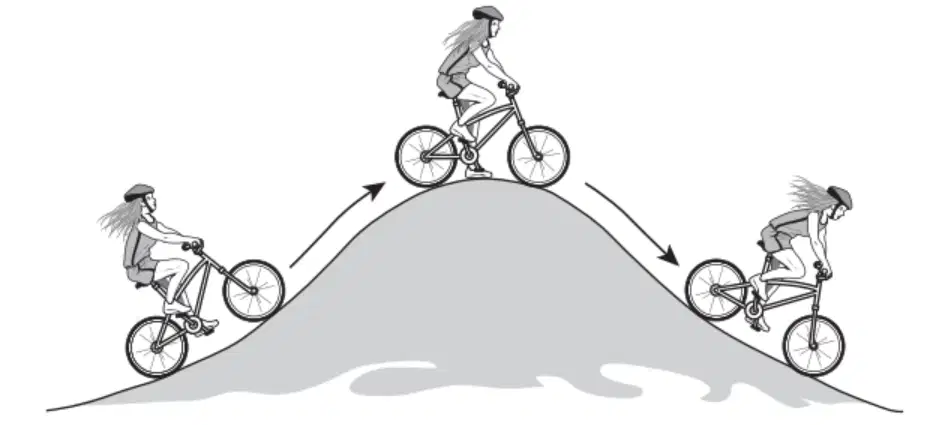
A bicycle rider is traveling up a hill. When the rider reaches the top of the hill, she stops to rest. Then she travels down the hill. The diagram shows the rider in the three different positions.
Which of these correctly describes the potential energy and the kinetic energy of the bicycle rider?
When the rider is at the top of the hill, her potential energy is the greatest, and her kinetic
energy is the least.
As the rider moves up the hill, her kinetic energy increases, and her potential energy
decreases.
When the rider goes down the hill, her potential energy increases, and her kinetic energy
decreases.
As the rider reaches the bottom of the hill, her kinetic energy and her potential energy
decrease.
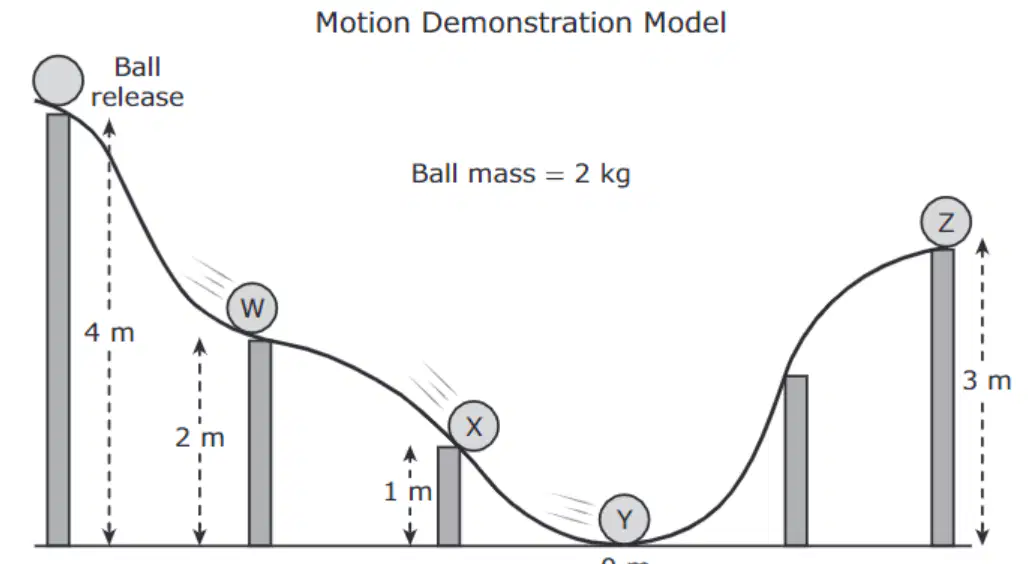
A demonstration helps students understand a principle of roller coaster design.
Which answer choice correctly describes the ball’s kinetic and potential energy?
The ball has more potential energy at position X than at position Z.
The ball has more kinetic energy at position Y than at position W.
The potential energy and kinetic energy of the ball are equal at position X.
The potential energy and kinetic energy of the ball are greatest at position Z.
What is responsible for keeping an object at rest or maintaining an object's constant velocity?
gravity
external forces
balanced forces
friction
Which wave parameter measures the number of cycles that are completed in one second?
wavelength
period
frequency
speed
What processes create sedimentary rocks (and fossils)
Heat
Compaction
Cementation
Cooling
rock fragments that have been transported to a different location
metamorphic rock
sedimentary rock
sediment
soil

What is letter G?
Heat and pressure
Cooling
Deposition, Compaction, Cementation
Weathering and erosion

What is number 4?
heat pressure
melting
weathering
cooling/crystallization
These Rocks are formed from Heat and Pressure
Metamorphic
Igneous
Sedimentary
Where do metamorphic rocks form?
underwater
near volcanoes
deep underground
in the air


What sphere does this represent?
geosphere
hydrosphere
cryosphere
atmosphere

In what category would you classify this image below?
cryosphere
hydrosphere
atmosphere
biosphere

