
Font size
 Worksheets
Test - Water, Weather & Climate
Total questions: 18
Worksheet time: 10mins
After a rainstorm, where would the water most likely evaporate fastest from?
Sidewalk
green grassy area
open dirt field
All puddles would take the same amount of time if ground coverings are in the same area.
What helps plants & animals survive in different environments?
(a)
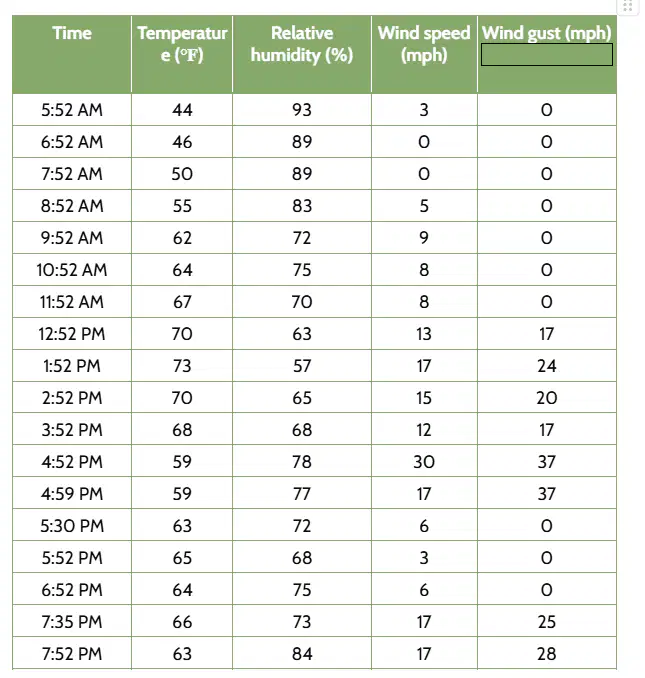
Around what time did it most likely hail?
10 am
12 noon
5:00 pm
7 am
What happens to make it hail?
There's a huge updraft of wind that takes rain high up in the clouds where it's below 32⁰F, freezes falls and repeats until it's too heavy to remain in the air.
There must be snow on the ground for at least a few days before it precipitates again. Rain will fall out of the clouds and immediately freeze into hail when it hits the snow.
The air temps near the ground must be at or below freezing point before hailing.
Hail always starts out as wet icy snow, they hit each other as they are falling fast towards the ground and combine into hailstones.
Why are areas far away from the equator typically colder?
They don't receive much direct sunlight.
They are always higher elevations.
Lower air pressure to keep in the heat.
Very few cities with concrete and black asphalt streets to hold in the heat.
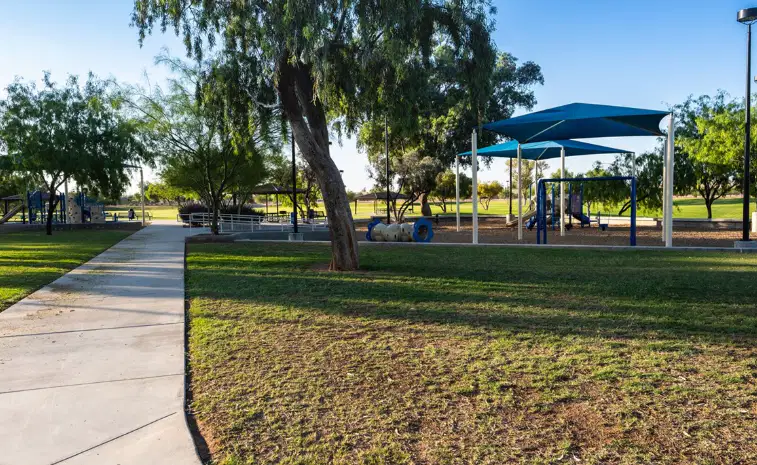
It's a cold winter day in Mesa, AZ. Richard is feeling dizzy and wants to lay down for a few minutes. Where would it most likely be the warmest?
A spot in the concrete where it's shady.
The grass field.
On the concrete in the sun.
On the plastic slide underneath the blue awning.
Why are ground coverings in the same area not the exact same temperatures as each other?
100% depends on the color of the covering.
Some materials absorb more light & heat energy.
Natural coverings will ALWAYS be lower than man-made coverings.

Kim recorded 2 sets of data, one set shows every year on her birthday and the other set on the 1st day of every month for a year.
Which line of data is probably gathered on the 1st of every month?
(Jan. 1, Feb. 1, March 1.........)
Red
Blue
Who knows, there's no label.
What would you expect the data to show if you collected the high temp on February 25th of every year in the exact same city?
The temps would go up or down depending upon which season it is.
There's no way to tell what the data might show.
It should be around the same temp.
It should get about 2 degrees hotter each year on Feb. 25th.
What's the biggest reason higher elevations have a cooler temp?
Mountains are closer to the moon, so they cool down at night.
There's less air pressure to hold heat together.
There's more air pressure so cold air stays together.
The trees in the area create lots of wind, making it stay cool.
Pyongyang, North Korea is located at about 39⁰N of the equator with an elevatin of about 16 meters above sea level.
Luanda, Angola is located about 8⁰S of the equator, with an elevatin of about 16 meters above sea level.
Which place is proably a warmer climate?
Pyangyang, North Korea
Not enough info to predict
Luanda, Angola
They'd be about the same becase they are at the same elevation.
Which tern tells you about the Patterns of a region over a long period of time (decades)
weather
climate
What turns vapor into liquid water?
condensation
transpiration
evaporation
precipitation
The forecast for tomorrow is a low temp of 72⁰F and there's also a 95% chance of precipitation. Which form is it likely to be?
sleet
dry powdery snow
wet icy snow
rain
What type of adaptation would it be for a fish to swim in a group (properly called a school) to avoid being eaten by a predator?
Chemical
physical
behavioral
mechanical
If you're buying clothes to take with you on a 6 month world tour visiting 12 different countries - which would probably help you best determine how many shorts vs warm clothes to take with you.?
tomorrow's weather forecast
the area's climate pattern for the months you'll be visiting
Last week's low & high temps.
The amont of space in your backpack.
Which is NOT a factor that determines an area's climate?
Altitude - how high a location is.
Latitude - distance from the equator.
People, Plants and Animals that live in an area.
Geography - how close an area is to water.
What makes hailstone different sizes?
The wind speed of the updraft.
The altitude of the cloud.
The ground temperature.
The humidity level 2 meters above the ground.

