

wayground logo

Free Printable Worksheets

Font size

S
M
L
XL
Worksheets

Unit 4-Westward Expansion

Total questions: 35

Worksheet time: 19mins
Name
Class
Date
1.

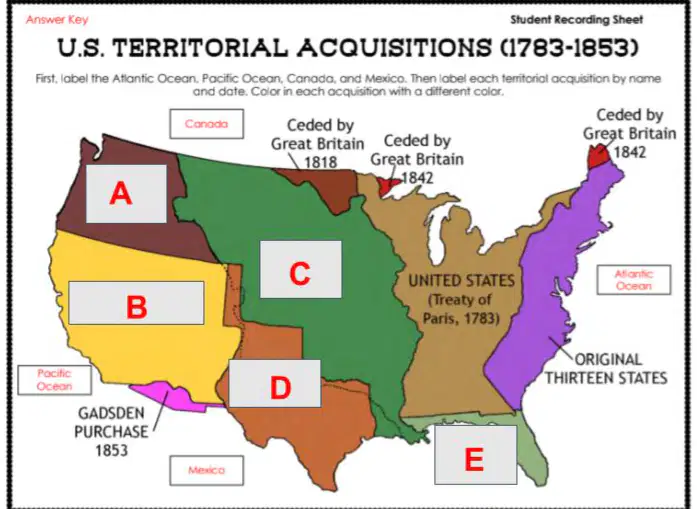
Which territory does A represent?

a)

Florida Cession

b)

Mexican Cession

c)

Louisiana Purchase

d)

Oregon Territory

2.

Which territory does D represent?

a)

Texas Annexation

b)

Mexican Cession

c)

Louisiana Purchase

d)

Gadsden Purchase

3.
What were the forces driving Westward Expansion? Select all that apply.
a)
the feeling of overpopulation in the eastern United States
b)
the transportation revolution made it easier to travel west
c)
new inventions made it easier to be successful out west
d)
the new opportunity for cheap land
e)
trying to escape having to take retakes in history class
4.
Which state fought its own revolution, was it's own separate country, and then later annexed by the United States.
a)
California
b)
Tennessee
c)
Texas
d)
Florida
5.
There were conflicts between white settlers and Native Americans long before the U.S. government forced Native Americans to move west. White settlers wanted more land and would often take it from Native Americans, sometimes with the help of the government. This sometimes led to war between the government and different tribes. Soon after the American Revolutionary War, the U.S. government came up with a new policy, or plan, to get Native American land without going to war. Government leaders thought that if Native Americans became more like white Americans, Native Americans would eventually want to sell their land. The table below shows the government's policy in 1790. Look at the table then select the three actions from the choices below that apply to the new policy.
a)
practice Christianinty
b)
learn to read and write English
c)
immediately leave all their lands
d)
farm like white Americans
6.
Jackson developed and supported a new policy for working with Native American nations. This policy became the Indian Removal Act, which Congress passed in 1830. The Indian Removal Act gave the U.S. government a way to move Native American nations off of their land. Based on the information below, what did the Indian Removal Act give the president permission to do?
a)
move Native American nations to smaller areas of land where they already lived and sell the rest.
b)
let white Americans and Native Americans live together on government lands.
c)
give Native American nations money and new land in exchange for their land in the East.
7.
The Indian Removal Act passed in 1830. White settlers and government officials began taking Native Americans' land even before the U.S. government made agreements with Native American nations. Many settlers and government officials harassed, threatened, and attacked Native Americans. The U.S. government forced tribes in the North and South to sign treaties agreeing to leave their land. Some Native American tribes felt like they had no choice but to leave. The timeline below shows some important events from 1830 to 1834. Look at the timeline. Based on the timeline below, which of the following is true?
a)
Many different Native American nations were forcibly removed after the Indian Removal Act passed.
b)
The Cherokee, Choctaw, Chickasaw, Seminole, and Muscogee were the only Native American nations that were removed.
c)
The Cherokee Nation was the first Native American nation to be forcibly removed under the Indian Removal Act.
8.

Which of the following states was an independent republic before joining the United States?

a)

Alaska

b)

Hawaii

c)

Texas

d)

Vermont

9.

What was a significant consequence of the Indian Removal Act of 1830?

a)

Native American nations were given more land in the East.

b)

Native American nations were forcibly relocated to areas west of the Mississippi River.

c)

Native American nations were allowed to remain on their ancestral lands.

10.

Which president signed the Indian Removal Act into law?

a)

John Quincy Adams

b)

Thomas Jefferson

c)

James Madison

d)

Andrew Jackson

11.

Which Native American nation was involved in the Trail of Tears?

a)

Apache

b)

Navajo

c)

Sioux

d)

Cherokee

12.

What was the primary reason for the U.S. government to pass the Indian Removal Act?

a)

To create new states in the East

b)

To establish peace with Native American nations

c)

To open up land for white settlers

d)

To protect Native American cultures

13.

Which of the following states was once an independent republic before becoming part of the United States?

a)

California

b)

New Mexico

c)

Texas

d)

Louisiana

14.

Which Native American nation resisted removal and fought the U.S. government in the Seminole Wars?

a)

Apache

b)

Seminole

c)

Sioux

d)

Cherokee

15.

What was the Trail of Tears?

a)

A peaceful migration of Native American nations to new lands.

b)

A path used by settlers to move westward.

c)

The forced relocation of the Cherokee Nation to the west of the Mississippi River.

d)

A treaty signed between the U.S. government and Native American nations.

16.

Which U.S. state was primarily involved in the events leading to the Trail of Tears?

a)

New York

b)

California

c)

Georgia

d)

Texas

17.

Which Native American nation was primarily involved in the Black Hawk War?

a)

Sauk and Fox

b)

Sioux

c)

Apache

d)

Cheyenne

18.

Which U.S. state was the destination for many Native American nations during the Trail of Tears?

a)

Oklahoma

b)

California

c)

New York

d)

Florida

19.

What were the effects of Manifest Destiny? Remember effects can be positive or negative.

a)

expansion of land for the United States

b)

more opportunities...especially for white settlers

c)

increased tension over the issue of slavery

d)

War

e)

loss of power and land for Native Americans
20.

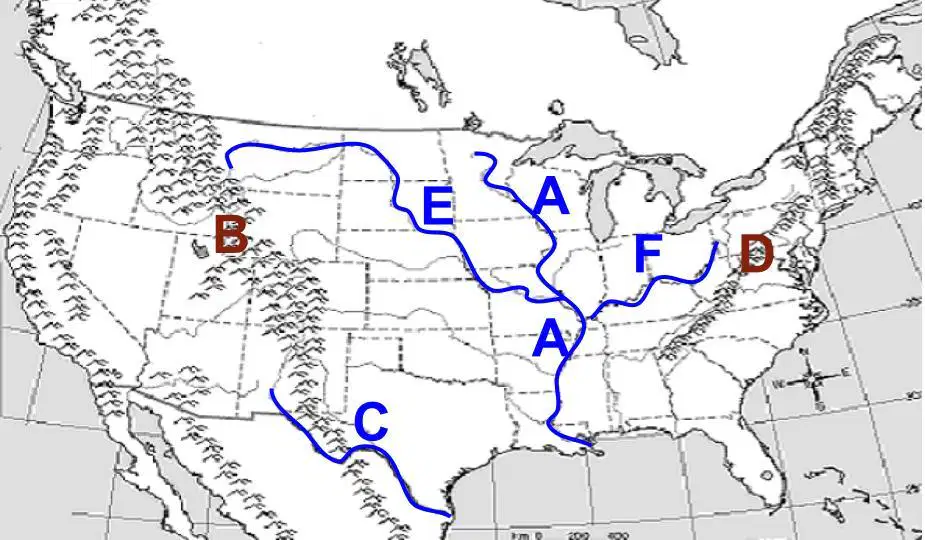
Which natural feature is represented by the letter D?

a)

Rocky Mountains

b)

Rio Grande River

c)

Mississippi River

d)

Appalachian Mountains

21.

Which natural feature is represented by the letter A?

a)

Rocky Mountains

b)

Rio Grande River

c)

Mississippi River

d)

Appalachian Mountains

22.

Which natural feature is represented by the letter E?

a)

Missouri River

b)

Rio Grande River

c)

Mississippi River

d)

Ohio River

23.
What was the effect of the Transcontinental Railroad?
a)
Became a more efficient form of transportation for settlers
b)
Increased trade between the east and west and boosted the economy
c)
Polluted the air and the natural environment
d)
All of the above
24.

Which statement bests represents the United States’ view on land acquisition (getting land) in

the 1800’s?

a)

America’s attitude toward completing Manifest Destiny was to get all land they wanted through any means needed

b)

America was not willing to get into wars or battles attempting to gain land

c)

America thought that all nations had the right to keep the land they controlled

d)

America was ready to fight to ensure the Native Americans kept a fair share of the western land

25.
The taking over of a piece of land to add to your country is call what?
a)
Administration
b)
Annexation
c)
Adoption
d)
Acquisition
26.

The image above best represents which U.S. history era

a)

Reform Movements

b)

Manifest Destiny

c)

Industrial Revolution

d)

Colonial Period

27.
Which state joined the Union with Missouri?
a)

Minnesota

b)

Florida

c)

Maine

d)

Kansas

28.
Which of the following led to fierce congressional debate over U.S. expansionism?
a)
The massacre at Wounded Knee
b)
The end of the Spanish-American War.
c)
The purchase of Alaska.
29.

​ was responsible of the Indian Removal Act?

a)
Andrew Jackson
b)
Benjamin Franklin
c)
Abraham Lincoln
d)
Sam Houston
e)
Thomas Jefferson
30.

The Trail of Tears was a result of which event?

a)

Nullification Crisis

b)

Manifest Destiny

c)

Spoils System

d)

Indian Removal Act

31.

What was the purpose of the Indian Removal Act?

a)

To relocate Native American tribes to lands west of the Mississippi River.

b)

To provide financial assistance to Native American tribes

c)

To promote cultural exchange between Native Americans and settlers

d)

To establish trade routes with European countries

32.

The map shows what event?

a)

exploration of Louisiana Purchase

b)

Trail of Tears

c)

Battle of New Orleans

d)

Westward Expansion

33.
This tribe lived mostly in Florida and were either killed or forced to leave their homes.
a)
Souix
b)
Choctaw
c)
Iroquois
d)
Seminole
34.

Which statement bests represents the United States’ view on land acquisition (getting land) in

the 1800’s?

a)

America’s attitude toward completing Manifest Destiny was to get all land they wanted through any means needed

b)

America was not willing to get into wars or battles attempting to gain land

c)

America thought that all nations had the right to keep the land they controlled

d)

America was ready to fight to ensure the Native Americans kept a fair share of the western land

35.

How did the first travelers on the Oregon Trail make the trip to the Oregon Country?

a)

By Train

b)

On Prairie Schooners

c)

By Plane

d)

They Swam
