
Font size
 Worksheets
T17 Review
Total questions: 25
Worksheet time: 5hrs 3mins
Read the quotation. “The state of monarchy is the supremest thing upon earth; for kings are not only God’s lieutenants upon earth, and sit upon God’s throne, but even by God himself are called gods.” —King James I, Works (1609) Which of the following people would have been most likely to agree with this statement?
Oliver Cromwell
Louis XIV
William of Orange
John Locke
During the English Civil War, which group would have been most likely to oppose the execution of Charles I?
Cavaliers
Roundheads
Puritans
Parliamentarians
Beginning with the earliest event, what is the correct sequence of events?
Gold and silver fund Spain’s “golden century.” / The Spanish take gold and silver from the Americas. / The Spanish claim colonies in the Americas.
The Spanish claim colonies in the Americas. / The Spanish take gold and silver from the Americas. / Gold and silver fund Spain’s “golden century.”
The Spanish claim colonies in the Americas. / Gold and silver fund Spain’s “golden century.” / The Spanish take gold and silver from the Americas.
The Spanish take gold and silver from the Americas. / Gold and silver fund Spain’s “golden century.” / The Spanish claim colonies in the Americas.
Read the passage. “. . . all men are created equal, that they are endowed . . . with certain unalienable Rights, that among these are Life, Liberty and the pursuit of Happiness. . . . whenever any Form of Government becomes destructive of these ends, it is the Right of the People to alter or to abolish it, and to institute new Government . . .” —The Declaration of Independence, 1776 This passage was most influenced by the ideas of
Bishop Bossuet.
Jean-Jacques Rousseau.
Baron de Montesquieu.
As king of France, what did Henry IV do to lessen religious conflict? Choose the TWO correct answers.
convert to Catholicism
convert to Protestantism
issue the Edict of Worms
issue the Edict of Nantes
In the 1500s, major wars broke out in Europe between which two groups?
Puritans and Huguenots
Protestants and Catholics
Tudors and Stuarts
monarchs and popes
Which of the following Enlightenment thinkers would have been most likely to agree with the statement by Susan B. Anthony: “There never will be complete equality until women themselves help to make laws and elect lawmakers.”
Rousseau
Wollstonecraft
Voltaire
Locke
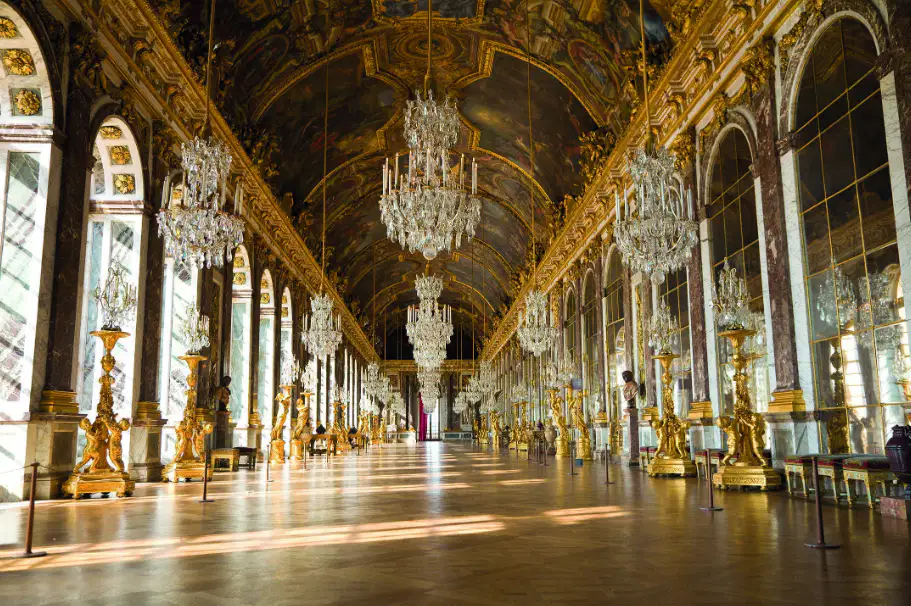
Look at the photograph of the Hall of Mirrors in the palace of Versailles. What can be inferred from this photograph about Louis XIV? Choose the TWO correct answers.
Louis XIV believed in the divine right of kings.
Louis XIV wanted to show off his power and prestige.
Louis XIV inherited a powerful kingdom.
Louis XIV spent a lot of money on the arts.
During the 1500s and 1600s, the most successful English monarchs were those who
ruled with absolute power.
cooperated with Parliament.
supported Catholicism and the Church.
ignored the Magna Carta and Bill of Rights.
In which of the following pairs of events was the first event a direct cause of the second?
Peter the Great visited Western Europe. / Peter the Great began a number of reforms in Russia.
Peter the Great began a number of reforms in Russia. / Peter the Great built a new capital city.
Peter the Great built a new capital city. / Peter the Great waged war against Sweden.
Peter the Great waged war against Sweden. / Peter the Great visited Western Europe.
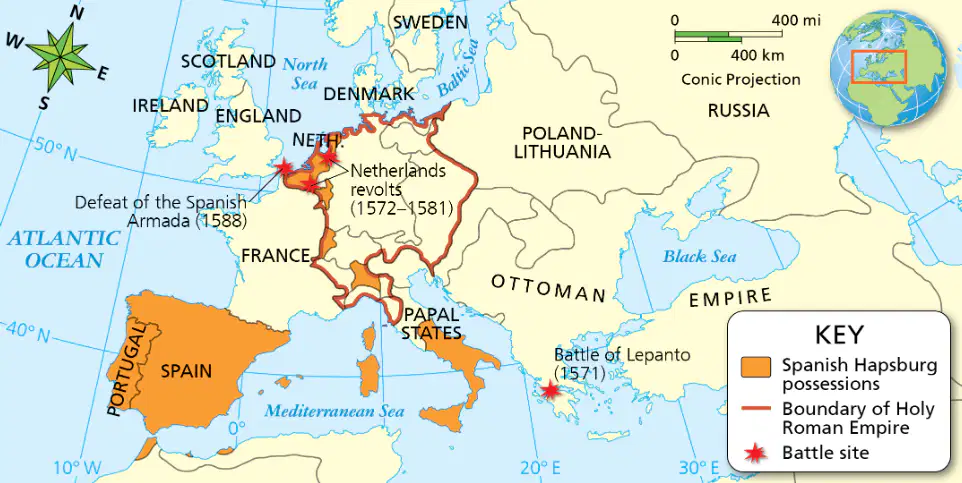
Which of the following conclusions are best supported by the map? Choose the TWO correct answers.
Philip II sought to prevent the expansion of the Ottoman Empire.
The Spanish Armada was defeated off the coast of England in 1588.
Spain fought to end rebellions in the Netherlands.
Under Philip II, Spain aspired to take control of the Holy Roman Empire.
How did Charles I show his intention of ignoring the 1628 Petition of Right?
by refusing to sign it
by dissolving Parliament
by forming the Church of England
by ending the Commonwealth
According to the passage, what is illegal without the consent of Parliament?
Petitioning the king
Keeping a standing army in time of peace
Imposing excessive fines
Forming a new government
This passage is most likely an excerpt from the
U.S. Constitution.
Edict of Nantes.
English Bill of Rights.
Declaration of Independence.
Why did Peter the Great wish to acquire a warm-water port for Russia?
to launch a naval attack against Sweden
to increase trade with the West
to encourage voyages of exploration
to defeat the Ottoman empire
Catherine the Great expanded Russian territory into
Western Europe.
North America.
Eastern Europe.
Sweden.
What point did Parliament make by executing Charles I?
England should be ruled according to divine right.
Parliament had the right to choose its own monarch.
The Cavaliers had won control of England.
No monarch could claim absolute power in England.
What idea does philosopher Jean-Jacques Rousseau believe?
People form social contracts to protect themselves and their rights.
People cannot overthrow the monarchs chosen by God to lead.
Men and women should be treated equally in society.
All people are born with natural rights that governments must protect.
Which of the following are actions that Empress Maria Theresa took to reform Austria? Choose the TWO correct answers.
established a policy of religious toleration
funded public schools
improved the tax system
freed the serfs

Which TWO statements best complete the chart?
First box: The three principles behind the social contract are freedom, equality, and independence.
First box: If a government fails to protect natural rights, the people have the right to rebel.
Last box: Each branch of government should limit the powers of the two other branches.
Last box: The best way for a nation to become wealthy is to allow free trade.
Which Russian ruler is known for modernizing Russia by adopting Western European technology and culture?
Nicholas II
Peter the Great
Catherine the Great
Ivan the Terrible
Which Enlightenment thinker is best known for advocating the separation of powers in government?
Voltaire
Baron de Montesquieu
Jean-Jacques Rousseau
John Locke
Which Enlightenment thinker is known for the idea that government should be a contract between rulers and the people?
John Locke
Baron de Montesquieu
Voltaire
Thomas Hobbes
Which event marked the beginning of the decline of Spain as a world power in the 16th century?
The defeat of the Spanish Armada
The signing of the Treaty of Tordesillas
The conquest of the Aztec Empire
The establishment of the Spanish Inquisition
Which monarch is known for the statement 'L'état, c'est moi' (I am the state), symbolizing absolute monarchy?
Philip II
Henry VIII
Louis XIV
Frederick the Great

