
 Worksheets
Chassereau Unit 4, Lesson 6 "Survival at 120 Above"
Total questions: 16
Worksheet time: 8mins
Name
Class
Date
1.
1. What does aquatic mean?
a)
having horns
b)
growing slowly
c)
living in water
d)
becoming colder
2.
2. . What does the word fleeting mean in this sentence? Janice had a fleeting look at the unusual bird.
a)
brief
b)
pleasant
c)
remarkable
d)
strange
3.
3. The outside of something is called its ____________
a)
rising.
b)
naughty.
c)
powder.
d)
surface.
4.
4. Which word fits best in this sentence?
The scientist checked the _____________ and recorded the results.
a)
truant
b)
sensor
c)
spangle
d)
vivid
5.
5. If things are equivalent, they are ____________
a)
quilted.
b)
rival.
c)
equal.
d)
valiant.
6.
6. The following question has two parts.
Part A: What does a thorny devil use to drink?
a)
its feet
b)
its spines
c)
its tongue
d)
its tail
7.
7. Part B: Which sentence from the selection best supports your answer for Part A?
a)
The top of his body is completely covered with thorny spikes, protecting him from predators.
b)
Thrusting out his sticky tongue, he devours the ants one by one.
c)
Through capillary action, this lizard can drink this water from his feet.
d)
Her gaping mouth tries to the bite the dancing tail.
8.
8. What populations do the feral cats threaten?
a)
dingos and camels
b)
small marsupials and reptiles
c)
beetles and spiders
d)
frogs and invertebrates
9.
9. When are crepuscular animals most active?
a)
midnight
b)
noon
c)
morning
d)
twilight
10.
10. Why are feral cats a threat?
a)
They take over the burrows of other animals.
b)
They drink too much water.
c)
They eat too many native species.
d)
They chase dingoes away.
11.
11. What is a joey in the selection?
a)
a hunting bird
b)
a baby kangaroo
c)
a gooey frog
d)
a fish that migrates
12.
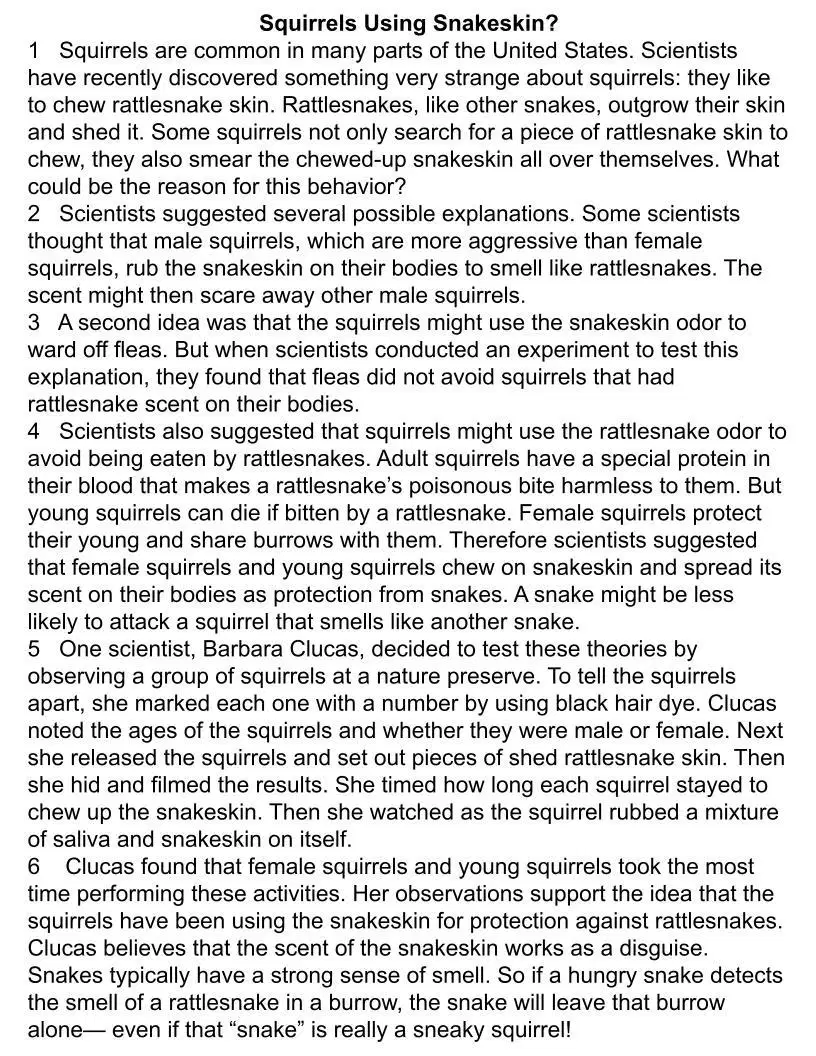
12. The author wrote this selection most likely to ____
a)
explain differences between squirrels and snakes
b)
explain an unusual squirrel behavior
c)
persuade readers to investigate the activities of squirrels
d)
entertain the reader through a story about a squirrel
13.

13. What is the central idea of this passage?
a)
There are similarities between squirrels and snakes.
b)
Rattlesnakes outgrow their skin and shed it.
c)
Scientists have different ideas about why squirrels use snakeskins.
d)
Snakes and squirrels live in the same habitats.
14.
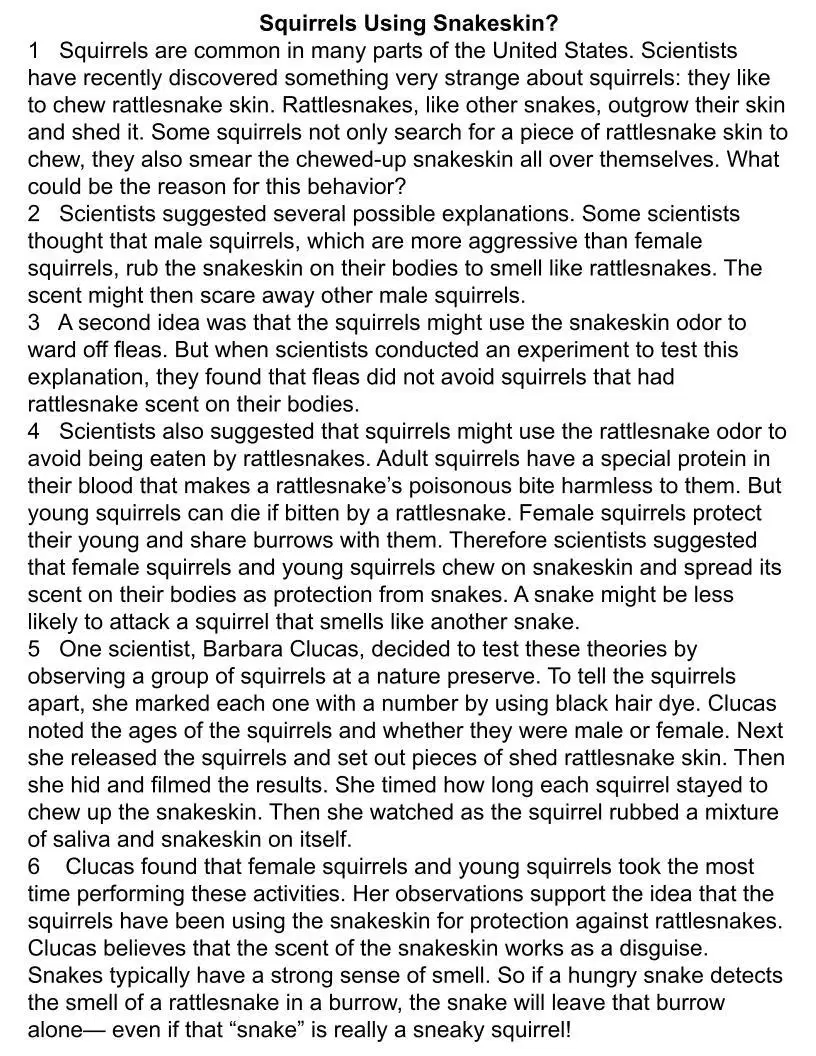
14. Which of the following is a detail that supports the central idea?
a)
Squirrels are common in many parts of the United States.
b)
Snakes usually have a strong sense of smell.
c)
Barbara Clucas, decided to test these theories by observing a group of squirrels at a nature preserve.
d)
Rattlesnakes, like other snakes, outgrow their skin and shed it.
15.

15. Paragraphs 2 through 4 are mainly about ______
a)
a special protein that adult squirrels have in their bodies
b)
how female squirrels use snakeskin to protect themselves
c)
how fleas can be avoided by using the skin shed by rattlesnakes
d)
possible reasons that squirrels spread chewed snakeskin on their bodies
16.
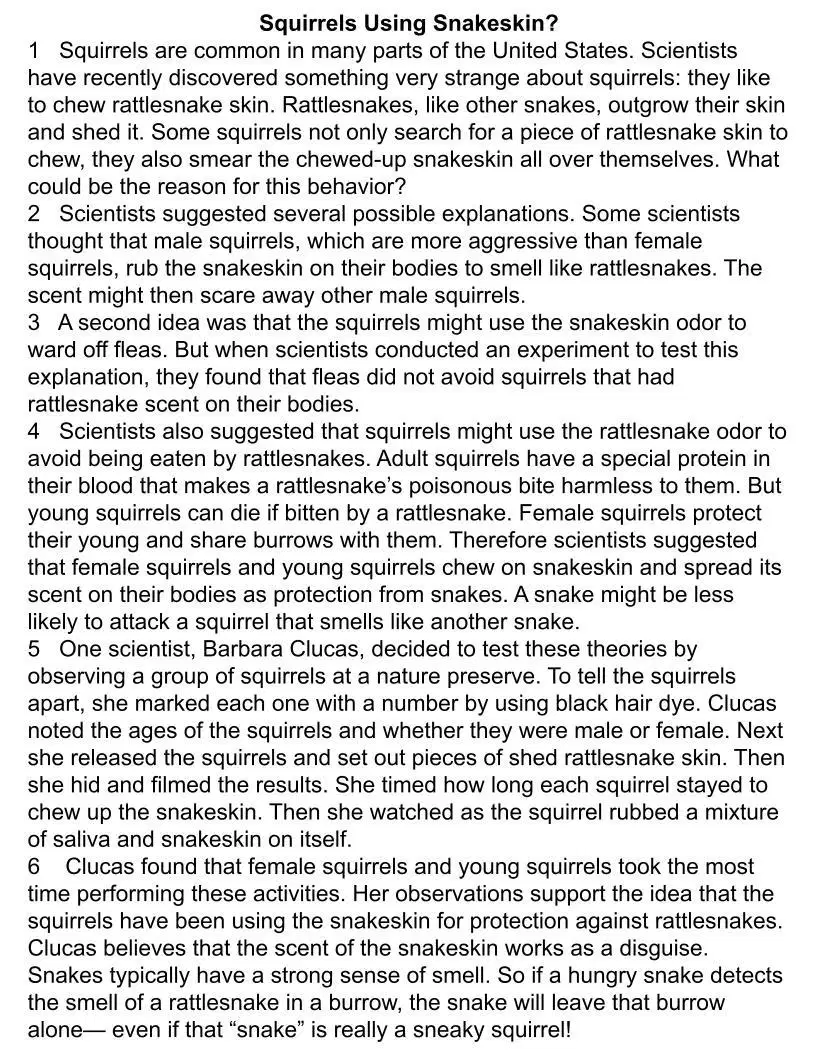
16. Which of these is the best summary of the selection?
a)
Scientists have discovered that some squirrels chew rattlesnake skin and apply it to themselves. There are several possible explanations for this behavior. Barbara Clucas conducted a study using a group of squirrels and discovered that it is likely that female squirrels and young squirrels use the snakeskin as protection against rattlesnakes.
b)
Some squirrels have an unusual habit of chewing rattlesnake skin and applying it to their fur for protection. Scientists have discovered that adult squirrels do not need protection from rattlesnake venom. However, female and young squirrels chew and apply rattlesnake skin to their bodies.
c)
Scientists developed a few theories to explain why squirrels chew rattlesnake skin and apply it to their fur. Barbara Clucas studied squirrels to find the answer. She numbered each squirrel in the study by using black hair dye.
d)
Some squirrels are known to look for the skin that rattlesnakes leave behind when they shed. Once the squirrels find the skin, they chew it up, spit it out, and put it on their fur. Scientists wonder about this behavior and have some possible explanations for it.
100 %

