
 Worksheets
Digestive System
Total questions: 40
Worksheet time: 1hrs 4mins
Which of the following correctly describes the purpose of digestion?
To break down complex food molecules into simple soluble molecules
To make complex food molecules from simple soluble molecules
To make use of simple soluble food molecules
To remove complex food molecules from the body
Large food molecules need to be broken down to be small enough to pass through cell membranes.
True
False
People in the Arctic region live in conditions where temperatures are as low as -40 °C. What should their diet be rich in, to adapt to these conditions?
amino acids
glucose
fats
vitamins
Which statement is NOT true about proteins?
Protein digestion begins in the mouth.
Proteins are used for cell growth and repair.
Proteins are broken down to form amino acids.
Some complex proteins function as enzymes in the body.
Which enzyme does the stomach produce?
amylase
lipase
maltase
protease
Where is the digestion of food completed?
liver
large intestine
stomach
small intestine
Why is the oesophagus muscular?
To break the food into even smaller pieces
To produce enzymes to digest food
To push food from the mouth into the stomach
To move the food back and forth in two directions
Where does carbohydrate digestion begins?
liver
mouth
oesophagus
stomach
Where does protein digestion begins?
large intestine
mouth
small intestine
stomach
Where does fat digestion begins?
colon
liver
small intestine
stomach
Select all the enzymes present in the intestinal juice.
amylase
lipase
maltase
protease
Which of the following kills bacteria in the human alimentary canal?
gastric juice
mucus
pancreatic juice
saliva
Which food is unsuitable for a person who cannot secrete enough bile?
butter
lean meat
spinach
rice
What are the names of the products formed by action of lipase on small fat droplets?
(a)
What is the name of the product formed by action of maltase on maltose?
(a)
What is the name of the product formed by action of protease on polypeptides or smaller protein molecules?
(a)
Name the enzyme that acts on starch.
(a)
What colour will starch turn brown iodine solution into?
blue-black
colourless
red
yellow
Which of the following is a physical digestion?
Bile emulsifies fats into smaller fat droplets.
Glucose formed by maltase in the small intestine.
Protease breaks down the proteins.
Salivary amylase mixes with starch in the mouth.
Large carbohydrates are chemically digested into smaller _____ molecules
proteins
amino acids
glucose
enzymes
Digestion begins in the ______.
Mouth
Stomach
Small intestine
Gallbladder
Proteins are broken down into _______.
Fatty acids
Glycerol
Glucose
Amino acids
The structure that keeps food from entering the trachea is called the _____________.
Salivary gland
Epiglottis
Pharynx
Esophagus

Which of the following kills bacteria in the human digestive system?
Hydrochloric acid
Mucus
Amylase
Pepsin
Which of the following kills bacteria in the human digestive system?
Hydrochloric acid
Mucus
Amylase
Pepsin
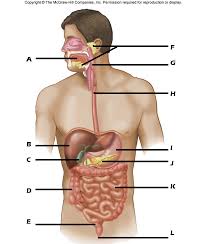
Which digestive organ is represented by the letter B?
Pancreas
Liver
Mouth
Small intestine
Which food is unsuitable for a person who cannot secrete enough bile?
butter
lean meat
spinach
rice
Where does protein digestion begin?
mouth
stomach
small intestine
large intestine


What is the name of the tissue that closes off the windpipe when you swollen so you do not choke?
epiglottis
esophagus
ileum
appendix
The salivary glands in your mouth produce about 6 cups of saliva which helps contains enzymes to break down food as well as water to help with swallowing.
TRUE
FALSE
You cannot live completely without this organ because it produces bile, stores glycogen and helps to detox the body. What is it?
gall bladder
liver
pancreas
ileum
A common term that is used for the small and large intestines is bowels.
TRUE
FALSE
Did you know that one third of your blood flows through this organ every minute. What is it?
intestines
liver
stomach
pharynx
Large food molecules need to be broken down to be small enough to pass through cell membranes.
True
False
Which enzyme does the stomach produce?
amylase
lipase
maltase
protease
Which organ stores bile?
stomach
gallbladder
pancreas
liver

