
 Worksheets
Aircraft Instrumentation Quiz
Total questions: 30
Worksheet time: 15mins
The airspeed indicator is showing 0 airspeed even though the plane is in motion. All the other instruments on the aircraft appear to be functioning normally. The pilot suspects a pitot-static malfunction. What might be the problem?
Ram air port blockage
Drain hole blockage
Static port blockage
Both ram port and drain hole blockage
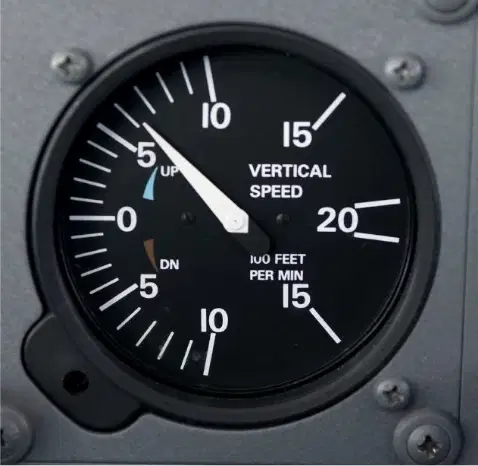
A pilot’s VSI shows the following. What is the vertical speed of the aircraft?
0.6 ft/min climb
600 ft/min climb
0.6 ft/min descent
600 ft/min descent
How does a gyroscope respond to a deflective force when it is powered?
It moves in the direction of deflection and the deflection occurs 90 degrees in the direction of rotation from the point at which the force is applied.
It moves in the direction of deflection and the deflection occurs 90 degrees opposite the direction of rotation from the point at which the force is applied.
It moves opposite the direction of deflection and the deflection occurs 90 degrees in the direction of rotation from the point at which the force is applied.
It moves opposite the direction of deflection and the deflection occurs 90 degrees opposite the direction of rotation from the point at which the force is applied.
What does the white arc on the airspeed indicator indicate?
The safe operating range for the flaps
The maximum speed with flaps extended
The normal operating range of the aircraft
The power-off stall speed at maximum takeoff weight
What information is processed by the air data computer (ADC)?
Information from gyroscopic instruments
Information about direction and heading
Information about static and ram pressure
None; it is used to store information collected during flight.
How is the groundspeed of an aircraft calculated?
Headwinds are added and tailwinds are subtracted from the true air speed
Tailwinds are added and headwinds are subtracted from the true air speed
Headwinds are added and tailwinds are subtracted from the calibrated air speed
Tailwinds are added and headwinds are subtracted from the calibrated air speed
What information is provided on a compass correction card?
The amount of adjustment required to correct for northerly turning error
The amount of adjustment required to correct for magnetic deviation
The amount of adjustment required to correct for magnetic variation
The amount of adjustment required to correct for acceleration error
How should a pilot adjust their altimeter before takeoff if operating at an airport where no altimeter setting is provided?
The altimeter should be adjusted until it displays 0.
The altimeter should be adjusted until it displays the airport’s elevation.
The altimeter should be adjusted until it displays the elevation at sea level.
The altimeter should be adjusted until it displays the lowest possible elevation.
An aircraft’s static port is blocked but the ram air port and the drain hole remain unobstructed. What instruments would become unreliable? Select all that apply.
Vertical speed indicator
Airspeed indicator
Heading indicator
Altimeter
Attitude indicator
A pilot is turning the plane north. Which of these guidelines should they follow?
The pilot should stop the turn after the desired heading because the compass leads the turn
The pilot should stop the turn before the desired heading because the compass leads the turn
The pilot should stop the turn after the desired heading because the compass lags the turn
The pilot should stop the turn before the desired heading because the compass lags the turn
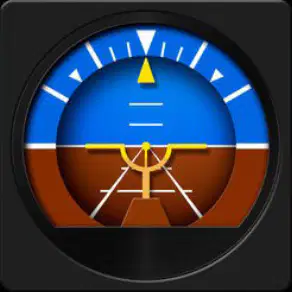
What do the white horizontal lines on the attitude indicator indicate?
The degrees of bank
The degrees of pitch
The height above the ground
The rate of turn
What is denoted by VLE?
The speed at which an aircraft will gain the greatest amount of altitude over a given distance
The speed at which a pilot can safely fully deflect one control surface in smooth air
The maximum speed for flying with landing gear extended
The never exceed speed
The pilot needs to regularly reset the compass card of the heading indicator to match the magnetic compass. Which of these will cause the compass card to drift so that it needs to be reset?
A change in aircraft altitude
A change in aircraft location
The rotation of the Earth
The magnetic field of the Earth
What type of speed is read directly from the airspeed indicator?
Calibrated airspeed
Groundspeed
Indicated airspeed
True airspeed
Acceleration in which of these situations would cause the magnetic compass to deflect toward the north?
Accelerating when flying eastward in the Northern Hemisphere
Decelerating when flying westward in the Northern Hemisphere
Accelerating when flying northward in the Northern Hemisphere
Decelerating when flying southward in the Northern Hemisphere
What is the definition of density altitude?
The indicated altitude when the pressure is set to 29.92 inHg
The altitude above mean sea level
The pressure altitude corrected for non-standard temperature
The altitude above the ground
What instruments are controlled by the attitude heading and reference system (AHRS) in aircraft with an electronic flight display (EFD)? Select all that apply.
Airspeed indicator
Attitude indicator
Slip/Skid indicator
Heading indicator
Turn indicator
Which of these instruments do not rely on a gyroscope? Select all that apply.
Altimeter
Attitude indicator
Heading indicator
Inclinometer
Turn and slip indicator
How are predicted future speed, altitude, and heading displayed on EFDs?
As green arrows
As green lines
As magenta arrows
As magenta lines
Explain how static, dynamic, and total pressure are related.
Static pressure is the sum of dynamic and total pressure.
Total pressure is the sum of static and dynamic pressure.
Dynamic pressure is the difference between static and total pressure.
Static pressure is the difference between dynamic and total pressure.
During flight, a pilot notices that adding power and raising the aircraft’s nose does not result in changes in the altimeter. Two actions the pilot should take to react to this situation are:
Turn on pitot heat if icing conditions are expected and activate alternate static source.
Increase speed and lower the aircraft’s nose.
Check the pitot-static system and continue increasing the throttle.
Decrease speed and raise the aircraft’s nose further.
Select the true statement(s) regarding the four forces of flight.
During accelerated flight, thrust and drag are equal
The four forces are in equilibrium during level, unaccelerated flight
In straight-and-level unaccelerated flight, thrust must be continually greater than drag in order for motion to continue forward
Lift must be greater than the weight of the aircraft in order to remain in level flight
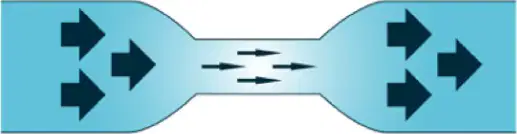
Which of the following describe the flow of gas in the Venturi tube?
Pressure is lower where the tube is narrow and the speed of the gas is faster.
Pressure and speed increases in the narrow part of the tube.
Pressure and speed decreases in the narrow part of the tube.
Pressure is higher where the tube is narrow and the speed of the gas is slower.
Which of these best describes the angle of attack of an airfoil?
Angle between the leading edge and the relative wind flow
Angle between the leading edge and the trailing edge
Angle between the chord line and the relative wind flow
Angle between the chord line and the ground
Which of these would increase the lift of an airplane? Select all that apply.
Increasing the altitude of the airplane
Increasing the speed of the airplane
Increasing the camber of the wing
Increasing the density of the air
Increasing the surface area of the wing
Which of these variables in the lift equation is considered constant on most airplanes?
Coefficient of lift
Air density
Air speed
Wing surface area
True or False. As airspeed increases, the angle of attack at which an airfoil stalls also increases.
True
False
Why would it be desirable for the wing to be twisted so that the wing tip has a lower angle of attack than the wing root?
The wing tip will stall after the wing root, and the ailerons will be effective after the wing root has stalled.
The wing tip will stall before the wing root, and the ailerons will be effective after the wing root has stalled.
The wing tip will stall after the wing root, and the ailerons will be effective after the wing tip has stalled.
The wing tip will stall before the wing root, and the ailerons will be effective after the wing tip has stalled.
Which of these affects the coefficient of lift? Select all that apply.
Camber of an airfoil
Density of an airfoil
Speed of an airfoil
Symmetry of an airfoil
Thickness of an airfoil
True or False. Total lift depends on the combined effects of airspeed and angle of attack. When the speed decreases, you must increase the angle of attack to maintain the same amount of lift.
True
False

