wayground logo

Free Printable Worksheets

Font size

S
M
L
XL
Worksheets

Orbital Motion Review

Total questions: 20

Worksheet time: 17mins

Name
Class
Date
1.

According to Copernicus, Saturn could be seen in the middle of the night and during the day time, so Saturn must be ___.

a)

outside of Earth's orbit

b)

inside of Earth's orbit.

c)

between Earth and the Sun

d)

bigger than Earth

2.

Kepler's law about "equal areas in equal time" tells us that orbiting objects

a)

move faster when they are closer

b)

have shorter periods when they have shorter average distance

c)

orbit in an ellipse

d)

have greater gravity when they are closer

3.
Copernicus' important contribution to astronomy was
a)
proving planets move around the Sun in elliptical orbits
b)
the theory of gravity
c)
proposing a simpler model for the motions of planets in the solar system
d)
discovering the Sun was not at the center of the Milky Way
4.
Which planet in our solar system will have the fastest orbital  speed?
a)
Venus 
b)
Earth 
c)
Saturn 
d)
Mercury 
5.
As mass increases, gravity ________________.
a)
Increases 
b)
Decreases 
c)
Stays the same 
6.

the path an object takes as it revolves around a star, planet, or moon

a)

revolve

b)

orbit

c)

rotate

d)

space probe

7.
What did Kepler discover about planets and their orbital speed?
a)
Planets closest to the Sun will orbit with the fastest orbital speed.
b)
Planets with the greatest mass will orbit the Sun with the fastest orbital speed.
c)
Planets furthest from the Sun will orbit with the fastest orbital speed.
d)
Planets with the least mass will orbit the Sun with the fastest orbital speed.
8.

What does heliocentric mean? 

a)
Earth centered
b)
Helium centered
c)
Sun centered
d)
Proof of the Big Bang
9.

Which will have a bigger force of gravity on the Earth

a)

Jupiter because its big

b)

Saturn because it is far

c)

the Moon because its closest

d)

The Mercury because it is moving the fastest

10.

Jupiter is much larger than its moon, Europa. The center of gravity between Jupiter and Europa is

a)

much closer to Jupiter (within Jupiter)

b)

much closer to Europa

c)

at Jupiter's core/center

d)

half way between to two.

11.
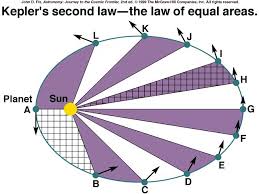
Where is the planet moving faster
a)
Position A to B
b)
Position B to C
c)
Position H to I
d)
Position I to J
12.

Which letter represents the position where the planet will move the slowest?

(a)  

13.
Which of Galileo's initial observations was most challenging to established geocentric beliefs?
a)
craters on the Moon
b)
sunspots
c)
lunar maria
d)
satellites of Jupiter?
14.

What early assumption of the heliocentric theory caused inaccuracies in many of is calculations?

a)

each planet rotates on its axis

b)

planets move in circular orbits

c)

the moon revolves around the earth

d)

the sun is the center of the universe

15.
According to Kepler’s discoveries, planets orbit around the Sun:
a)
in an oval shape.
b)
in perfect circles.
c)
in an ellipse.
d)
in a rectangular shape.
16.

Compared to closer planets, planets that are farther from the Sun will

a)

have longer periods.

b)

have more eccentric orbits.

c)

move slower

d)

be smaller

17.
What are the factors which combine to to keep celestial bodies in orbit? 
a)
Air Resistance and Gravity 
b)
Gravity and Inertia 
c)
Inertia and orbital speed
d)
Orbital speed and gravity 
18.

What is the force of gravity between two asteroids if one is 4 x 10¹⁰ kg and the other is 6 x 10¹⁵ kg and the distance between them is 80,000,000 m? (G=6.67 x 10⁻¹¹) Round to 2 places. Give your answer in Newtons.

(a)  

19.
The tendency of a moving object to continue moving in a straight line or a stationary object to remain in place is called:
a)
Orbital Speed 
b)
Gravity 
c)
Terminal Velocity 
d)
Inertia 
20.
Improved the telescope so that he could study the moons of Jupiter
a)
Galileo
b)
Kepler
c)
Newton
d)
Copernicus