
 Worksheets
Dilations & Proving Triangles Similar
Total questions: 36
Worksheet time: 3hrs 54mins

Choose the correct scale factor:
(Pay attention to which shape is the preimage!)

What is the definition of similarity?
same shape, same size
same shape, different size
different shape, same size
different shape, different size
A scale factor between zero and one means
that the image will be larger than the pre-image.
That the image will be the same as the preimage.
That the image will be a reduction of the preimage.


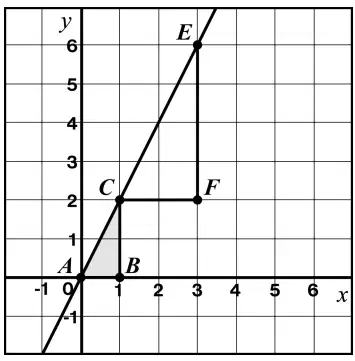
Triangles EFC and CBA are similar. Which sequence of transformations will map one triangle onto the other?
A translation, then a dilation.
A dilation, followed by another dilation.
A reflection, then dilation
A rotation, then a dilation

1//2
1/4
2
4

1/3
3/5
3
10
If a shape goes through the following series of transformations, what do we know about the image?
Rotated 90 degrees clockwise
Dilated by a scale factor of 1.5
Translated 3 units right and 5 units down
The image is CONGRUENT to the pre-image
The image is SIMILAR to the pre-image

The two figures are similar. What is the scale factor going from the figure on the left to the figure on the right?
6/5
5/6
25/36
36/25
Challenge: A scale factor of 2 is used to enlarge a square. What is the effect of this change on the AREA of the square?
The area will be half as big.
The area will be twice as large.
The area will be 4 times larger.
The area will be 8 times larger.
The area will not change.

Quadrilateral OBCD is similar to Quadrilateral OHTE because?
Quad OBCD can be reflected over the x axis and then rotated 90 degrees
Quad OBCD can be reflected over the x-axis and then dilated about point O by a scale factor of 2.
Quad OBCD can be reflected over the y-axis and then dilated about the origin by a scale factor of 2.
Quad OBCD can be reflected over the y-axis and then dilated about the origin by a scale factor of 1/2.

Determine if the triangles are similar. If so, state the similarity postulate or theorem.
AA~
SSS~
SAS~
The triangles are not similar.

Which method can be used to show that the two triangles at the right are similar?
AA~
SSS~
SAS~
Cannot be shown
I am allowed to use SSS~ or SAS~ without checking the ratios/proportions of the sides.
True
False

Determine whether the triangles are similar by AA~, SSS~, SAS~, or not similar.
AA~
SSS~
SAS~
Not similar

Determine if triangles are or are not similar, and, if they are, state how you know. (Note that figures are NOT necessarily drawn to scale.)
AA∼
SAS∼
SSS∼
The triangles are not similar

Determine if WXZ ~ ZXY. If they are, identify the triangle similarity theorem(s) that prove(s) the similarity.
AA ~ Theorem
SAS ~ Theorem
SSS ~ Theorem
Not similar

Determine whether the triangles are similar by AA~, SSS~, SAS~, or not similar.
AA~
SSS~
SAS~
NOT SIMILAR

Challenge!
45° : 117° : 18°
50° : 130° : 20°
40° : 104° : 36°
35° : 120° : 22°

Polygon A and B are similar. Give the scale factor of figure A to figure B.
5/2 or 2.5
2/5 or 0.4
5/3
3/5 or 0.6
The point A (8, 12) was dilated to become point A' (2, 3). What was the scale factor?
½
¼
4
2

32
23
2
3

Which algebraic expression could be the rule for a reduction?
ΔSQR∼ΔSPT. Which choice below lists two corresponding sides?
SP and SR
QS and PT
PS and RS
TP and RQ


If the triangles are similar, finish the similarity statement.
If not, choose "not similar"
ΔMLK∼?
ΔDEF
ΔFED
ΔEFD
not similar

What is Reason #2?
AA ~
SAS ~
SSS ~
Not Enough Information
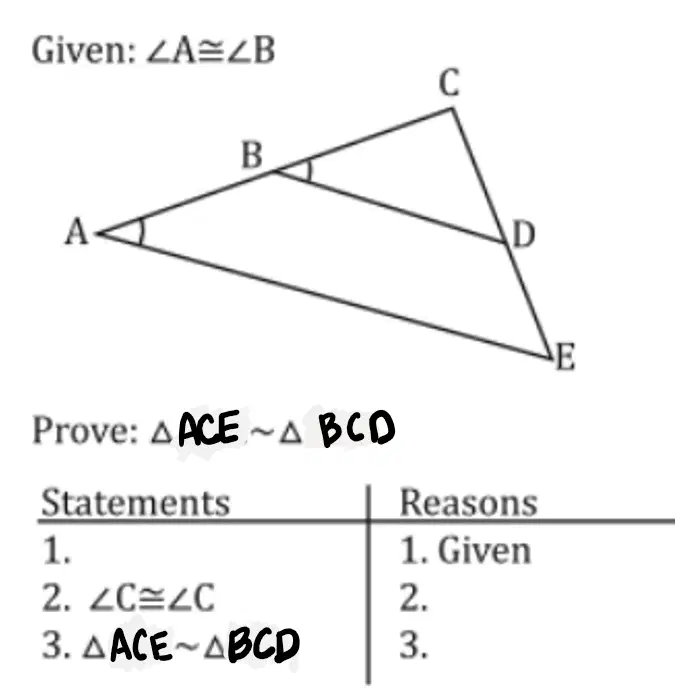
What is the Reasons for #2 and #3?
#2 - Corresponding Angles Theorem
#3 - AA ~
#2 - Reflexive Property
#3 - AA ~
#2 - Reflexive Property
#3 - SAS ~
#2 - Corresponding Angles Theorem
#3 - SAS ~

#2 Given
#3 AA~
#2 Vertical Angles Theorem
#3 AA~
#2 Reflexive Property
#3 SAS~
#2 Definition of Angle Bisector
#2 SSS~

