
Font size
 Worksheets
OSM The Universe SOL Review DO NOT USE
Total questions: 23
Worksheet time: 12mins
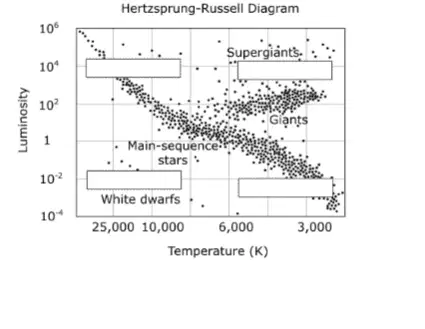
Label the characteristics of stars in each area of the Hertzsprung-Russell diagram. Move ONE correct answer to each box.
Cool, bright
Cool, dim
Hot, dim
Hot, bright
A Hertzsprung-Russell (H-R) diagram is shown. A star that has a luminosity of 10−2 and a temperature of 20,000 K is most likely a —
Main sequence
White dwarf
Blue giant
Red giant
Based on this information, the three objects that make up the Alpha Centauri system are all —
asteroids
comets
planets
stars
The Hertzsprung-Russell diagram shown is divided into four sections. Which section of the diagram includes the coolest, brightest stars?
Section 1
Section 2
Section 3
Section 4
Based on the information, which star is most like the sun?
Star 1
Star 2
Star 3
Star 4
Which statement best describes the location of the sun in the Milky Way galaxy?
The sun is located in the center of a spiral-shaped galaxy.
The sun is located off the center of an elliptical-shaped galaxy.
The sun is located on an arm of a spiral-shaped galaxy.
The sun is located on an arm of an elliptical-shaped galaxy.

An image of the Earth-moon-sun system is shown. The moon remains in orbit around Earth because of the force of —
F Earth’s rotation
G the moon’s rotation
H Earth’s gravity
J the sun’s gravity

A student makes a model of the sun-Earth system by swinging a ball around her head. Using this model, the student is trying to explain how Earth stays on a path around the sun. The student explains that this path is the result of —
the magnetic attraction between Earth and the sun
potential energy stored in Earth that originated in the sun
the gravitational attraction between the sun and Earth
electromagnetic energy from the sun pulling on Earth
How do fossil records support the theory of plate tectonics?
A) Similar fossils are found on the same continent at different time periods.
B) Similar fossils are found on various modern continents.
C) Different fossils are found on the same continent during the same time period.
D) Fossils found along coastal regions of modern continents are unique.
Part A: Which statement describes how each land feature MOST LIKELY formed?
A) The Himalayas formed at convergent boundaries, while the Great Rift Valley formed at divergent boundaries.
B) The Himalayas and the Great Rift Valley both formed at divergent boundaries.
C) The Himalayas formed at divergent boundaries, while the Great Rift Valley formed at convergent boundaries.
D) The Himalayas formed at convergent boundaries, while the Great Rift Valley formed at transform boundaries.
Part B: Which statement BEST explains the correct answer to Part A?
Tectonic plates are moving away from each other in areas that form both mountains and rift valleys.
Tectonic plates are moving away from each other in areas that form mountains, while tectonic plates are moving toward each other in areas that form rift valleys.
Tectonic plates are moving toward each other in areas that form mountains, while tectonic plates are sliding past each other in areas that form rift valleys.
Tectonic plates are moving toward each other in areas that form mountains, while tectonic plates are moving away from each other in areas that form rift valleys.

The diagram shows different types of tectonic plate boundaries. Which table accurately shows the surface features associated with each tectonic plate boundary?
A) Plate Boundary 1: Volcanoes and oceanic ridges; Plate Boundary 2: Trenches and continental rift valleys.
B) Plate Boundary 1: Oceanic ridges and continental rift valleys; Plate Boundary 2: Trenches and volcanoes.
C) Plate Boundary 1: Continental rift valleys and volcanoes; Plate Boundary 2: Oceanic ridges and trenches.
D) Plate Boundary 1: Trenches and continental rift valleys; Plate Boundary 2: Volcanoes and oceanic ridges.
Which table correctly compares features of divergent plate boundaries and convergent plate boundaries?
Divergent: Plates move away from each other, Ridges and rifts, Yes; Convergent: Plates move toward each other, Trenches and mountains, Yes
Divergent: Plates move toward each other, Ridges and rifts, Yes; Convergent: Plates move away from each other, Trenches and mountains, Yes
Divergent: Plates move toward each other, Trenches and mountains, Yes; Convergent: Plates move away from each other, Ridges and rifts, No
Divergent: Plates move away from each other, Trenches and mountains, Yes; Convergent: Plates move toward each other, Ridges and rifts, No
Which location is near a transform plate boundary?
Location A
Location B
Location C
Location D
Two oceanic plates are shown in the image. Which type of boundary results in the spreading of the oceanic ridge?
A) Convergent boundary
B) Subduction boundary
C) Transform boundary
D) Divergent boundary
This picture shows scratches in bedrock that were caused by a moving glacier. These scratches are called glacial striations. Glacial striations in the bedrock of South Africa indicate that glaciers once moved across the African continent. The presence of glaciers on the surface of Africa is evidence that —
the tectonic plate under Africa was closer to the South Pole at one time
the equator was not always where it is currently located
volcanoes did not exist until after faults occurred in Earth’s crust
the location of the North Pole and the South Pole changed
A teacher asks students to make a model of a transform plate boundary. The students use blocks to represent tectonic plates and slide the blocks past each other in the directions of the arrows as shown. Which event can the students best demonstrate with their model?
An earthquake
A volcanic eruption
Formation of a rift valley
Building up of a mountain.

The diagram shows Earth at different positions as it orbits the sun. What differences between Earth’s Northern and Southern Hemispheres are represented in the diagram, AND what causes these differences? Look at the diagram and read the question carefully. Then enter your answers in the box provided.
The Northern Hemisphere experiences summer while the Southern Hemisphere experiences winter due to the tilt of Earth's axis.
The Northern Hemisphere experiences winter while the Southern Hemisphere experiences summer due to the tilt of Earth's axis.
Both hemispheres experience the same season at the same time due to Earth's orbit.
The Northern Hemisphere experiences spring while the Southern Hemisphere experiences autumn due to the tilt of Earth's axis.
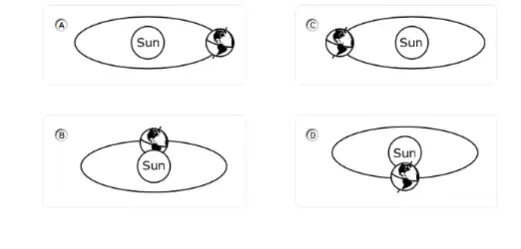
Which diagram shows the relative position of Earth's axis at the beginning of summer in Texas?
A
B
C
D

The model shows Earth in four different positions in its orbit around the sun. Which statement correctly explains which position of Earth represents summer in the United States?
Position 1, because the Western Hemisphere is facing the sun
Position 2, because the Northern Hemisphere tilts toward the sun
Position 3, because Earth is at its closest point to the sun in its orbit
Position 4, because Earth is traveling at its fastest rate in its orbit
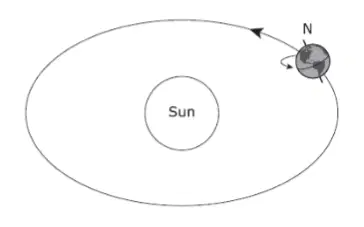
The diagram shows Earth in its orbit around the sun when very little light is visible at Earth’s South Pole. Which statement is true when Earth is in the position shown?
It is August in the Northern Hemisphere. It is April in the Southern Hemisphere.
It is summer in the Northern Hemisphere. It is winter in the Southern Hemisphere.
The number of hours of daylight is greater in the Southern Hemisphere than in the Northern Hemisphere.
Spring begins earlier in the year in the Southern Hemisphere than it does in the Northern Hemisphere.

The diagram shows the alignment of Earth, the moon, and the sun on one day in May 2019. The table shows tide heights for a coastal city on four different days in May 2019. Based on the table, on which date were Earth, the moon, and the sun MOST LIKELY arranged as shown in the diagram?
May 15
May 18
May 22
May 26

During which lunar phase is the tide highest?
Phase 1
Phase 2
Phase 3
Phase 4

