
Font size
 Worksheets
G8 Q3 Science Practice Assessment
Total questions: 19
Worksheet time: 10mins
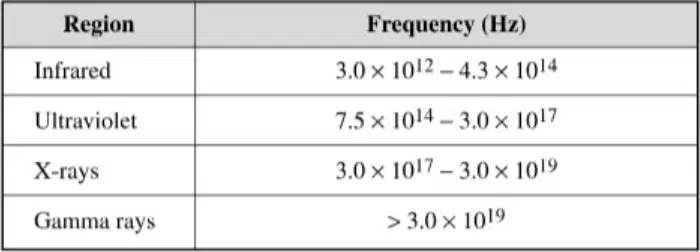
The table below shows the range of frequencies, in Hertz (Hz), for part of the electromagnetic spectrum. Which of the following types of radiation has the longest wavelength? (8.E.5.11)
Infrared
Ultraviolet
X-rays
Gamma rays
An astronomer observes a sunspot. Which of the following describes this feature of the Sun? (8.E.5.6)
a. a location where heat rises to the Sun's surface
b. a location that produces most of the Sun's heat energy
c. a location that is cooler than the other parts of the Sun's surface
d. a location where energy and matter leave the Sun's atmosphere
Nancy observes the Moon from the same location outside each night for one week. She notices that when it first appears each night, the Moon is a little farther east than it was the night before. Which of the following is one explanation for her observation? (8.E.5.9)
The Moon's speed of rotation changes as it revolves around Earth.
The Moon revolves around Earth as Earth revolves around the Sun.
The Moon and Earth take the same amount of time to complete one rotation.
The Moon completes one rotation each time Earth completes one revolution.
The Andromeda Galaxy was previously called the Great Andromeda Nebula because
it was thought to be a cloud of gas and dust.
it was thought to be a star cluster.
it was thought to be a planet.
it was thought to be a black hole.
Astronomers thought this patch of light was composed of glowing gases. In the 1900s, scientists determined the nebula was actually a spiral galaxy. Which of the following describes the relationship between this galaxy and other astronomical bodies? (8.E.5.2)
This galaxy is the largest star and is found in the universe.
The galaxy is surrounded by thousands of stars in the universe.
The galaxy includes a universe that is composed of millions of stars.
This galaxy is one of billions of galaxies in the universe and contains billions of stars.
Why does Saturn take longer to complete one orbit around the Sun than Earth does?
Saturn has stronger gravity.
Saturn is farther from the Sun.
Saturn has a thicker atmosphere.
Saturn is the only planet with rings.
Which of the following correctly lists the order of objects in space from largest to smallest? (8.E.5.3)
Earth, Milky Way, Universe, Solar System
Universe, Solar System, Earth, Milky Way
Universe, Milky Way, Solar System, Earth
Earth, Universe, Solar System, Milky Way
If the average distance between Earth and the Sun were doubled, what changes would occur in the Sun’s gravitational pull on the Earth and Earth’s period of revolution? (8.E.5.7)
Gravitational pull would decrease and period of revolution would increase
Gravitational pull would decrease and period of revolution would decrease
Gravitational pull would increase and period of revolution would increase
Gravitational pull would increase and period of revolution would decrease
If the distance between the Moon and Earth were to decrease steadily for one week, which water-level changes would be expected to occur? (8.E.5.9)
High tides would get higher and low tides would get lower
Both high tides and low tides would get higher
Both high tides and low tides would get lower
High tides would get lower and low tides would get higher
Which unit would best be used to represent the distance between Mercury and Neptune? (8.E.5.1)
astronomical unit
kilometer
light year
mile
Based on this information, what can you conclude about the Andromeda Galaxy?
The galaxy is one of the newest parts of the solar system.
The galaxy is closer to Earth than all the other stars.
To an observer on Earth, the galaxy appears brighter than the Sun.
To an observer on Earth, the galaxy appears as it did one million years ago.
Which of the following objects is farthest from Earth?
Triangulum Galaxy
Neptune
North Star
Sun
Marlee uses a telescope to observe a red star. What does its color tell her about the star? (8.E.5.5)
the star’s age
the star’s temperature
the star’s distance from Earth
the star’s location relative to other stars
Eduardo looks at stars through his telescope. He says that the star Sirius is brighter than the star Rigel. In reality, Rigel has a greater absolute brightness than Sirius. What can explain Eduardo’s observation?
Sirius is closer to Earth than Rigel.
Rigel is a variable star.
Sirius is a supernova.
Eduardo is mistaken.
The Moon has many more impact craters than Earth. Which of the following gives the best explanation for the Moon having more craters than Earth? (8.E.5.7)
The Moon has no atmosphere.
The Moon orbits between Earth and the Sun.
The Moon rotates much slower than Earth does.
The Moon has no gravity.
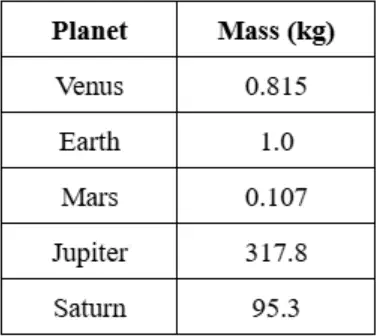
On which of the following planets would a person weigh the least? (8.E.5.7)
Jupiter
Mars
Saturn
Venus
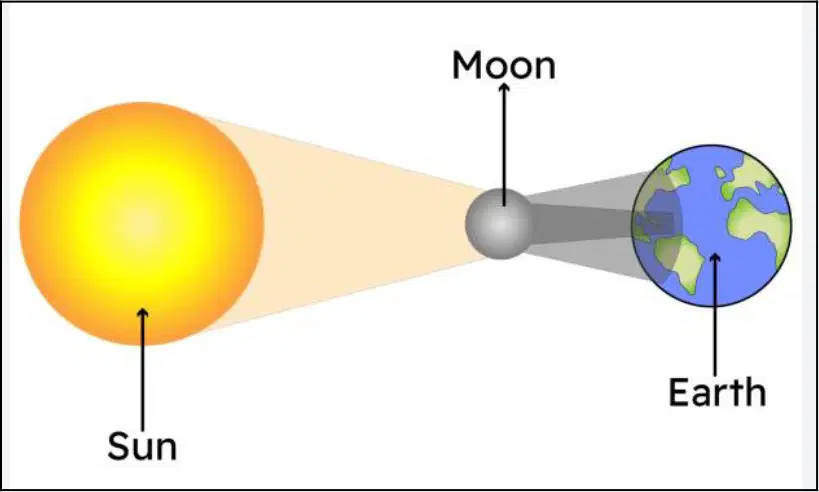
Ping’s class is studying the Sun/Moon/Earth system. He studies the diagram of the Sun, Moon, and Earth shown below. What event is shown in this diagram? (8.E.5.9)
Winter solstice
Lunar eclipse
Full moon
Solar eclipse
Which factor has the greatest overall influence on gravity?
Weight
Mass
Height
Altitude
Which of the following statements is true about the largest gravitational force?
The largest gravitational force would be between the Earth and Jupiter because they are close together.
The largest gravitational force would be between the Earth and Jupiter because Jupiter has a high mass.
The largest gravitational force would be between the Earth and the Moon because they are made of similar material.
The largest gravitational force would be between the Earth and Moon because of their size and proximity.

