
 Worksheets
AP Chem Unit 6
Total questions: 15
Worksheet time: 8mins

Which of the following can be concluded?
D) The final temperature is less than the average starting temperature of the metal and the water; therefore the total energy of the metal and water decreased.
A) The metal temperature changed more than the water temperature did; therefore the metal lost more thermal energy than the water gained.
B) The metal temperature changed more than the water temperature did, but the metal lost the same amount of thermal energy as the water gained.
C) The metal temperature changed more than the water temperature did; therefore the heat capacity of the metal must be greater than the heat capacity of the water

According to the information above, what is the standard enthalpy of formation, ΔH°f , for NH3(g) at 298 K ?
C) 46 kJ/mol
D) 92 kJ/mol
A) -92 kJ/mol
B) -46 kJ/mol
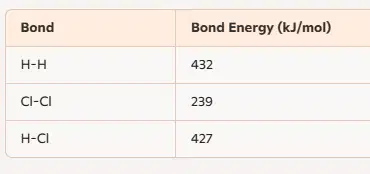
Based on the table of bond energies shown, the value of ΔH for the reaction H2 + CI2 -> 2HCI is closest to which of the following?
D) +244 kJ/molrxn
A) -244 kJ/molrxn
C) +183 kJ/molrxn
B) -183 kJ/molrxn

Which of the following best explains why the enthalpy of vaporization of methane is less than that of water?
D) Methane has a much lower density.
A) Methane does not exhibit hydrogen bonding, but water does.
B) Methane has weaker dispersion forces.
C) Methane has a smaller molar mass.
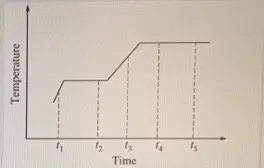
The graph shows the temperature of a pure substance as it is heated at a constant rate in an open vessel at 1.0 atm pressure. The substance changes from the solid to the liquid to the gas phase.
The substance is at its normal freezing point at time :
A) t1
C) t3
B) t2
D) t4
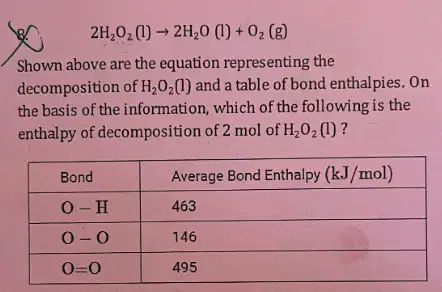
On the basis of the information, which of the following is the enthalpy of decomposition of 2 mol of H2O2 (l)?
D) +349 kJ
A) -349 kJ
C) +203 kJ
B) -203 kJ

Based on the reaction represented by the chemical equation shown above, what is the amount of heat released when 4.00mol of H2S(g) reacts with 9.00mol of O2(g)?
C) -2240 kJ
A) -560 kJ
D) -3360 kJ
B) -1120 kJ
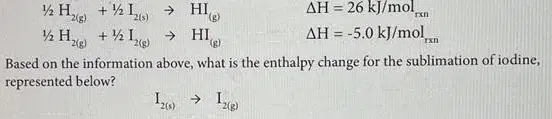
Based on the information above, what is the enthalpy change for the sublimation of iodine, represented below?
A) 15 kJ/mol
B) 21 kJ/mol
C) 31 kJ/mol
D) 42 kJ/mol
E) 62 kJ/mol
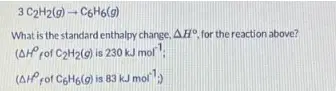
What is the standard enthalpy change, ΔH° , for the reaction above?
D) +773 kJ
A) -607 kJ
C) +19 kJ
B) -147 kJ
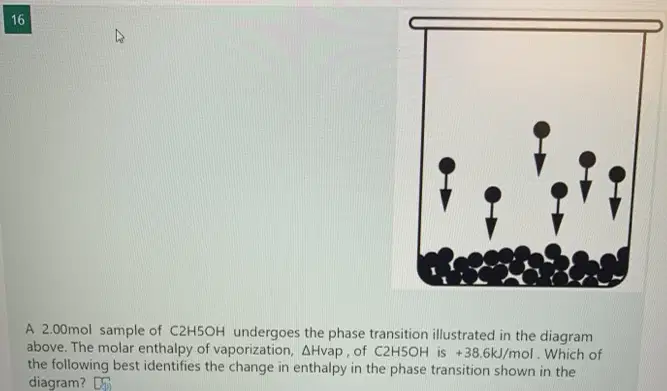
Which of the following best identifies the change in enthalpy in the phase transition shown in the diagram?
D) -77.2 kJ
A) +19.3 kJ
C) -19.3 kJ
B) +77.2 kJ

Based on the information above, what is the value of ΔH° for the following reaction?
A) -483 kJ/molrxn
C) +141 kJ/mol rxn
B) -141 kJ/mol rxn
D) +483 kJ/mol rxn
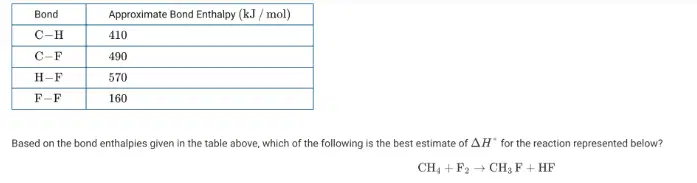
Based on the bond enthalpies given in the table above, which of the following is the best estimate of ΔH° for the reaction represented below?
B) -490 kJ/molrxn
C) +490 kJ/molrxn
A) -650 kJ/molrxn
D) +650 kJ/molrxn
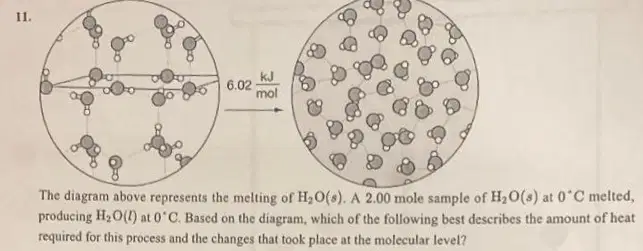
Based on the diagram, which of the following best describes the amount of heat required for this process and the changes that took place at the molecular level?
C) 12.0kJ of heat was absorbed to decrease the polarity of the water molecules, which increases the density of the liquid compared to the solid.
D) 12.0kJ of heat was absorbed to overcome some of the hydrogen bonding forces holding the water molecules in fixed positions in the crystalline structure.
A) 3.01kJ of heat was absorbed to decrease the average speed of the water molecules in the liquid, which decreases the distance between molecules.
B) 6.02kJ of heat was absorbed to increase the number of hydrogen bonds between water molecules in the liquid compared to the solid.

The best explanation for this phenomenon is that the heat absorbed by the mixture
B) is used in overcoming the intermolecular attractions in the solid
D) causes the nonbonding electrons in the molecules to move to lower energy levels
A) is lost to the surroundings very quickly
C) is used in breaking the bonds within molecules of the solid
E) causes evaporation of the liquid which has a cooling affect
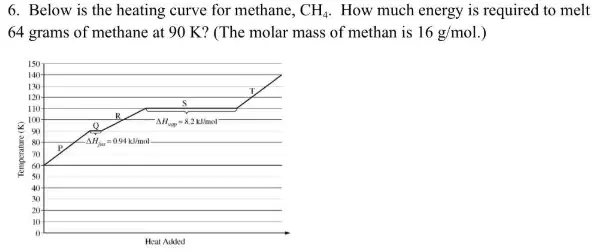
How much energy is required to melt 64 g of methane at 90 K? (The molar mass of methane is 16 g/mol.
D) 60 kJ
A) 0.24 kJ
C) 33 kJ
B) 3.8 kJ

