
 Worksheets
CBA #3 Earth and Space Review
Total questions: 175
Worksheet time: 5hrs 4mins
What step of the water cycle occurs when liquid water changes into water vapor?
precipitation
accumulation
condensation
evaporation
The sun is the source of energy for the water cycle.
True
False
Condensation occurs when water vapor_____________.
heats up and becomes liquid water
cools off and becomes liquid water
freezes and becomes ice
rains on the land
The Earth can make new water, we just have to wait long enough for the cycle to be over.
True
False
Which of the following weather tools measures rainfall?
barometer
wind vane
anemometer
rain gauge
Which of the following are forms of precipitation? Click ALL that apply.
Rain
Snow
Dew
Hail
Which of the following is an example of condensation?
Water boiling on a stove
Puddles on the sidewalk after a hard rain
water droplets on the outside of a cold drink
Snow falling in Colorado
The process when plants release water vapor from their leaves is called _____________.
precipitation
evaporation
transpiration
condensation
Check all the boxes that are true.
Over 70% of Earth is covered in water
All living things need water to survive
Most of the water on Earth is freshwater/drinkable
We are drinking the same water that the dinosaurs drank millions of years ago
Which weather tool measures wind direction?
wind vane
anemometer
hygrometer
barometer
_____________________ happens when rocks on Earth's surface break apart or change without moving anywhere.
Erosion
Weathering
Deposition
_____________________ is the movement of soil and rock by wind, water, ice, and gravity.
Weathering
Erosion
Deposition
______________________ occurs when eroded materials stop moving and begin to build up.
Weathering
Erosion
Deposition
_______________ moves material from one place to another.
Weathering
Erosion
Deposition

This is an example of _____________________________.
physical weathering
chemical weathering

The Grand Canyon was caused by _____________________ erosion from the Colorado River.
water
wind

The movement of water in a river causes the rocks to become ______________ over time.
smaller/smoother
larger/rougher

A ______________ is a hill of sand created by the wind.
dune
delta
sediment


Some examples of slow changes are
earthquakes, volcanoes, and landslides
weathering, erosion and deposition
sloths in the rain forest
turtle vs snail racing
Some examples of fast changes are
earthquakes, volcanoes, and landslides
weathering, erosion and deposition
sloths in the rain forest
turtle vs snail racing
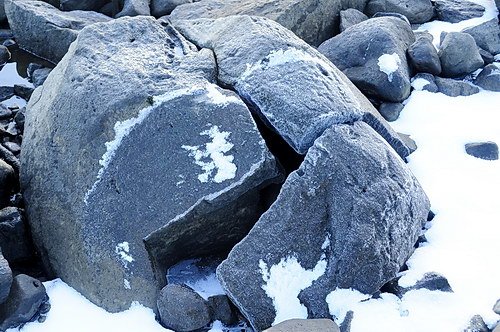
How does freezing water cause the weathering of rocks? The freezing water—
keeps the rocks in place.
makes the rocks last longer.
expands cracks and breaks rocks.
causes rocks to fall in landslides.

Sea caves are coastal landform made by
Erosion
Deposition
Beaches are form by
Erosion
Deposition
All above


Erosion ________________________.
breaks down rock
moves rocks
deposits rock
is caused by ice wedging

Weathering is the__________________.
breaking down of rocks
movement of rocks
deposition of rocks

What process most likely formed the Grand Canyon?
weathering by wind
rain pounding the rocks
erosion by a river (water)
_____________________ happens when rocks on Earth's surface break apart or change without moving anywhere.
Erosion
Weathering
Deposition
_____________________ is the movement of soil and rock by wind, water, ice, and gravity.
Weathering
Erosion
Deposition
______________________ occurs when eroded materials stop moving and begin to build up.
Weathering
Erosion
Deposition
The Grand Canyon was caused by _____________________ erosion from the Colorado River.
water
wind
Which process describes rain washing away soil from a hill?
Weathering
Erosion
Deposition
Which process describes layers of sediment forming at the bottom of the ocean?
Weathering
Erosion
Deposition
Which process describes flood water pounding against a canyon wall and wearing it down?
Weathering
Erosion
Deposition
Weather ____________ every day.
changes
is the same
Weather in any area tends to follow a ____________.
pattern
map
_______________ is the average weather pattern of a region over time.
Climate
Maps
Climate ___________ from weather.
is the same
differs
Average temperature and average rainfall, in addition to other weather information, are important parts of _____________.
climate
changes
The United States can also be divided into many specific local climate ____________.
patterns
zones
Climate is closely related to latitude, which is a location's distance north or south of the ________________.
equator
north pole
Because Earth is shaped like a sphere, areas closer to the equator receive _________ direct energy from the sun than do areas farther from the equator.
more
less
A ___________ is the constant movement of ocean water.
current
pool
Ocean currents moderate worldwide ________________ throughout the year.
zones
temperatures
Several factors affect ____________ in different places on Earth.
climate
clouds
Being near an __________ or other large body of water affects climate.
pond
ocean
How high in the atmosphere a place is affects its climate. This is called __________________.
elevation
distance
Mountains can also affect how wet a climate is. Air cools and loses _________________ as it moves up and over a mountain.
moisture
heat
Weather ____________ every day.
changes
is the same
Weather in any area tends to follow a ____________.
pattern
map
_______________ is the average weather pattern of a region over time.
Climate
Maps
Climate ___________ from weather.
is the same
differs
Average temperature and average rainfall, in addition to other weather information, are important parts of _____________.
climate
changes
The United States can also be divided into many specific local climate ____________.
patterns
zones
Climate is closely related to latitude, which is a location's distance north or south of the ________________.
equator
north pole
Because Earth is shaped like a sphere, areas closer to the equator receive _________ direct energy from the sun than do areas farther from the equator.
more
less
A ___________ is the constant movement of ocean water.
current
pool
Ocean currents moderate worldwide ________________ throughout the year.
zones
temperatures
Several factors affect ____________ in different places on Earth.
climate
clouds
Being near an __________ or other large body of water affects climate.
pond
ocean
How high in the atmosphere a place is affects its climate. This is called __________________.
elevation
distance
Mountains can also affect how wet a climate is. Air cools and loses _________________ as it moves up and over a mountain.
moisture
heat


All the following is classified as a nonrenewable resource, BUT...
oil
natural gas
water
coal
All the following is classified as a renewable resource, BUT...
oil
solar
water
wind
A resource is renewable because...
it cannot be replaced as fast as people use it.
it can be recycled.
it can easily be replaced as it is used.
it is available in limited supplies.
A resource is nonrenewable because...
it cannot be replaced as fast as people use it.
it can be recycled.
it can easily be replaced as it is used.
it is available in limited supplies.
The following are renewable sources of energy
wind and water
coal and natural gas
sunlight and petroleum
minerals and oil
The following are nonrenewable sources of energy
wind and water
coal and natural gas
sunlight and petroleum
minerals and oil
Fossil fuels are
Renewable resource
Nonrenewable resource
Forests are
Renewable resource
Nonrenewable resource

This natural resource is...
nonrenewable wind
renewable solar
renewable wind
renewable water

This natural resource is...
nonrenewable solar
renewable solar
nonrenewable wind
renewable water
Which of the following is a major cause of air pollution?
burning fossil fuel
dumping waste in landfills
using wind and solar energy
releasing waste into rivers, lakes, streams...
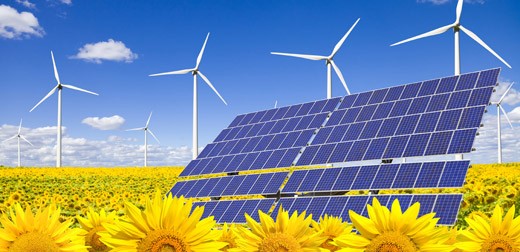
__________ is an energy resource that WILL NOT run out in the next several hundred years.
Renewable Energy Resource
Nonrenewable Energy Resource
Fossil fuels
biodegradable
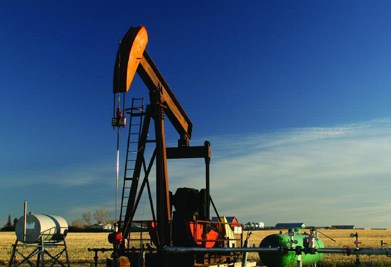
__________ is an energy resource that WILL run out in the next several hundred years.
Renewable Energy Resource
Nonrenewable Energy Resource
natural resources
pollution
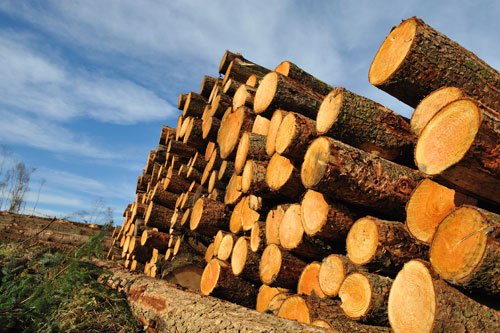
Wood is...
A renewable resource
A nonrenewable resource
Used to make oil
Used to make plastic
All the following is classified as a nonrenewable resource, BUT...
oil
natural gas
water
coal
All the following is classified as a renewable resource, BUT...
oil
solar
water
wind
A resource is renewable because...
it cannot be replaced as fast as people use it.
it can be recycled.
it can easily be replaced as it is used.
it is available in limited supplies.
A resource is nonrenewable because...
it cannot be replaced as fast as people use it.
it can be recycled.
it can easily be replaced as it is used.
it is available in limited supplies.
This natural resource is...
nonrenewable solar
renewable solar
nonrenewable wind
renewable water
The following are renewable sources of energy
wind and water
coal and natural gas
sunlight and petroleum
minerals and oil
The following are nonrenewable sources of energy
wind and water
coal and natural gas
sunlight and petroleum
minerals and oil
Fossil fuels are
Renewable resource
Nonrenewable resource
Our main reasons for using fossil fuels are
Cheap
Expensive
Convenient
Clean
Inconvenient
Our main reason to use renewable resources are
Cheap
Expensive
Convenient
Clean
Limitless supply
Our main reasons why we don't use renewable resources are
Cheap
Expensive
Convenient
Clean
Inconvenient
This natural resource is...
nonrenewable wind
renewable solar
renewable wind
renewable water
Which of the following is a major cause of air pollution?
burning fossil fuel
dumping waste in landfills
using wind and solar energy
releasing waste into rivers, lakes, streams...
Which of the following is a major cause of water pollution?
burning fossil fuel
dumping waste in landfills
using wind and solar energy
releasing waste into rivers, lakes, streams...
Ways we can limit pollution include...
reduce amount used
recycle what's been used
reuse resources
re-purpose resources to meet other needs

Which of the following resources WILL eventually run out?
natural resources
renewable resources
nonrenewable resources
What is one advantage of using solar energy as a resource?
It is non-renewable.
It is renewable and reduces pollution.
It is expensive to install.
It is only available at night.
Which of the following is a nonrenewable resource?
Wind
Water
Coal
Sunlight
How does recycling help the environment?
It increases the amount of waste in landfills.
It conserves natural resources and reduces pollution.
It uses more energy than creating new products.
It harms wildlife habitats.
What is a disadvantage of using oil as an energy resource?
It is renewable.
It causes air pollution.
It is abundant and cheap.
It is easy to transport.
Why is it important to conserve energy resources?
To increase the use of nonrenewable resources.
To ensure resources are available for future generations.
To make energy more expensive.
To reduce the need for recycling.
Which of the following is a renewable resource?
Natural gas
Oil
Wind
Coal
What is one way to conserve natural resources?
Use more plastic products.
Increase the use of fossil fuels.
Practice recycling and reusing materials.
Cut down more trees.
What is a disadvantage of using wind energy?
It produces harmful emissions.
It is nonrenewable.
It can be inconsistent and depends on weather.
It is expensive to maintain.
How does the disposal of natural resources impact the environment?
It has no effect on the environment.
It can lead to pollution and habitat destruction.
It always benefits wildlife.
It increases the availability of resources.
Which of the following is an advantage of using water as an energy resource?
It is nonrenewable and limited.
It produces no air pollution.
It is only available in certain areas.
It is expensive to harness.
What is one critical role of energy resources in modern life?
They are not needed for transportation.
They power homes, industries, and transportation.
They are only used for cooking.
They are not important for communication.
Which of the following is a disadvantage of using coal as an energy resource?
It is renewable.
It produces a lot of greenhouse gases.
It is clean and safe for the environment.
It is easy to extract.
How can individuals help conserve natural resources?
By using more disposable products.
By reducing, reusing, and recycling materials.
By wasting water and electricity.
By driving more frequently.
What is an advantage of using natural gas as an energy resource?
It is renewable.
It is abundant and produces less pollution than coal.
It is difficult to transport.
It is expensive to extract.
Why is it important to properly dispose of natural resources?
To increase pollution.
To protect the environment and conserve resources.
To waste resources.
To harm wildlife.
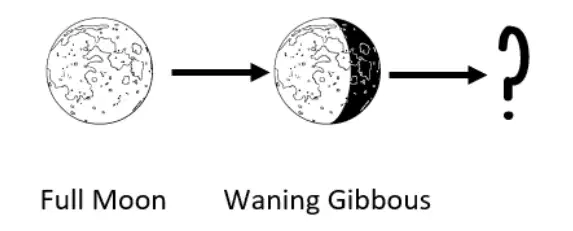
Analyze the illustration of changes in the appearance of the moon during the lunar cycle. During the lunar cycle the moon’s appearance changes in a predictable way. Based on what you know about this sequence, what phase of the moon will come next?
Waxing Crescent
Waxing Gibbous
Third Quarter
New Moon
What change in the night sky occurs about every 28 - 30 days?
An eclipse of the moon
An eclipse of the sun
The phases of the moon
The orbit of the Earth

The table shows the portion of the visible moon illuminated on several different dates for 2012. Which of the following is the most reasonable prediction for the portion of the visible moon that will be illuminated on July 16th?
23%
14%
8%
0%
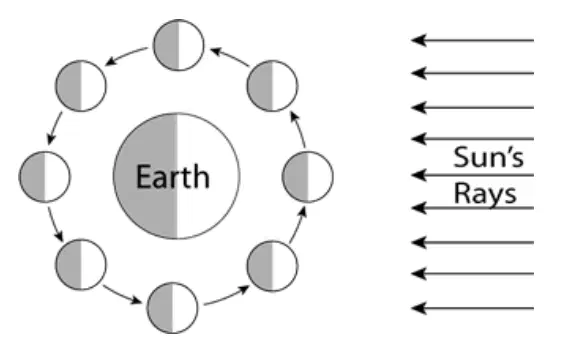
The picture shows a model of the moon, Earth, and sunlight. What does this model help explain?
Length of day
Length of year
Changing seasons
Changing moon phases
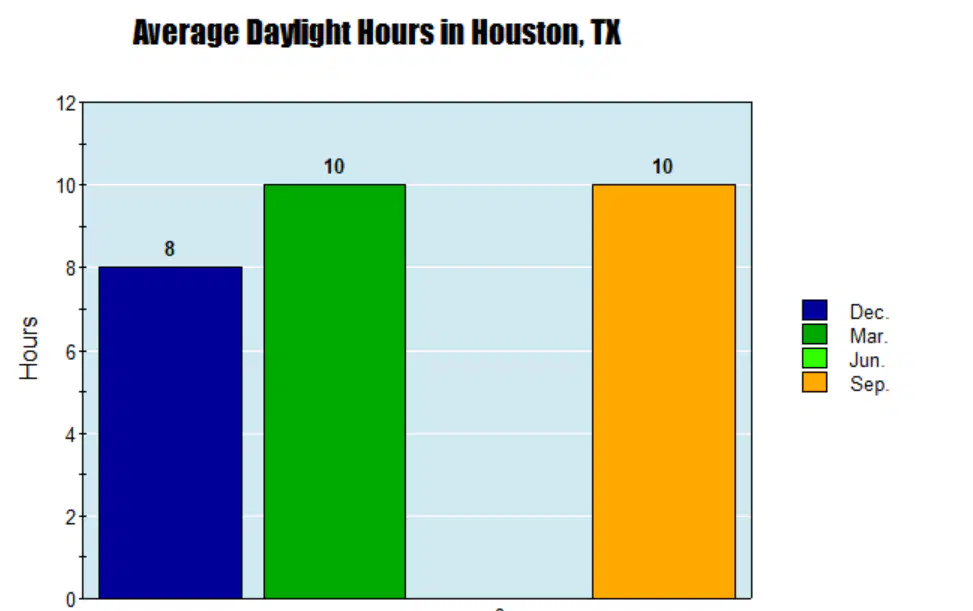
The bar graph below shows the average number of daylight hours in Houston, Texas. The data for June is not included in the bar graph. Analyze the data carefully. What is the most likely average number of daylight hours during June?
8 hours
12 hours
6 hours
4 hours
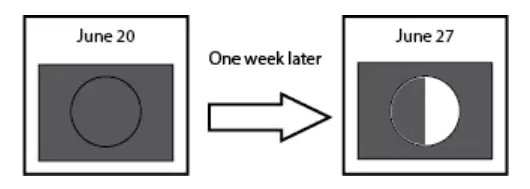
Students recorded the appearance of the Moon one day and then again a week later. What is the most reasonable prediction for the appearance of the Moon one week after that, on July 4?

Moon Image A

Moon Image B

Moon Image C

Moon Image D
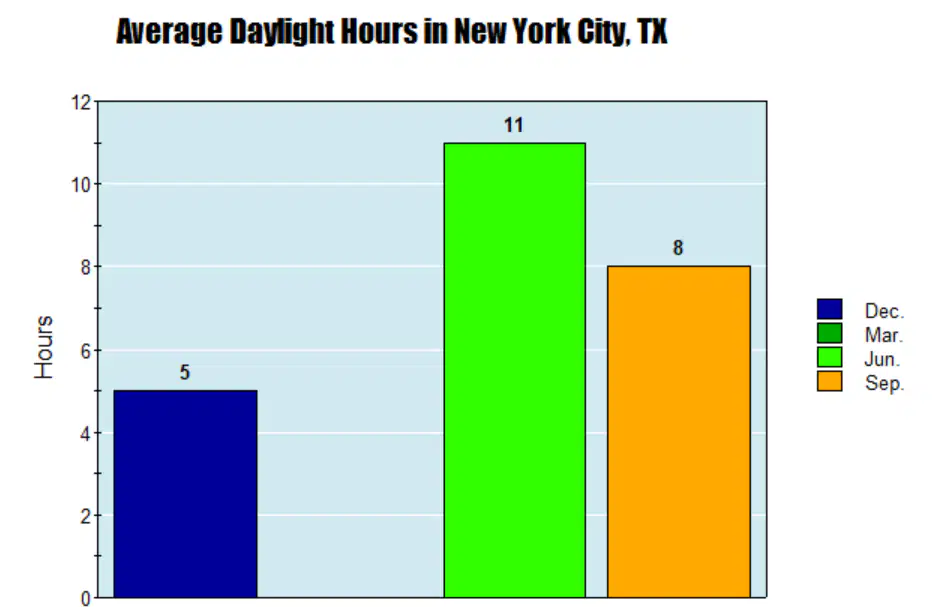
The bar graph below shows the average number of daylight hours in New York City, New York. The data for March is not included in the bar graph. Analyze the data carefully. What is the most likely average number of daylight hours during March?
6 hours
2 hours
10 hours
8 hours
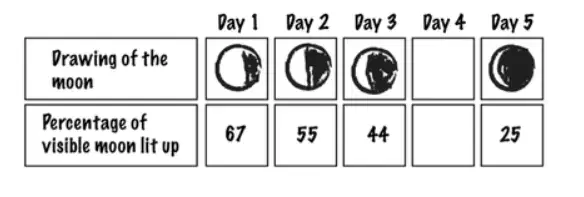
A student was documenting the moon and the percentage of illuminate light on the moon's surface for a week. What is the most reasonable prediction for the student's missing data for Day 4? Select TWO characteristics of the moon below.
Waxing moon
Crescent moon
White light is on the right side of the moon
White light is on the left side of the moon
Gibbous Moon
If Willow sees a Full Moon on April 7th, when will she most likely see the next New Moon?
April 14th
April 21st
April 28th
March 5th
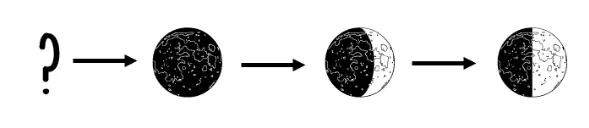
The moon's appearance in the night sky seems to change during the monthly lunar cycle. The illustration below shows part of the lunar cycle. Which phase of the moon would have appeared before the sequence of moon phases above?
Waxing Crescent
Waxing Gibbous
Waning Crescent
Waning Gibbous
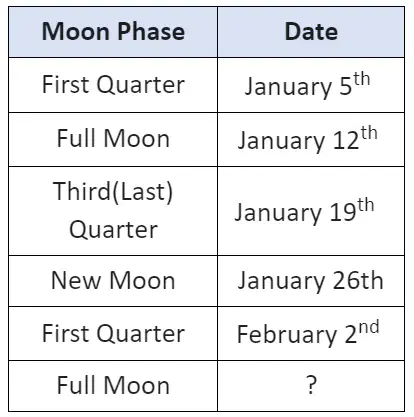
Astronomers use predictable patterns in change to construct moon phases calendars. Below is a portion of moon phase calendar. Based on the pattern in the table, what is a reasonable prediction for the date of the next Full Moon?
January 30th
February 7th
February 15th
February 9th

Ignacio documented the moon phases for a month in his science journal. He is missing two moon phases in the lunar cycle. Which moon phases would complete Ignacio's journal entry?
First Quarter and Waning Crescent
Waxing Gibbous and Last Quarter
First Quarter and Last Quarter
Full Moon and New Moon

The image below shows the four major phases of the moon. As the moon revolves around the Earth, the moon's illuminated surface looks different to us on Earth. Which answer has the correct order as shown by the image?
New Moon, First Quarter, Full Moon, Last (Third) Quarter
Waxing Crescent, Waxing Gibbous, Waning Gibbous, Waning Crescent
Last Quarter, New Moon, First Quarter, Full Moon
First Quarter, Waxing Gibbous, Full Moon, Waxing Gibbous
A ___ star has a greater temperature than a ___ star.
blue, red
red, blue
red, yellow
yellow, blue

In the image (not to scale), which phase of the moon would you observe from the earth?
crescent
full
half
new

The tilt of the Earth's axis of rotation is responsible for the
ocean's tides
size of the moon
brightness of stars
Earth's seasons
The stars in the night sky look as if they are slowly moving because
the earth is moving
they rotate around the sun
they rotate around the earth
the sun blocks them out at times
What causes the phases of the moon as observed from the Earth?
Filtering of the light from the moon due to the Earth's atmosphere.
The tidal forces of the Earth's oceans change the appearance of the moon.
Change in distance of the moon from the Earth as it orbits in an elliptical orbit.
The angle of light from the sun as it reflects off the moon and viewed from the Earth's surface.
Stars are grouped together according to patterns known as ___________________.
galaxies
orbitals
solar systems
constellations
You know that the sun rises in the east every morning and sets in the west every evening. What is it that causes this to happen?
the rotation of the sun on its axis
the rotation of the earth on its axis
the rotation of the earth around the sun
the rotation of the sun around the earth
The ______________ is an artificial satellite found low in Earth's orbit. It is the space home to scientists conducting research on microgravity, biology, physics, astronomy, and meteorology. It is also used for the testing of spacecraft systems and equipment required for missions to the Moon and Mars. This artificial satellite is called the
lunar lander
Galileo probe
Hubble telescope
International Space Station
Why are constellations in predictable locations in the night sky, but planets are so hard to find?
The stars are so far away we cannot tell how they move.
The stars do not move but the planets move around Earth.
The planets move around the sun much faster than the stars.
Both Earth and the other planets are moving in orbits; the stars are not.
The Earth belongs to the group of rocky planets that orbits between the sun and the asteroid belt. Place these planets in order, starting closest to the sun.
Mercury-Earth-Venus-Mars
Mercury-Venus-Earth-Mars
Mercury-Venus-Earth-Saturn
Venus-Mars-Earth-Jupiter

Day and night are the result of the earth's rotation on its own axis and its location from the sun. As the earth spins on its axis, parts of the planet are in the sun while others are in the dark. In other words, the sun appears to rise and set. The parts of the world that are in daylight get warmer while the parts that are dark gradually lose the heat they absorbed during the day. What causes day and night on Earth?
The Earth orbits the Sun.
The Sun goes around the Earth.
The moon rises causing night time.
The Earth rotates or spins on its axis every 24 hours.
Miguel enjoys observing the night sky. Which tool would Miguel use to observe distant objects in the night sky?


Omitting Pluto, what is the last planet in the sequence of planets in our solar system?
Jupiter
Neptune
Uranus
Saturn

Review the data in the bar graph. Which planet has the fastest rotation speed?
Earth
Jupiter
Saturn
Uranus

Earth orbits the Sun every 365 days, causing seasonal patterns that vary by location. In the summer, the Northern Hemisphere is tilted toward the Sun, receiving the greatest amount of solar energy than any other time of the year. What can be expected in the Northern Hemisphere during this season?
warmer temperatures and decreased daylight
cooler temperatures and increased daylight
warmer temperatures and increased daylight
cooler temperatures and decreased daylight

Use the diagram to decide if the statement is true or false.
After a New Moon, the lighted side of the moon appears to grow bigger. This is called waning.
True
False
Use the diagram to decide if the statement is true or false.
Sometimes you can see the moon during the day.
True
False
Use the diagram to decide if the statement is true or false.
After the Full Moon, the lighted side of the moon appears to grow smaller. This is called waxing.
True
False
Use the diagram to decide if the statement is true or false.
The Full Moon appears about two weeks after the New Moon.
True
False
Use the diagram to decide if the statement is true or false.
The moon revolves around the Earth.
True
False
A ___ star has a greater temperature than a ___ star.
blue, red
red, blue
red, yellow
yellow, blue
In the image (not to scale), which phase of the moon would you observe from the earth?
crescent
full
half
new
The tilt of the Earth's axis of rotation is responsible for the
ocean's tides
size of the moon
brightness of stars
Earth's seasons
The stars in the night sky look as if they are slowly moving because
the earth is moving
they rotate around the sun
they rotate around the earth
the sun blocks them out at times
What causes the phases of the moon as observed from the Earth?
Filtering of the light from the moon due to the Earth's atmosphere.
The tidal forces of the Earth's oceans change the appearance of the moon.
Change in distance of the moon from the Earth as it orbits in an elliptical orbit.
The angle of light from the sun as it reflects off the moon and viewed from the Earth's surface.
Stars are grouped together according to patterns known as ___________________.
galaxies
orbitals
solar systems
constellations
You know that the sun rises in the east every morning and sets in the west every evening. What is it that causes this to happen?
the rotation of the sun on its axis
the rotation of the earth on its axis
the rotation of the earth around the sun
the rotation of the sun around the earth
The ______________ is an artificial satellite found low in Earth's orbit. It is the space home to scientists conducting research on microgravity, biology, physics, astronomy, and meteorology. It is also used for the testing of spacecraft systems and equipment required for missions to the Moon and Mars. This artificial satellite is called the
lunar lander
Galileo probe
Hubble telescope
International Space Station
Why are constellations in predictable locations in the night sky, but planets are so hard to find?
The stars are so far away we cannot tell how they move.
The stars do not move but the planets move around Earth.
The planets move around the sun much faster than the stars.
Both Earth and the other planets are moving in orbits; the stars are not.
The Earth belongs to the group of rocky planets that orbits between the sun and the asteroid belt. Place these planets in order, starting closest to the sun.
Mercury-Earth-Venus-Mars
Mercury-Venus-Earth-Mars
Mercury-Venus-Earth-Saturn
Venus-Mars-Earth-Jupiter
Day and night are the result of the earth's rotation on its own axis and its location from the sun. As the earth spins on its axis, parts of the planet are in the sun while others are in the dark. In other words, the sun appears to rise and set. The parts of the world that are in daylight get warmer while the parts that are dark gradually lose the heat they absorbed during the day. What causes day and night on Earth?
The Earth orbits the Sun.
The Sun goes around the Earth.
The moon rises causing night time.
The Earth rotates or spins on its axis every 24 hours.
Miguel enjoys observing the night sky. Which tool would Miguel use to observe distant objects in the night sky?
Omitting Pluto, what is the last planet in the sequence of planets in our solar system?
Jupiter
Neptune
Uranus
Saturn
Review the data in the bar graph. Which planet has the fastest rotation speed?
Earth
Jupiter
Saturn
Uranus
Earth orbits the Sun every 365 days, causing seasonal patterns that vary by location. In the summer, the Northern Hemisphere is tilted toward the Sun, receiving the greatest amount of solar energy than any other time of the year. What can be expected in the Northern Hemisphere during this season?
warmer temperatures and decreased daylight
cooler temperatures and increased daylight
warmer temperatures and increased daylight
cooler temperatures and decreased daylight
Use the diagram to decide if the statement is true or false.
After a New Moon, the lighted side of the moon appears to grow bigger. This is called waning.
True
False
Use the diagram to decide if the statement is true or false.
Sometimes you can see the moon during the day.
True
False
Use the diagram to decide if the statement is true or false.
After the Full Moon, the lighted side of the moon appears to grow smaller. This is called waxing.
True
False
Use the diagram to decide if the statement is true or false.
The Full Moon appears about two weeks after the New Moon.
True
False
Use the diagram to decide if the statement is true or false.
The moon revolves around the Earth.
True
False

