
 Worksheets
Weather, Maps & Events Test REVIEW
Total questions: 25
Worksheet time: 13mins
Name
Class
Date
1.
What weather is associated with a warm front?
a)
slow, steady rain followed by hot and humid weather
b)
violent storms and heavy rain followed by cold and fair weather
c)
many days of rain
d)
strong winds & heavy rain thunderstorms
2.
How are stationary fronts different than other fronts?
4 lines
3.
What air mass is pushed ABOVE the other? (HINT - think about density)
a)
warm
b)
cold
c)
neither is pushed above the other
4.
What weather is associated with a cold front?
a)
slow, steady rain followed by hot and humid weather
b)
violent storms and heavy rain followed by cold and fair weather
c)
many days of rain
d)
strong winds & heavy rain thunderstorms
5.
Which of the following diagrams shows a cold front?
a)
Option 1
b)
Option 2
c)
Option 3
d)
Option 4
6.
What weather is associated with a stationary front?
a)
slow, steady rain followed by hot and humid weather
b)
violent storms and heavy rain followed by cold and fair weather
c)
many days of rain
d)
strong winds & heavy rain thunderstorms
7.

What type of weather is most likely to occur based on the weather map below.
a)
dry weather that lasts for a short time
b)
bad weather that lasts for a short time
c)
nothing happens
d)
light drizzles and windy conditions that last for a long time
8.

How are the weather conditions in Billings and Minneapolis different?
4 lines
9.
Which weather map shows the weather conditions in the place where the air masses meet and do not move?
a)
Option 1
b)
Option 2
c)
Option 3
d)
Option 4
10.

Which of the following cities WILL experience warm temperatures, clouds and showers in the next day or two?
a)
El Paso (1)
b)
Memphis (2)
c)
Chicago (6)
d)
Los Angeles (3)
11.

Which city is CURRENTLY experiencing low temperatures and PREVIOUSLY experienced rain?
a)
Los Angeles (3)
b)
Memphis (2)
c)
Chicago (6)
d)
El Paso (1)
12.
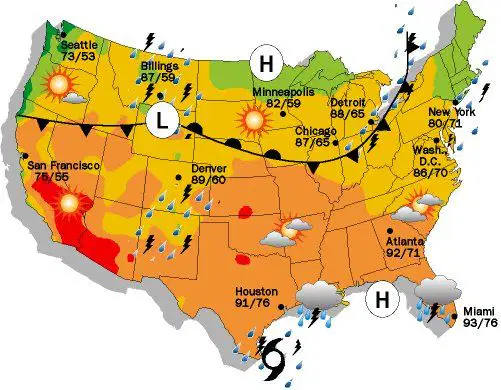
Which prediction about New York is most accurate?
a)
New York will experience rain for a few days before temperatures drop (decrease)
b)
New York will experience warm temperatures and sunny skies
c)
New York will experience severe thunderstorms and heavy rain due to a hurricane coming
d)
New York will experience clear skies and sunny weather.
13.
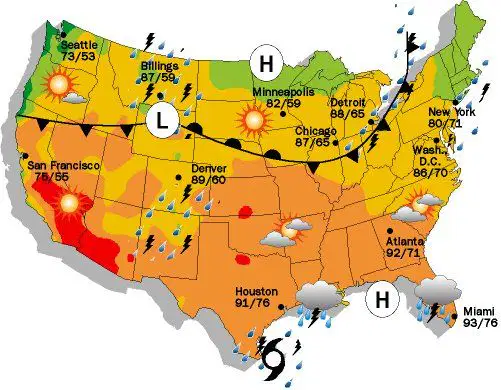
Which prediction about Houston is most accurate?
a)
Houston will experience rain for a few days before temperatures drop (decrease)
b)
Houston will experience warm temperatures and sunny skies
c)
Houston will experience severe thunderstorms and heavy rain due to a hurricane coming
d)
Houston will experience clear skies and sunny weather.
14.

Which prediction about Dallas is most accurate?
a)
Dallas will experience rain for a few days before a drop in temperature
b)
Dallas will experience an increase in temperatures and humidity after light showers
c)
Dallas will experience severe thunderstorms and heavy rain
d)
Dallas will not experience any significant weather over the next few days
15.

Which city has an occluded front headed towards it?
a)
Albuquerque
b)
Washington D.C.
c)
Miami
d)
Seattle
16.
What is the eye of the storm?
a)
circular center that is the calmest
b)
where a storm can see
c)
there is not an eye in a storm
d)
the eye is where the most violent part of the storm is
17.
An earthquake can cause a tsunami
a)
True
b)
False
18.
funnel-shaped cloud of spinning, rising air that touches the ground
a)
thunderstorm
b)
tornado
c)
hurricane
d)
flood
19.
Thunderstorms can form tornadoes & hurricanes.
a)
True
b)
False
20.

Four locations are labeled (I, II, III, IV). At which of the four locations is the hurricane predicted to be the LEAST intense?
a)
I
b)
II
c)
III
d)
IV
21.
A storm that gets its energy from warm, humid air at the surface of the ocean is called a
a)
blizzard
b)
hurricane
c)
thunderstorm
d)
tornado
22.
Which weather event has the lowest wind speed?
a)
thunderstorm
b)
tornado
c)
hurricane
23.
A giant swirling air mass that can have speeds of 74mph or greater. This event loses energy as it reaches land and cool water.
a)
tornado
b)
hurricane
c)
tsunami
d)
thunderstorm
24.
A violently rotating column of air in contact with the ground. This event has a narrow path of destruction.
a)
thunderstorm
b)
hurricane
c)
tornado
d)
drought
25.
Choose a catastrophic event that we've learned about. What is one interesting fact about that event? (Hint - "Droughts are..."
4 lines
100 %

