
 Worksheets
Genetic Engineering Quiz
Total questions: 22
Worksheet time: 11mins
Modifying the arrangement of DNA bases is known as
DNA replication
genetic mapping
genetic engineering
gene therapy
Put the following steps of genetic engineering in order
Extract specific gene sequence from cells
Identify the sequences of bases in a DNA molecule
Insert gene sequence in vector
Make unlimited copies of DNA
Which enzyme is responsible for recognizing specific DNA sequences and cleaving the DNA at those sites?
Restriction enzyme
DNA Ligase
DNA Polymerase
Sucrase
Gel electrophoresis is a process used to
separate out fragments of DNA by size
separate out fragments of DNA by positive and negative charge
keep recombinant plasmids together
recombine DNA from different species

Explain how DNA fragments are separated by size during gel electrophoresis.
Smaller fragments move faster and travel further
Larger fragments move faster and travel further
_____ is a common laboratory technique used to make many copies of a particular gene.
Polymerase Chain Reaction (PCR)
Gel Electrophoresis
DNA Sequencing
Sanger Method

The following DNA fingerprint was produced after DNA was found in blood at a crime scene. Which suspect was most likely the criminal?
Bob
Sue
John
Lisa

The diagram shows DNA fingerprints from a daughter horse, the mother horse, and four possible fathers. Which horse is most likely the father?
1
2
3
4
Selective breeding involves the selection by humans of specific _______________.
traits
behaviors
features
characters
All of the following are examples of transgenic organisms except
prokaryotes used to grow human insulin
a mule
plants that are genetically modified to be more nutritious
glow in the dark lab rats
Genetic engineering has been applied to enhance certain crop varieties by
eliminating genes that make them susceptible to pests
introducing genes that confer resistance to diseases
incorporating genes that accelerate their growth
all of the above

According to the image what has been created as a result of placing the gene into the plasmid?
a polymorph
Cloned DNA
Hybrid
Recombinant DNA
One of the most common types of recombinant DNA can be found in ______, which are used by pharmaceuticals to produce ______ for use by individuals with diabetes.
prokaryotes, humulin
prokaryotes, penicillin
eukaryotes, humulin
eukaryotes, glucagon
A clone is a member of a population of genetically ______ cells produced from ______.
different, many parent cells
identical, a single parent cell
similar, 2 parent cells
identical, 2 parent cells
What is the term for DNA that is formed by combining DNA from different organisms?
mutations
transgenic DNA
cloned DNA
recombinant DNA
Genetic engineering can be used to __________. (click all that apply).
create transgenic organisms
increase the vitamin content in certain foods
produce medicines (e.g. Humulin)
cure all known viral infections
What is the main application of DNA fingerprinting in forensic science?
To match crime scene evidence with suspects.
To determine the ancestry of an individual.
To clone organisms.
To sequence the human genome.
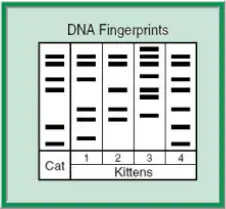
The picture shows a segment of DNA from a cat and 4 possible offspring from that cat. Which of these is most likely the kitten from that cat’s litter?
Kitten #1
Kitten #2
Kitten #3
Kitten #4
Which of the following is a hybrid animal obtained through genetic engineering?
Lion
Elephant
Chicken
Mule
What is the primary purpose of using restriction enzymes in genetic engineering?
To sequence the human genome
To replicate DNA
To cut DNA at specific sequences
To synthesize proteins
Which of the following techniques is used to amplify a specific segment of DNA?
DNA Sequencing
Polymerase Chain Reaction (PCR)
Gel Electrophoresis
Gene Cloning
In genetic engineering, what is the role of a plasmid?
To sequence DNA
To act as a vector for gene transfer
To replicate DNA
To synthesize proteins

