
 Worksheets
Geometry Spring Term Benchmark Review: CoordinateGeo/Trig/Circle
Total questions: 82
Worksheet time: 2hrs 3mins
Which formula can be used to find the distance between 2 points on the coordinate plane?


What is the perimeter of a rectangle with corners at (2,2), (2,-4), (-5,-4), and (-5,2).
13 units
26 units
42 units
10 units
What is the area of a rectangle with corners at (2,2), (2,-4), (-5,-4), and (-5,2).
11 units2
42 units2
13 units2
26 units2

Calculate the length for each side of the triangle.
AB = 3.6, BC = 4.5, AC = 4.1
AB = 4.1, BC = 5.6, AC = 7.5
AB = 4.5, BC = 3.6, AC = 4.1
AB = 4.1, BC = 3.6, AC = 4.5

What is the perimeter of the triangle? (Round to the nearest tenth)
12
about 13.2
21
about 12.6

What is the approximate perimeter of right triangle ABC? (round to the nearest whole number)
17 units
15 units
14 units
16 units

Calculate the length for each side of the rectangle.
AB = 9, BC = 4.5, CD = 9, DA= 4.5
AB = 6, BC = 3.29, CD = 6, DA= 3.29
AB = 6.31, BC = 4.1, CD = 6.31, DA= 4.1
AB = 5.65, BC = 4.24, CD = 5.65, DA= 4.24
Calculate the perimeter of the rectangle.
27 units
18.58 units
14.73 units
19.78 units

What is the perimeter of rectangle ABCD? Round to the nearest whole number if necessary.
18 units
19 units
12 units
25 units
What is the perimeter (in units) of the triangle formed by the points (-3,1), (-3,5), and (4,1)?
65
8.06
14
19.06
What is the area (in units2) of the triangle formed by the points (-3,1), (-3,5), and (4,1)?
16 units2
28 units2
14 units2
32 units2

What is the perimeter of the parallelogram? Round to the nearest hundredth if necessary.
20.95 units
20.94 units
18.33 units
18.32 units


Square ABCD has vertices A(-2,-3), B(4, -1), C(2, 5), and D(-4, 3). What is the area of the square?
210
410
40
20

Find the area of rectangle ABCD. (Hint: You'll need to use the distance formula to find the side lengths).
4.47
11.18
30.0
22.36

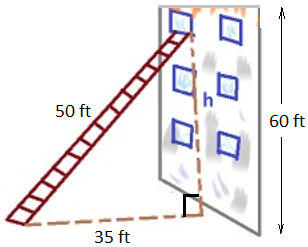
Find the missing side.
18
16
17
19

A soccer field is a rectangle 100 meters wide and 130 meters long. The coach asks players to run from one corner to the other corner diagonally across. What is the distance? Round your answer to the nearest whole number.
30 meters
83 meters
164 meters
260 meters


A kite is flying 84 ft off the ground, and it string is pulled taut. The angle of elevation of the kite is 65° . Find the length of the string. Round your answer to the nearest tenth.
198.8 ft
92.7 ft
39.2 ft
76.1 ft


If a tree casts a 8-meter shadow, and the angle from the ground to the tree is 30 degrees, what is the height of the tree?
2.3
6.9
10.3
4.6


Jake is 6 ft. tall. He is standing outside when the angle of elevation of the sun is 28 degrees. How long would his shadow be?
5.3 feet
2.8 feet
3.2 feet
11.3 feet
The vertices of triangle GHI are G(1, 2), H(3, 4), and I(4, 2). The triangle will be reflected across the x-axis. What will be the coordinates of the image point H′?
(-3, 4)
(3, -4)
(-3, -4)
(3, 4)


Figure EFGH in the coordinate plane has vertices at (-5,2), (-5,-2), (-1,-2), and (-1,2). If the figure is translated 7 units to the right and 3 units down, what are the coordinates of the E'F'G'H'?
Plot the 4 new points.

(x, y) ----> (x + 2, y - 3)


Use the given translation rule to find the image of the point (4,2)
(a)
Use the given translation rule to find the
pre-image of the point (7,-5)
(a)


Pick a rule to describe the rotation
90 degrees clockwise around the origin
90 degrees counter clockwise around the origin
180 degrees around the origin

Pick a rule to describe the rotation
90 degrees clockwise around the origin
90 degrees counter clockwise around the origin
180 degrees around the origin


Rotation Rules (clockwise):
90o rotation: (x, y)→(y, -x)
What are the coordinates for A' after a 90⁰ rotation clockwise?
(1, 3)
(3, 1)
(3, -1)
(1, -3)

Give the coordinate of the point A after of rotation of 900 counterclockwise (anticlockwise) about the point (1, 3)
(1, 4)
(2, 1)
(2, 7)
(2, 3)

Give the coordinate of point C after a rotation of 1800 about the point (-1, 1)
(-5, 0)
(-2, 5)
(0, -3)
(0, 3)
Rotate triangle ALT 180° clockwise about the origin, then reflect over the line x=1.
L''(3, -2)
T''(3, 2)
L''(-1, 2)
T''(-1,-2)

Plot A(4,1) B(5,4) C(1,2). Reflect it over the x-axis, then translate it 3 units left. What are the coordinates of A'B'C'?
A' (-1, -1) B' (-2, -4) C' (2, -2)
A' (4, -4) B' (5, -7) C' (1, -5)
A' (-7, 1) B' (-8, 4) C' (-4, 2)
A' (1, -1) B' (2, -4) C' (-2, -2)
Write the equation of a circle with center (7, 0) with radius 3.
(x - 7)2 + y2 = 9
x2 + (y -7)2 = 9
(x - 7)2 + y2 = 3
x2 + (y -7)2 = 3
What are the coordinates of the center and the radius of the circle with equation:
(x - 4)2 + (y - 3)2 = 25 ?
Center (4,3)
Radius = 5 units
Center (4,3)
Radius = 25 units
Center (-4,-3)
Radius = 25 units
Center (-4,-3)
Radius = 5 units
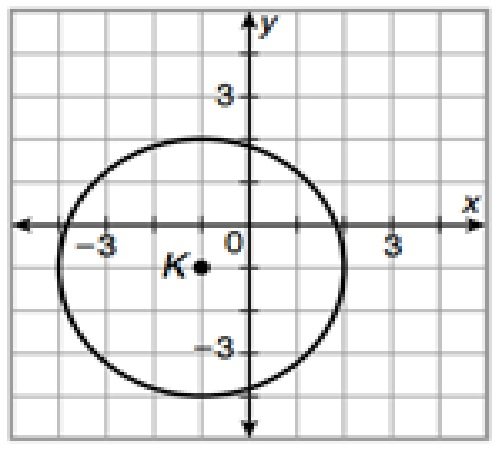
What is the equation of the circle?
(x+1)2 + (y +1)2 = 3
(x+1)2 + (y -1)2 = 3
(x+1)2 + (y +1)2 = 9
(x-1)2 + (y -1)2 = 9
A circle has a center of (-1, 3) and passes through the point (-5, 6). Write the equation of the circle.
(x + 1)2 + (y - 3)2 = 5
(x - 1)2 + (y + 3)2 = 25
(x + 1)2 + (y - 3)2 = 25
(x - 1)2 + (y + 3)2 = 5

Convert the equation of the circle from standard to general.
A
B
C
D

Identify the center and the radius of the circle in general form.
A
B
C
D
Graph the circle given by the equation (x−6)2+(y−1)2=9 and identify its center and radius.
Center: (6, 1), Radius: 3
Center: (0, 0), Radius: 9
Center: (6, 1), Radius: 9
Center: (1, 6), Radius: 3
Graph the circle given by the equation (x−2)2+(y+3)2=36 and identify its center and radius.
Center: (2, -3), Radius: 6
Center: (-2, 3), Radius: 6
Center: (2, 3), Radius: 36
Center: (-2, -3), Radius: 36

Write the equation of the circle with center C( 4 , -8 ) and radius = 5
( x - 4 )2 + ( y + 8 )2 = 25
( x + 4 )2 + ( y - 8 )2 = 25
( x - 4 )2 + ( y - 8 )2 = 25
( x + 4 )2 + ( y - 8 )2 = 10


Which equation matches the circle on the graph?
(x-3)2+(y-4)2=16
(x-5)2+(y-2)2=20
(x+3)2+(y+4)2=16
(x-9)2+(y-16)2=32
The point (3,3) is on a circle whose center is at (-1,3). Write the standard form of the equation of the circle.
(x-3)2+(y-3)2=4
(x-3)2+(y-3)2=16
(x+1)2+(y-3)2=9
(x+1)2+(y-3)2=16

Use the information provided to write the standard form equation of the circle.
A
B
C
D

Use the information provided to write the standard form equation of the circle.
A
B
C
D
What is the equation for the circle, if it has diameter endpoints at (3,-4) and (-5,-4)?
(x+1)² + (y-4)² = 4
(x+1)² + (y+4)² = 16
(x-1)² + (y-4)² = 16
(x+1)² + (y+4)² = 4

If the endpoints of a diameter of a circle are (6, 2) and (0, 2), what is the equation of the circle?
(x−3)2+(y−2)2=9
(x+3)2+(y+2)2=3
(x−6)2+(y+4)2=9
(x−6)2+(y+4)2=3
Which is the equation of a circle given endpoints of the diameter are (0,5) (2,3)
(x - 1)2 + (y - 4)2 = 2
(x - 1)2 + (y - 4)2 = 4
(x + 1)2 + (y + 4)2 = 1
(x + 1)2 + (y - 4)2 = 4
x² + y² + 4x + 6y - 36 = 0
x2 + y2 - 10x + 8y -8 = 0
Use the given general form to write the equation of the circle.
x2+y2+10x−26y+169=0
(x+5)2+(y−13)2=625
(x+5)2+(y−13)2=25
(x+5)2+(y−13)2=9
(x+13)2+(y−5)2=25
Use the given general form to write the equation of the circle.
x2+y2−12x−18y+81=0
(x+7)2+(y+11)2=1296
(x−8)2+(y+5)2=36
(x−6)2+(y−9)2=36
(x−4)2+(y+8)2=36

