
 Worksheets
6.1 Food Webs and 6.2 Population Dynamics
Total questions: 25
Worksheet time: 25mins

Where does the energy start in this food chain?
Hawk
Snake
Sun
Fungi

What is the role of an autotroph?
Gain energy from eating other organisms
Breaking down dead stuff
To produce its own food
Keep other species from overpopulating
An organism that needs to eat other organisms to obtain energy is known as a:
Autotroph
Producer
Mutualist
Heterotroph

The arrows in a food chain or web represents what?
They point to the organism that is being eaten.
They show what direction the energy is flowing between organisms.
It shows how sunlight flows within an ecosystem.
They represent how water is transferred within a habitat.

Which of the following options has the trophic levels placed in the correct order from most energy to least energy?
Producer-> Primary Consumer-> Secondary Consumer -> Tertiary Consumer -> Quaternary Consumer
Primary Consumer-> Producer -> Secondary Consumer -> Quaternary Consumer -> Tertiary Consumer
Tertiary Consumer -> Producer -> Secondary Consumer -> Primary Consumer-> Quaternary Consumer
Quaternary Consumer-> Tertiary Consumer-> Secondary Consumer -> Primary Consumer-> Producer

What type of consumer is the small bird, starting from the grass?
secondary consumer
primary consumer
tertiary consumer
producer
quaternary consumer

350,000 calories of energy are found in the plant in this forest.
How many kcalories would be available on the tertiary level?
350,000 kcal
35,000 kcal
3,500 kcal
350 kcal
35 kcal
How much energy is available to be passed on to the next trophic level in an ecosystem?
700%
20%
5%
10%
How is energy lost as it moves through a food web?
Energy is lost through photosynthesis at each level.
Energy is lost as heat when organisms move, grow, and digest food.
Energy is lost as chemical energy stored in plants and animals.
Energy is lost only when animals decompose.

In the energy pyramid here, which organisms have the most energy available?
Top Predator
Herbivores
Carnivores
Producers

A food pyramid represent the relative amount of energy in trophic levels. Which of the following correctly shows a food pyramid?
A
B
C
D

The owl receives energy from which organisms?
grasshopper and mouse
rabbit and butterfly
mouse and rabbit
butterfly and frog

What would happen to the blue whale population if the krill population went extinct?
the blue whale population eats other things in the food web
the blue whale population would increase
The blue whale population would remain the same.
the blue whale population would also decrease

A group of individuals that belong to the same species that live in the same area at the same time.
age structure
population
density

The number of individuals per unit area.
density
dispersion
age structure
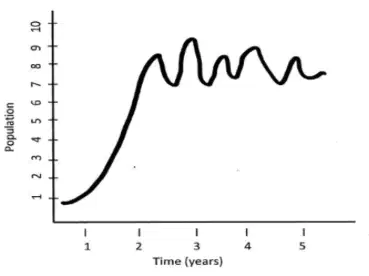
The most common predator of the Northern Pike fish is humans, who enjoy the sport of catching this fast swimmer along with consuming their catch. These fish seek areas of dense vegetation or shallow water that is covered and stays cool. A certain lake with a large pike population becomes isolated due to development that eliminates the road leading to the lake.
After several years, what explains the population changes seen in the graph?
The birth rate of the pike has increased while the death rate has been constant.
The number of pike are changing since a new predator has moved to the lake.
The pike population has reached the carrying capacity of the lake
The pike have consumed all of the small fish in the lake that they feed on.
American crocodiles have been hunted by humans since their skin has been popular for belts, bags, and shoes. During the 1950’s and 1960’s, excessive hunting placed the crocodile in the endangered category.
What is the best explanation for why crocodile hunting caused such a threat for this species?
The death rate from hunting was greater than the birth rate of the crocodiles.
The death rate from hunting was greater than the natural death of the crocodiles.
The hunting of the crocodiles removed animals of all ages, especially young crocodiles.
Human hunters replaced the crocodile’s natural predators in most of its ecosystems.
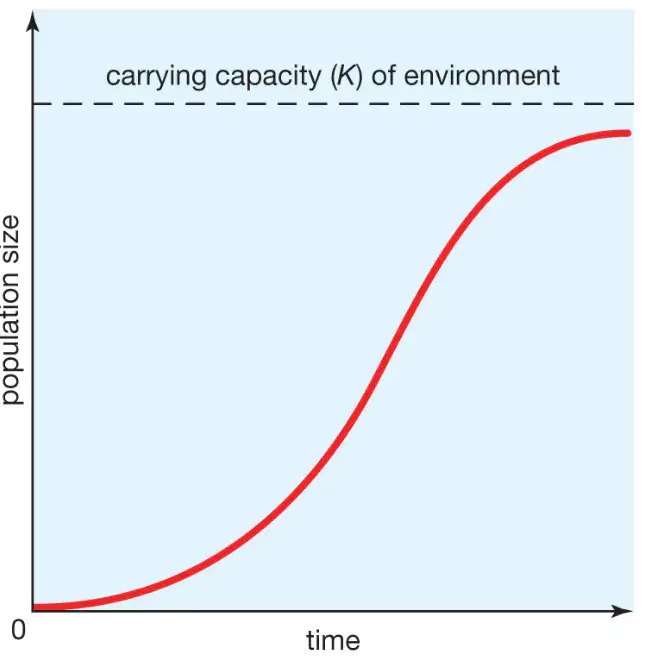
Which of the following statements best explains the pattern of growth shown in the graph?
The population grows exponentially because there are no limiting factors.
The population grows exponentially and then slows down due to an increase in food resources.
The population reaches carrying capacity because resources such as food, water, and space become limited.
The population grows exponentially until it reaches zero, as there are no birth rates at the carrying capacity.
Limiting factors can result from natural events or changes in human activity. Which of the following situations is an example of a density-dependent limiting factor?
Hurricane Katrina forced the relocation of thousands of people from New Orleans.
Increasing greenhouse gases changes the Arctic zone and the polar bear population.
Populations of deer and rabbit in the Appalachian Forest eat the same plants.
The BP oil spill in the Gulf of Mexico harmed many of its aquatic organisms.
Which of the following is an example of the type of distribution of organisms in their habitat?
Clumped
Uniform
Random
All of the above
Aquatic ecosystems are influenced by the following:
(Check all the apply)
Temperature
Salinity
Light
Air pressure
Presence of aquatic plants and animals
Marine life in the deepest part of the ocean shows unusual physical features and habits. Some are the result of isolated ecosystems while others are necessary for survival at that depth. For example, the hagfish, or slime eel, produces slime to ward off predators and consumes decaying carcasses using tooth-like structures to burrow into the remains.
Which list best characterizes these depths that have led to features and habits needed for survival?
cold temperatures, high pressures, and darkness
cold temperatures, low pressures, and darkness
warm temperatures, high pressures, and low light
warm temperatures, low pressures, and low light
Different populations in a lake located 120 miles downwind of a coal fired power plant are being studied by biologists, who find that both the fish and amphibians’ numbers are decreasing. The team of biologists sample a number of the lake’s characteristics and find that its pH is 2.8.
What conclusions could be made based on this finding?
A pollution source close to the lake contributed to acid rain that fell on the lake.
The lake water has become acidic due to emissions from the distant power plant.
Power plant pollutants could be making the lake basic and affecting lake life.
The pH of the lake water is normal, so the population changes have a different cause.
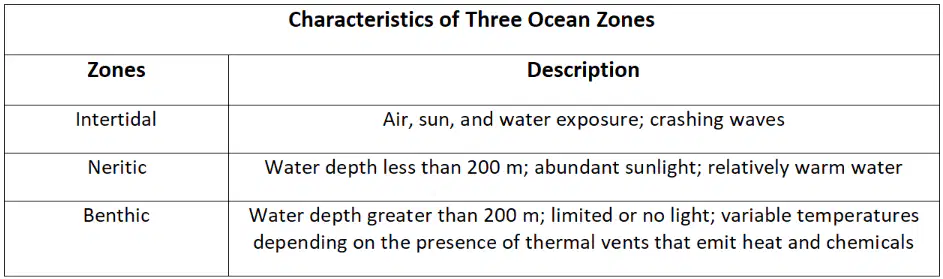
A marine biology student made some observations of ocean life based on his research into various ocean zones. He summarized the information in the table below.
What conclusion can be made based on this information?
Benthic organisms can accommodate occasional air exposure.
Intertidal organisms must be able to tolerate cold water.
The benthic zone cannot support photosynthetic producers.
Warm water and ample sunlight limit the neritic zone algae population.
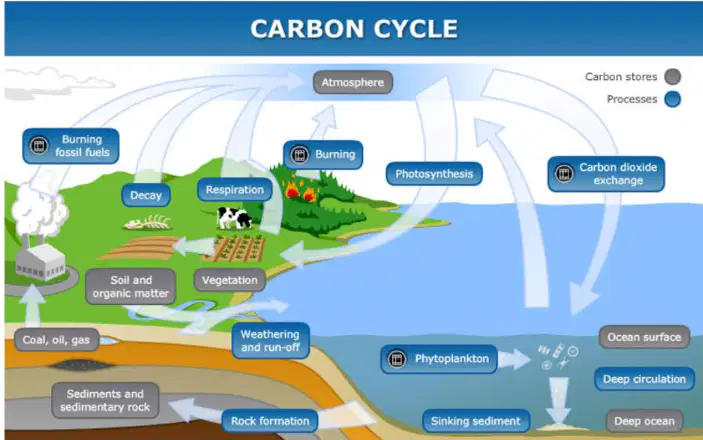
The carbon cycle involves a variety of processes that move and convert carbon between Earth systems. The diagram summarizes the main processes of the carbon cycle.
Which pair of events could best be represented by the same direction arrow in the carbon cycle diagram?
Termites consume a tree trunk, and a tree trunk burns in a forest fire.
A plant performs photosynthesis, and an animal performs cellular respiration.
A plant performs photosynthesis, and carbon dioxides dissolves and acidifies in ocean water.
Humans burn trees to release energy in the trees, and humans burn fossil fuels to release energy in the fuels.

