
 Worksheets
On Ramps Unit 5 Precalc Review
Total questions: 68
Worksheet time: 3hrs 16mins

Simplify the rational function
1/(x + 5)
1/(x - 5)
(x - 5)(x + 5)
(x - 5)/[(x - 5)(x + 5)]


Find the horizontal asymptote:
y = 0
y = 1
None
y = 3/2

How do you find the y-intercept?
replace all x-values with 0
replace all y-values with 0
set denominator equal to 0
compare the degrees of the numerator and denominator
How do you find the x-intercept?
replace all x-values with 0
replace the y-value with 0 or make the numerator equal 0
set denominator equal to 0
compare the degrees of the numerator and denominator
How do you determine the Horizontal Asymptote?
replace all x-values with 0
replace the y-value with 0 or make the numerator equal 0
set denominator equal to 0
compare the degrees of the numerator and denominator
How do you know if a factor in the denominator is a hole instead of a V.A. ?
It cancels out
it equals 0
you set the numerator equal to 0
you compare the degrees
When finding the H.A., if the numerator degree is greater than the denominator degree, the answer is...
y = 0
none
y =a / b
What's an H.A.?
When finding the H.A., if the numerator degree is equal to the denominator degree, the answer is...
y = 0
none
y =a / b
What's an H.A.?
The first thing you should do to find all the attributes for a rational function is...
Factor it all out
Find the V.A.
Find the H.A.
Find the x / y intercepts
The horizontal asymptote equals zero when:
the degree of the numerator and denominator are equal
the degree of the numerator is less than the degree of the denominator
the degree of the numerator is greater than the degree of the denominator
the numerator equals zero


What are the excluded vales of this function?
−3 only
1 only
−3 and 2
−3 and 1
1 and 2
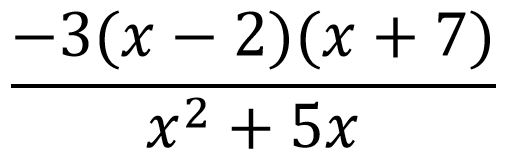

Find the coordinates of the hole.
(-3, -3)
(-3, 3)
(3, -3)
(3, 3)
Which graph is the function:
f(x)=x2−4x2x2+14x


What is the equation of the graph?


What is the equation of the graph?


f(x)=x2−162x−8
What is the reason that this function does not have any x-intercepts?
The function is not factorable.
There is a hole on the x-axis where the x-intercept would go.
Once simplified, there is no variable in the numerator
There is a vertical asymptote at y=0.
The degree of the numerator is less than the denominator.
Choose all of the functions that have a horizontal asymptote at y=1
f(x)=x2−1x2
f(x)=x+5x2+5
f(x)=(x+1)(2x−3)2x(x−4)
f(x)=3x2−33x
What is the y-intercept for f(x)=(x+1)(x−2)(x−3)(x−4) ?
(0,3) and (4,0)
(0,-6)
(0,6)
(0,7)
no y-intercept
Select all the functions that have a slanted asymptote?


(x2 - 2x - 8) / (x - 2)

Identify the Oblique Asymptote for this function.
y = 5x - 7
y = 5x + 13
y = 5x + 3
y = 5x + 7


Find x→2− limf(x)
-1
5
0
DNE
Find x→2+ limf(x)
-1
5
0
DNE
Find x→2 limf(x)
-1
5
0
DNE
Find x→−1− limf(x)
4
0
-1
DNE
Find x→−1+ limf(x)
4
0
-1
DNE
Find x→−1 limf(x)
4
0
-1
DNE
Find x→−4− limf(x)
-2
3
-4
DNE
Find x→−4+ limf(x)
-2
3
-4
DNE
Find x→−4 limf(x)
-2
3
-4
DNE
Find f(−4)
-2
3
-4
undefined
Find f(4)
2
4
-4
undefined
Find x→4 limf(x)
2
0
-4
DNE

What is the limit?
2
-2
1/2
-1/2


Find the derivative of the given equation x3+x2+12
3x2+2x
5x
3x3+2x2
x2+x

At which point(s) will the slope(s) of the tangent line be POSITIVE?
at C only
at points A, C and E only
at point B and D only
at points A and E only
Find the fully simplified Derivative of y = 4x2 + 3x + 6x-2
y' = 8x + 3 -12x-3
y' = 8x + 3 +12/x3
y' = 8x + 3 -12/x3
y' = 8x + 3 + 12/x
At which point(s) will the slopes of the tangent line be zero?
at C only
at points A, C and E only
at point B and D only
at points A and E only
Differentiate f(x)=x52−5
−x45
−x410
x62
−x610
Find the slope of y=3x2−5 at x=2
10
11
12
13
Find the derivative of the function: f(x)=x31
f′(x)=−2x53
f′(x)=−3x52
f′(x)=−x3
f′(x)=−2x3

Between which time intervals does the object speed up/increase velocity?(velocity moves away from 0 m/s point)
0-10 sec and 40-55 sec
15-30 sec and 40-55 sec
0-10 sec and 30-40 sec
15-30 sec and 30-40 sec
Between which time intervals does the object slow down/decrease velocity?(velocity move towards 0 m/s point)
0-10 sec and 40-55 sec
15-30 sec and 40-55 sec
0-10 sec and 30-40 sec
15-30 sec and 30-40 sec

How many times does this object have no acceleration?(no acceleration means velocity doesn't change so acceleration = 0 m/s2)
0
1
2
3
What is the rate of acceleration during the first line segment? (slope between 0 - 10 sec)
0 m/s2
2.7 m/s2
6 m/s2
- 4 m/s2
What is the rate of acceleration during the 2nd line segment? (slope between 10 - 15 sec)
0 m/s2
2.7 m/s2
6 m/s2
- 4 m/s2
What is the rate of acceleration during the 3rd line segment? (slope between 15 - 40 sec)
0 m/s2
2.7 m/s2
6 m/s2
- 4 m/s2

Calculate the average rate of change from 20 to 40 minutes.
-2 minutes per gallon
-20 minutes per gallon
-2 gallons per minute
-20 gallons per minute
Find the absolute extrema for f(x) = 2x3 + 6x2 + 4 over the interval [-4, 0] (using calculus).
Abs max @ (2, 12), Abs min @ (0, 4)
Abs max @ (-4, 48), Abs min @ (0, 4)
Abs max @ (2, 72), Abs min @ (0, 0)
Abs max @ (2, 12), Abs min @ (-4, -28)
What are the intervals of the graph increasing for f(x) = 2x4- 4x2 + 1
(-1,0)
(0,1)
(-∞,-1) ∪ (1,∞)
(-1, 0) ∪ (1, ∞ )
Which one of the following statements is always true?
When a graph is increasing, its derivative is negative.
When a graph is decreasing, so is its derivative.
When a graph is decreasing, its derivative is negative.
When a graph is increasing, so is its derivative.
f(x) is a polynomial function. Which one of the following statements is FALSE?
f(x) has a derivative of zero when the graph of f has a relative min or max.
If the derivative of f(x) changes from positive to negative at some point, then the graph of f has a relative minimum at that point.
If the derivative of f(x) is always positive, then the graph of f has no relative extrema.
If the graph of f is always increasing, then the derivative of f(x) is never negative.
If given f'(x) how would you find the intervals which the graph f(x) has a positive slope( increasing)?
f'(x) < 0 (negative)
f'(x) > 0 (positive)
f'(x) is increasing
Can't be determined

