
 Worksheets
Exploring Ancient India
Total questions: 20
Worksheet time: 11mins
What was one of the main reasons the Indus Valley Civilization is considered advanced for its time?
They had a written language that has been fully deciphered.
They developed a complex urban planning system with grid patterns and advanced drainage.
They were the first to use iron tools.
They had a monarchy system.
Explain how the Maurya Empire contributed to the spread of Buddhism.
By building large temples dedicated to Hindu gods.
By sending missionaries to other parts of Asia and supporting Buddhist councils.
By creating a new form of Buddhism that was more appealing to the masses.
By banning all other religions in the empire.
Compare and contrast the core beliefs of Hinduism and Buddhism.
Both religions believe in a single god and reject the caste system.
Hinduism believes in the caste system, while Buddhism rejects it; both believe in karma and reincarnation.
Buddhism believes in multiple gods, while Hinduism does not; both reject the caste system.
Both religions originated in China and have no concept of karma.
How did the geography of India influence its cultural development?
The deserts isolated India from all other cultures.
The mountains and rivers facilitated trade and cultural exchange with other regions.
The flat plains made it easy for invaders to conquer India.
The dense forests prevented any form of agriculture.
What was a significant cultural achievement of ancient India in the field of mathematics?
The invention of the abacus
The development of the concept of zero
The creation of the first calendar
The discovery of the Pythagorean theorem
Analyze the impact of Emperor Asoka's conversion to Buddhism on his rule.
It led to the expansion of his empire through military conquests.
It resulted in the promotion of peace and the spread of Buddhism throughout Asia.
It caused a civil war within the empire.
It led to the decline of trade with neighboring regions.
Describe the structure of the caste system in ancient India.
A classless society where everyone had equal rights.
A rigid social hierarchy with four main classes and numerous sub-castes.
A system based on wealth and property ownership.
A flexible system where people could easily change their caste.
What was a key feature of the Maurya Empire under Emperor Asoka's rule?
The promotion of Hinduism as the state religion.
The establishment of a vast network of roads and rest houses.
The construction of the Great Wall of India.
The introduction of a new currency system.
What is Mohenjo-Daro?
ancient Persian spiritual leader
ancient Aryan game
ancient Indian warrior
an Indus River Valley ancient city
Which Indian civilization produced some of the world's first planned cities?
Aryan
Guptan
Mauryan
Harappan
Mohenjo-Daro literally means "place or hill of the dead."
True
False
Which of the following rivers was most closely associated with the Indus Valley Civilization?
Ganges
Yamuna
Indus
Brahmaputra
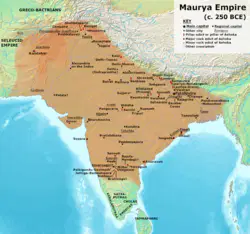
Which Indian ruler of the Mauryan Empire renounced war and embraced Buddhism?
Ashoka
Siddhartha Gautama
Chandragupta Maurya
Bimbisara
Buddhism originated under which historical figure?
Ashoka
Siddhartha Gautama
Chandragupta Maurya
Harsha
Where did Hinduism & Buddhism originate?
China
Mesopotamia
India
Egypt
Which belief is shared by Hindus and Buddhists?
Everyone should have the same social status.
People should paray five times a day.
The soul can be reincarnated
Material wealth is a sign of the blessing of the gods.
What island is at the southern tip of India?
Nepal
Thailand
Pakistan
What weather phenomenon is common in India?
Which empire was considered India's "Golden Age"?
What was the written language of Ancient India?
Hindi
Cuneiform

