wayground logo

Free Printable Worksheets

NEW

Font size

S
M
L
XL
Worksheets

Earth & Space Science Review

Total questions: 65

Worksheet time: 2hrs 57mins

Name
Class
Date
1.
Galaxies that are redshifted are:
a)
actually blue.
b)
really far away.
c)
invisible.
d)
moving away from us.
2.
The universe is expanding!  This means that:
a)
all of the galaxies are spreading out.
b)
the universe must have started from a single point.
c)
the universe is cooling down.
d)
all of the above.
3.

The Cosmic Background Radiation is:

a)

the remaining energy from the big bang.

b)

incredibly hot.

c)

visible to the human eye.

d)

only located in certain places in the universe.

4.
If a star is being observed from Earth and it's light has shifted towards the blue side of the electromagnetic spectrum it would be...
a)
Moving towards the Earth
b)
Moving away from the Earth
c)
This is a trick question that cannot be answered
d)
It isn't a star, it is a very large blueberry.
5.
What are the puzzle pieces of the Earth's surface called?
a)
Tectonic plates
b)
Puzzles
c)
Earthquakes
6.

What type of boundary is shown in the diagram?

a)

Divergent

b)

Convergent

c)

Transform

7.

What type of boundary is shown in the diagram?

a)

Divergent

b)

Convergent

c)

Slide/Transform

8.
This boundary is described by two plates moving away from eachother along the edges and separating. The resulting gap allows magma to rise and create new crust, forming new lithosphere. 
a)
Convergent Boundary 
b)
Divergent Boundary  
c)
Transform Boundary
9.
This boundary is described as two plates moving past eachother ALONG THE EDGES horizontally.  These boundaries will get stuck or lock against eachother causing earthquakes when they slip and release. 
a)
Convergent Boundary
b)
Divergent Boundary
c)
Transform Boundary
10.
This boundary is described as moving toward one another  When the plates are both continental plates the will crumple up and form a mountains. When they are continental and oceanic plates, subduction occurs  and earthquakes and volcanoes form. 
a)
Convergent Boundary
b)
Divergent Boundary
c)
Transform Boundary
11.
Wegener’s proposal of a supercontinent was supported by:
a)
earthquake data
b)
seafloor magnetism
c)
rock, fossil, and climate data.
d)
convection currents in the mantle.
12.
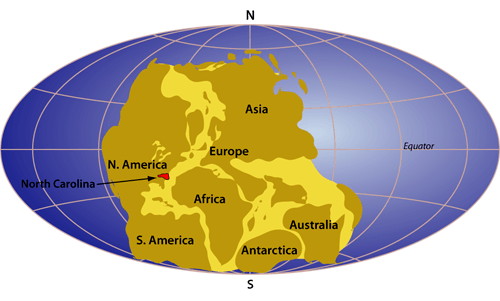
What is this a picture of?
a)
plate tectonics
b)
continental drift
c)
pangea
d)
glacier scaring
13.

Ocean Ridges are formed by _______ plate boundaries

a)

Convergent Oceanic / Continental

b)

Convergent Continental / Continental

c)

Convergent Oceanic / Oceanic

d)

Divergent

14.

The Appalachian Mountains in the U.S. match up with a similar mountain ranges in northern Europe. How does this support Wegener's theory of Continental Drift?

a)

The mountains were formed after tectonic plates had moved away from each other

b)

The similarities provide evidence North America & Europe were connected when the mountains formed.

c)

Similar rock samples were found on the ocean floor and at the two mountain ranges indicating that they both formed around the same time.

d)

It is just a coincidence that the mountain ranges both had the same rock layers and were the same age.

15.
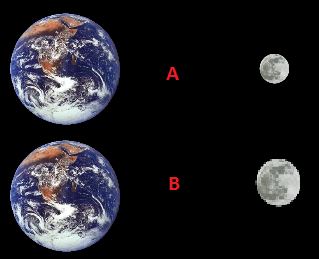
Which model has greater gravitational attraction (if any)
a)
Model A
b)
Model B
c)
Both Model A and Model B (same gravity)
16.
Which system has the greater gravitational attraction between the two objects (if any)?
a)
System A
b)
System B
c)
Same gravitational attraction fro System A and System B
17.
As mass increases, what happens to gravitational force?
a)
increases
b)
decreases
c)
stays the same
d)
i don't know
18.
Two factors effecting the magnitude of the force of gravity between 2 objects are...
a)
mass and distance 
b)
mass and matter
c)
distance and weight 
d)
weight and mass
19.
What are the reasons for the season?
a)
Earth's tilt & rotation
b)
Earth's tilt & revolution
c)
Earth's rotation & rovolution
d)
Earth's tilt & resolution
20.
The earth is a tilted planet.  What is the degree of tilt?
a)
Approximately 25 degrees
b)
Exactly 25 degrees
c)
23.5 degrees
d)
90 degrees with respect to the sun
21.
Which season is taking place in the Northern Hemisphere in Position 1?
a)
Winter
b)
Spring
c)
Summer
d)
Fall
22.
Which season is taking place in the Northern Hemisphere in Position 3?
a)
Winter
b)
Spring
c)
Summer
d)
Fall
23.
At position A, which hemisphere would have summer?
a)
Northern hemisphere
b)
Southern hemisphere
24.

_______are daily changes in ocean water.

a)

Waters

b)

Tides

c)

Colors

d)

Earths

25.
Which body has the greater effect on Earth's tides?
a)
Sun
b)
Saturn
c)
Moon 
d)
Venus
26.
How many high tides does a place have each day?
a)
3
b)
4
c)
5
d)
2
27.
What causes tides?
a)
gravity
b)
wind
c)
spring
d)
neap
28.

A new moon and/or a full moon result in a ____ Tide

a)
Neap
b)
Spring
c)
Neither
29.

A 3rd Quarter and/or a 1st Quarter moon result in a ____ Tide

a)
Neap
b)
Spring
c)
Neither
30.
What is a difference between spring and neap tides?
a)
Spring tides occur when the earth and sun are IN LINE with the new or full moon. 
b)
Spring tides occur when moon in 3rd or 1st quarter phases
c)
Spring tides are LOWER than neap tides
d)
Spring tides occur in Spring and neap tides can occur in any season
31.
What type of tide would this arrangement of earth-moon-sun create?
a)
full moon tide
b)
new moon tide
c)
neap tide
d)
spring tide
32.
What type of tides would this arrangement of earth-moon-sun create?
a)
neap tide
b)
spring tide
c)
new moon tide
d)
full moon tide
33.
Red stars are the _____________.
a)
hottest
b)
coolest
c)
biggest
34.
Blue stars are the _____________.
a)
hottest
b)
coolest
c)
smallest
35.
What determines the color of a star? 
a)
It's size
b)
It's temperature
c)
It's composition
d)
They are all the same color 
36.
The category that contains the most stars is...
a)
Main Sequence
b)
Supergiants
c)
Giants
37.
Which star has the lowest temperature?
a)
A
b)
B
c)
C
d)
D
38.

Which best describes stars located in area A

a)

Bright and Hot

b)

Cooler and bright

c)

Dim and hot

d)

Dim and colder

39.

Which best describes area D?

a)

Brighter and Cooler

b)

Brighter and Hotter

c)

Dimer and Cooler

d)

Dimmer and Hotter

40.

Which of the following choices orders the components of the universe correctly from largest to smallest?

a)

planet, star, solar system, galaxy, universe

b)

galaxy, universe, solar system, star planet

c)

universe, galaxy, solar system, planet, star

d)

universe, galaxy, solar system, star, planet

41.
What type of galaxy is this?
a)
Spiral
b)
Elliptical
c)
Irregular 
d)
Irrational
42.
What type of galaxy is this?
a)
Spiral
b)
Elliptical
c)
Irregular
d)
Irrational
43.
What type of galaxy is this?
a)
Spiral
b)
Elliptical
c)
Irregular
d)
Irrational
44.
How do we name air masses?
a)
Water and temperature
b)
Air pressure
c)
Humidity and temperature
d)
Cold and warm
45.

Define a(n) air mass.

a)

An area only over an ocean

b)

An area where two air masses collide

c)

A large region of air that has similar temperature and humidity.

d)

A cloud.

46.
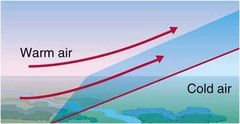
Which type of front is displayed?
a)
Cold
b)
Warm
c)
Stationary
d)
Occluded
47.
Which type of front is displayed?
a)
Cold
b)
Warm
c)
Stationary
d)
Occluded
48.
Which type of front is displayed?
a)
Cold
b)
Warm
c)
Stationary
d)
Occluded
49.
Which type of front is displayed?
a)
Cold
b)
Warm
c)
Stationary
d)
Occluded
50.
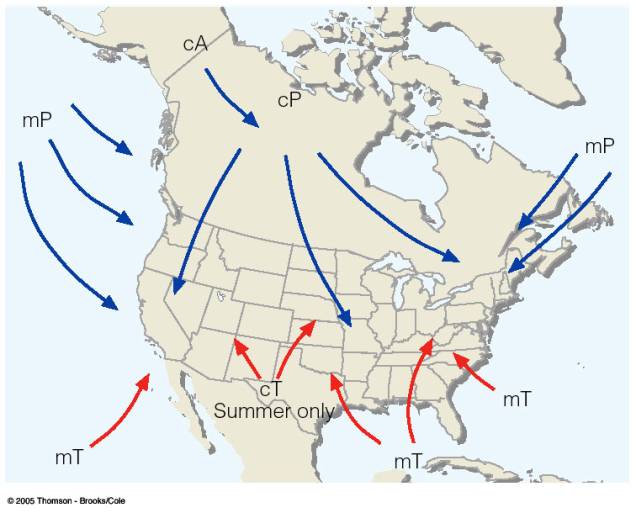
Which abbreviation of an air mass can be identified as dry and cold?
a)
cP
b)
mP
c)
cT
d)
mT
51.
Which abbreviation of an air mass can be identified as warm and moist?
a)
cP
b)
mP
c)
cT
d)
mT
52.
Which abbreviation of an air mass can be identified as dry and hot?
a)
cP
b)
mP
c)
cT
d)
mT
53.
A severe storm that involves strong winds and forms over warm water is:
a)
tornado
b)
thunderstorm
c)
hurricane
d)
blizzard
54.
What kind of weather is usually associated with a low pressure system?
a)
Sunny weather
b)
Precipitation (rain, snow, etc.)
55.
What kind of weather is usually associated with a high pressure system?
a)
Sunny weather
b)
Precipitation (rain, snow, etc.)
56.
The Coriolis Effect is caused by
a)
Earth rotating around the sun
b)
Earth rotating on its axis
c)
The tides
d)
Gravity
57.
What causes surface currents north and south of the equator to move in different directions? 
a)
Gases in the ocean
b)
The rotation of the Earth
c)
Temperature differences
d)
Continental deflection
58.
Two types of water currents are
a)
local and global
b)
sea and land
c)
surface and deep
d)
warm and cold
59.
Regular movements of water far below the oceans surface are called
a)
Warm Currents
b)
Deep Currents
c)
Shallow Currents
d)
Surface Currents
60.
The water on or surrounding the surface of the globe
a)
Glaciers
b)
Hydrosphere
61.

When living things breathe, they interact with which of Earth's spheres?

a)

Geosphere

b)

Hydrosphere

c)

Atmosphere

d)

Biosphere

62.

What is included in the biosphere?

a)

All living things on earth

b)

All the gases

c)

All the fresh water and saltwater

d)

All the rocks and minerals

63.

Earth's core, mantle. mountains, sand, metals are all examples of:

a)

The hydrosphere

b)

The geosphere

c)

The atmosphere

d)

The biosphere

64.

When the volcano erupts adding carbon dioxide to the air the interaction is between the:

a)

Biosphere and geosphere

b)

Hydrosphere and biosphere

c)

Geosphere and atmosphere

d)

Atmosphere and hydrosphere

65.

What spheres of the Earth is Spongebob a part of?

a)

Biosphere and atmosphere

b)

Geosphere and hydrosphere

c)

Hydrosphere and biosphere

d)

Atmosphere and geosphere