wayground logo

Free Printable Worksheets

NEW

Font size

S
M
L
XL
Worksheets

Unit 8 Review

Total questions: 54

Worksheet time: 5hrs 32mins

Name
Class
Date
1.
Find the slope from the table.
a)
1/4
b)
-1/4
c)
-4/1
d)
4/1
2.
What is the slope?
a)
-1/3
b)
-3
c)
-4
d)
5
3.
What is the slope?
a)
5
b)
1/5
c)
15
d)
10
4.
What does 'b" represent in y=mx=b
a)
y-intercept
b)
macaroni
c)
nothing
d)
slope
5.
What is the y-intercept in this table?
a)
(-2, -2)
b)
(1, 2)
c)
(0, 6)
d)
(6, 0)
6.
What is the y-intercept in this table?
a)
(-1, 9)
b)
(1, 1)
c)
(0, 5)
d)
(5, 0)
7.
What is the slope?
a)
2
b)
½
c)
1
d)
1.5
8.
About how many male math teachers were there in 2006?
a)
15
b)
30
c)
35
d)
45
9.
Find the slope from the table.
a)
-4
b)
1
c)
4
d)
-2
10.
Which panda will weigh more at 5 weeks?
a)
Mochi
b)
Kappa
c)
Po the dragon warrior
d)
Jack Black
11.
Find the average rate of change of Pete's height from 3 years old to 5 years old.
a)
2 inches per year
b)
8 inches per year
c)
2 years
d)
4 inches per year
12.
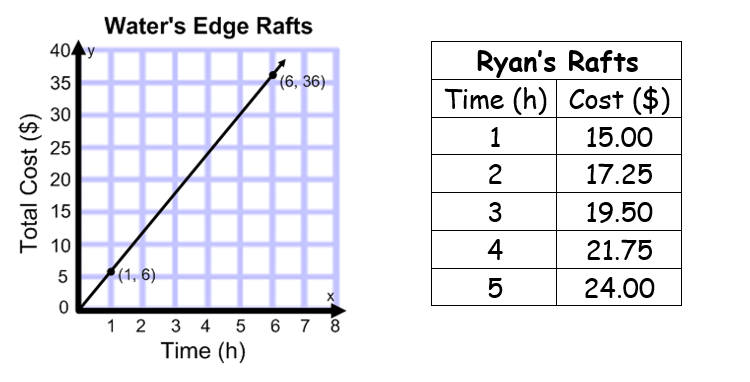
Which company shows a greater rate of change?
a)
Water's Edge Rafts
b)
Ryan's Rafts
13.
Find the rate of change
a)
4
b)
-4
c)
-1/4
d)
1/4
14.
Find the rate of change
a)
5
b)
-5
c)
-1/5
d)
1/5
15.

An aquarium is being filled with water. The graph shows the height of the water over time as the aquarium is being filled.


Which statement best describes the rate of change for this situation?

a)

The height of the water increases 20 inches per second.

b)

The height of the water increases 1 inch per second.

c)

The height of the water increases 5 inches per second.

d)

The height of the water increases 2.5 inches per second.

16.
What is the slope of the table?
a)
-2/5
b)
5/-2
c)
5/2
d)
2/5
17.
Find the rate of change
a)
1
b)
2
c)
11
d)
Not a constant slope/Non-Linear
18.

What is the definition of function?

a)

Has inputs and outputs

b)

Every input has only ONE output

c)

Inputs have different outputs every time

d)

x-values and y-values

19.
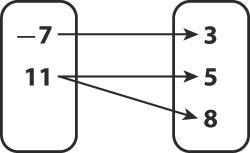
Is the relation a function? Why.
a)
Yes, because the x-value 11 has two y-values pair with it.
b)
Yes, because each x-value has only one y-value paired with it.
c)
No, because the x-value 11 has two y-values pair with it.
d)
No, because each x-value has only one y-value paired with it.
20.
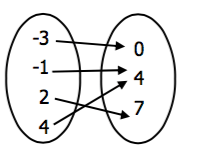
Is this mapping a function or not a function? 
a)
Function
b)
Not a Function 
21.
Is this table a function or not a function? 
a)
Function
b)
Not a Function
22.
Which set of values is a function?
a)
(9,5) (10,5) (9,-5) (10,-5)
b)
(3,4) (4,-3) (7,4) (3, 8)
c)
(6,-5) (7, -3) (8, -1) (9, 1)
d)
(2, -2) (5, 9) (5, -7) (1, 4)
23.
Is this set of ordered pairs a function or not a function? 
a)
Function
b)
Not a Function 
24.
.
a)
Function
b)
Not a Function
25.

Which of the following is a function?

a)

A

b)

B

c)

C

d)

D

26.

Is the following a function?

a)

Yes, this is a function.

b)

No, it's not a function.

c)

Can't be determined with this information.

27.

Which is a function?

a)

W

b)

X

c)

Y

d)

Z

28.

Which is a function?

a)

A

b)

B

c)

C

d)

D

29.

Which set of ordered pairs represents y as a function of x?

a)

{(0, 0.5), (2, 1.5), (−5.5, 5), (−5.5, −6)}

b)

{(5, −7), (3, −7), (−9.2, −7), (9.2, −7)}

c)

{(9.3,-1), (7.3, -2), (7.3, 2), (9.3, 1)}

d)

{(8.1, 9), (9.1, 10), (10.1, 9), (9.1, 8)}
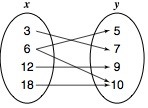
30.
Is this mapping a function or not a function? 
a)
Function
b)
Not a Function
31.

Which table does not represent a function?

a)

A

b)

B

c)

C

d)

D

32.
Which ordered pair could you add to the following list of points to create a function?  (3, 5) (4, 9) (2, 5) 
a)
(3, 7)
b)
(4, 1) 
c)
(1, 9)
d)
(2, 6)
33.
a)

A

b)

B

c)

C

d)

D

34.
a)

A

b)

B

c)

C

d)

D

35.
Does this mapping diagram represent a function?
a)
No, because there are repeating input values
b)
Yes, because there are no repeating input values
36.

Which representation shows y as a function of x?

a)

A

b)

B

c)

c

d)

D

37.

Which statement describes the mapping?

a)

The mapping represent y as a function of x, because each y-value corresponds to exactly one x-value.

b)

The mapping does not represent y as a function of x, because two of the x-values correspond to the same y-value.

c)

The mapping represent y as a function of x, because each x-value corresponds to exactly one y-value.

d)

The mapping does not represent y as a function of x, because there are more x-values than different corresponding y-values.

38.
Find the slope
a)
4/5
b)
5/4
c)
-5/4
d)
-4/5
39.
Find the slope
a)
-5/7
b)
7/5
c)
-7/5
d)
5/7
40.
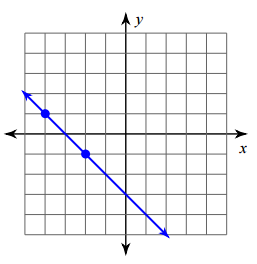
Find the slope of the line.
a)
-5/4
b)
5/4
c)
-4/5
d)
4/5
41.
Find the slope
a)
-5/3
b)
-3/5
c)
5/3
d)
3/5
42.
Find the slope:
(-3, 3) and (7, 6)
a)
3/4
b)
-4/3
c)
3/10
d)
-10/3
43.

Find the slope:

a)

34\frac{3}{4}

b)

43\frac{4}{3}

c)

14\frac{1}{4}

d)

31\frac{3}{1}

44.
Find the slope of the line.
a)
-2
b)
2
c)
-1
d)
1
45.

What is the slope of the line that passes through these two points (0, -2) and (3, -4)?

a)

2/3

b)

-2/3

c)

3

d)

-2

46.

What is the slope of the line that passes through these two points (8, 4) and (5, 3)?

a)

3

b)

-1

c)

-1/3

d)

1/3

47.
Find the slope:
a)
3/4
b)
4/3
c)
-3/4
d)
-4/3
48.
Find the slope of the line that passes through:
(10, 1) and (5, 2)
a)
1/5
b)
-1/5
c)
5
d)
-5
49.
Find the slope of the line that passes through: 
(2, 4) and (6, 12)
a)
1/2
b)
-1/2
c)
2
d)
-2
50.
Find the slope of the line that passes through: 
(2, 4) and (6, 12)
a)
1/2
b)
-1/2
c)
2
d)
-2
51.

Find the slope of the line that goes through the points

(−11,−5) and (1,−12)

a)

58-\frac{5}{8}  

b)

1611\frac{16}{11}  

c)

16\frac{1}{6}  

d)

712-\frac{7}{12}  

52.

Find the slope of the line that goes through the points

(−1,−2) and (−3,−4).

a)

1

b)

2

c)

3

d)

4

53.

Find the slope of the line that goes through the points


(−11,−5) and (1,−12)

a)

58-\frac{5}{8}

b)

1611\frac{16}{11}

c)

16\frac{1}{6}

d)

712-\frac{7}{12}

54.
Find the slope given the points (2, −7) and (−1, 6). 
a)
-13/3
b)
13/3
c)
0
d)
2/3