
 Worksheets
World History End of 3rd 9 Weeks Review
Total questions: 31
Worksheet time: 16mins
Which principle championed by Enlightenment thinkers laid the groundwork for modern democratic movements?
Feudalism
Natural rights
Colonial expansion
Absolute monarchy
What was a key reason for the American colonies seeking independence from British rule?
The colonists' refusal to adhere to British regulations
Conflicts over the institution of slavery in the colonies
Severe food shortages due to unsuccessful harvests
The absence of colonial representation in the British parliament
What was a common outcome of both the American and French Revolutions?
The citizens experienced an expansion of political rights
The influence of the Catholic Church grew significantly
A completely new social hierarchy was established
The monarchs retained their absolute authority
What was a significant factor that led to the outbreak of the French Revolution?
Increase in the population of the First Estate
Conflicts over religious freedoms
Implementation of heavy taxes on the Third Estate
Expansion of colonial territories
How did the economic conditions in France and the American colonies differ at the start of their respective revolutions?
The American colonies had a stronger economy than France.
France had a more stable economy than the American colonies.
Both France and the American colonies faced similar economic challenges.
France experienced more severe economic hardships than the American colonies.
While the American revolutionaries sought independence from colonial rule, the French revolutionaries aimed to —
establish a constitutional monarchy
defend the privileges of the nobility
overthrow the monarchy and aristocracy
expand French territories overseas
Following the defeat of Napoleon, European powers came together at the Congress of Vienna in order to —
restore a balance of power in Europe
return the French monarch to the throne
support the creation of a united German territory
establish democratic governments throughout Europe
What impact did the Napoleonic Wars have on the political landscape of Latin America?
They led to the imposition of French rule over Latin America.
They created a power vacuum that allowed Latin American countries to seek independence.
They resulted in the colonization of Latin America by the British.
They enforced the application of European laws in Latin American territories.
What was one significant impact of the Congress of Vienna on Europe after the fall of Napoleon?
It promoted the spread of nationalism across Europe.
It established the European Union.
It led to the widespread adoption of democracy.
It abolished monarchies in Europe.
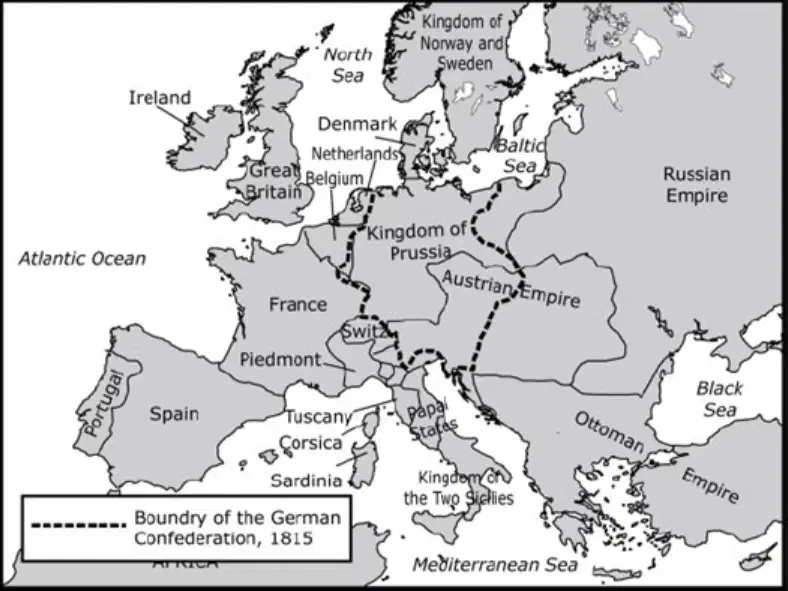
How did the territorial changes made by the Congress of Vienna influence the political landscape of Europe?
The changes led to the decline of the Austrian Empire's influence.
The changes established a balance of power that prevented major conflicts for decades.
The changes facilitated the rise of a unified Italian state.
The changes allowed France to expand its territories further into Central Europe.
What role did Enlightenment ideals play in Simón Bolívar's revolutionary activities?
He drafted a new constitution for France based on Enlightenment principles.
He was inspired by Enlightenment thinkers to challenge Spanish colonial rule.
He rejected Enlightenment ideas and supported traditional monarchies.
He used Enlightenment ideals to support the British Empire's expansion.
What role did Enlightenment thinkers play in shaping the political landscape during the eighteenth-century revolutions?
Their ideas sparked discussions between ruling monarchs and legislative bodies.
They provided slogans and mottos that inspired revolutionary movements.
They were cited by monarchs to resist revolutionary changes.
Their concepts were embedded in the constitutional frameworks of the new governments.
Which of the following is a feature of an absolute monarchy?
the establishment of a constitutional framework
the division of power among various branches of government
the ruler having complete authority over the government
the presence of a democratic electoral system
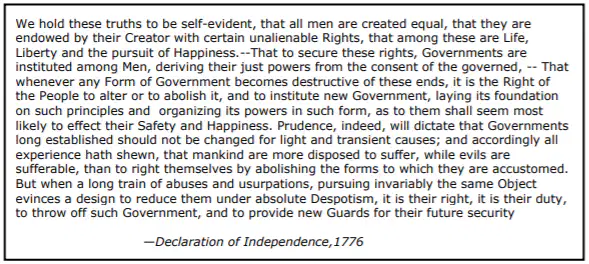
Why did Thomas Jefferson emphasize the right of the people to alter or abolish government in the Declaration of Independence?
To highlight the importance of individual freedoms
To justify the colonies' decision to break away from British rule
To encourage the formation of a new constitution
To demonstrate the colonies' military strength
Which principle of the U.S. Constitution is demonstrated by the division of government into legislative, executive, and judicial branches?
Checks and balances
Federalism
Popular sovereignty
Separation of powers
How does the Bill of Rights influence the legal system in the United States?
It mandates that all citizens must serve on a jury.
It ensures that citizens have access to free healthcare.
It provides citizens with specific rights and freedoms.
It allows citizens to bypass laws they disagree with.
What principle was reinforced in England with the signing of the Magna Carta by King John?
Judges must adhere to fair trial standards.
No ruler is exempt from the laws of the realm.
Defendants are entitled to a speedy trial.
The monarch can override parliamentary decisions.
What principle found in the American and French declarations justified their revolutionary actions?
Governments are naturally tyrannical and unjust.
Governments exist to safeguard the rights of individuals.
Government authority should be shared among various factions.
Government is responsible for ensuring citizens' economic prosperity.
Montesquieu’s philosophy inspired the framers of the U.S. Constitution to establish a government system with —
an extensive bill of rights
checks and balances
universal suffrage
an influential judiciary

Which philosopher's ideas are reflected in the principles of liberty and equality mentioned in the excerpt?
Thomas Hobbes
John Locke
Charles de Montesquieu
Voltaire
Which factor contributed most to the development of the Renaissance in Italy?
City-states in Italy had become wealthy from trade.
Nobles in Italy had been military leaders in the Crusades.
The Catholic Church provided political stability to the region.
The region had become politically unified under one Italian king.
What was one of the key principles established by the Magna Carta signed by King John in 1215?
The monarchy must be abolished
The king is subject to the law
All men are created equal
Taxation without representation is unjust
How did the principles in the Magna Carta and the English Bill of Rights influence the formation of American government?
By establishing the framework for a federal government
By emphasizing the importance of individual liberties
By outlining the process for amending the Constitution
By granting the right to overthrow a tyrannical leader
What did Thomas Hobbes believe individuals exchanged for the security provided by a sovereign?
Shared wealth and resources
The ruler's promise of fairness
Protection from external threats
Personal freedoms and rights
What was one significant impact of the Columbian Exchange on European societies?
The introduction of the potato and maize, which became staple foods
The adoption of the Mayan calendar system
The spread of European languages in the Americas
The establishment of European colonies in Asia
Which of the following was a significant impact of the Columbian Exchange on the agriculture of the Americas?
Introduction of advanced irrigation techniques
Discovery of new gold mines
Introduction of European livestock
Development of terrace farming methods
How did the Catholic Church contribute to the Spanish colonization efforts in the Americas?
By advocating for the rights of indigenous peoples
By sending explorers to map new territories
By financing the voyages of Spanish explorers
By establishing missions to spread Christianity among indigenous communities
What was a common feature of societies during the Early Civilizations Era (8000 B.C.-500 B.C.)?
Universal suffrage
Polytheistic religions
Homogeneous cultures
Patriarchal social structures
What was a significant effect of Hammurabi's Code on the legal system?
It established a uniform set of laws for all citizens.
It allowed laws to be changed frequently by the king.
It eliminated the need for written laws.
It required all laws to be approved by a council of elders.
Which aspect of the U.S. government is influenced by the democratic principles of ancient Greece?
Checks and balances
Jury system
Electoral college
Federalism
What was a significant impact of Muslim scholars in Spain on European intellectual traditions?
They introduced the concept of zero to European mathematics
They established the first European universities
They preserved and translated ancient Greek and Roman manuscripts
They developed the Gothic architectural style

