
 Worksheets
Physical Education Studies General - Year 11
Total questions: 45
Worksheet time: 28mins

What is the process shown in the diagram?
Exhalation
Inhalation
Digestion
Circulation
Which of the following is a major function of the skeletal system?
Support and protection
Digestion
Hormone production
Nerve transmission
Which system is responsible for transporting nutrients and oxygen throughout the body?
Circulatory system
Respiratory system
Digestive system
Nervous system
What is the primary function of the respiratory system?
Gaseous exchange
Nutrient absorption
Waste elimination
Hormone regulation
What is the function of the vertebrae in the skeletal system?
To assist with skeletal movement
To produce red blood cells
To store calcium
To protect the heart
Which of the following bones is found in the arm and connects to the thumb?
Radius
Pelvis
Femur
Tibia
What is the primary function of the axial skeleton?
To assist with movement and includes the major limbs
To form the basic central structure and protect vital organs
To connect muscles to bones
To store minerals and produce blood cells
Which of the following is protected by the vertebrae?
The brain
The heart
The spinal cord
The kidneys
How many bones make up the human skeleton?
Over 100
Over 150
Over 200
Over 250
What is the function of ligaments in the skeletal system?
To produce blood cells
To hold bones together
To store calcium
To protect the spinal cord
Which bones are part of the shoulder girdle in the appendicular skeleton?
Clavicle and scapula
Humerus and radius
Carpal bones and phalanges
Pelvic girdle and femur
What bones make up the forearm in the appendicular skeleton?
Clavicle and scapula
Radius and ulna
Humerus and femur
Carpal bones and metacarpals
What bones make up the lower leg in the appendicular skeleton?
Femur and patella
Tibia and fibula
Radius and ulna
Humerus and scapula
What is the function of the appendicular skeleton?
Protects the brain
Assists with movement and includes all the major limbs
Supports the body's weight
Produces blood cells
What is the primary function of the skeletal system?
To produce hormones
To support and protect the body
To digest food
To circulate blood
What is the longest bone in the human body?
Humerus
Tibia
Femur
Radius
Which bone is located in the upper arm?
Femur
Tibia
Humerus
Fibula
What is the name of the bone found in the lower leg alongside the tibia?
Radius
Fibula
Ulna
Pelvis
Which bone is part of the forearm?
Pelvis
Femur
Ulna
Vertebral
Which of the following is a major function of bones?
Digestion
Blood cell production
Respiration
Excretion
Which classification of bones is NOT mentioned in the syllabus?
Short
Flat
Irregular
Round
What is one of the primary functions of the skeletal system?
Produces hormones
Provides support and framework for the body
Regulates body temperature
Filters blood
Which organ does the cranium protect?
Heart
Lungs
Brain
Kidneys
What role does the skeletal system play in movement?
It creates energy for muscles
It provides attachment points for muscles
It absorbs nutrients for muscles
It cools down muscles
Which minerals are stored in the bones?
Iron and zinc
Calcium and phosphorous
Magnesium and potassium
Sodium and chloride
Where are red blood cells produced in the skeletal system?
In the muscles
In the bone marrow
In the skin
In the liver
What characteristic is true for short bones?
Longer than they are wide
Equal in length, width, and thickness
Primarily located in the axial skeleton
Hollow and lightweight
Where are short bones primarily located?
In the appendicular skeleton
In the axial skeleton
In the skull
In the wrist and ankle
Which type of bones are thin, flat, and often curved, and function to protect internal organs?
Flat bones
Irregular bones
Long bones
Short bones
What is the major function of irregular bones?
Support body weight
Protect vital organs such as the spinal cord
Facilitate movement
Store minerals
Which of the following is an example of a flat bone?
Vertebrae
Cranium
Femur
Tibia
Irregular bones have complicated shapes and do not fit into other categories. Which of the following is an example of an irregular bone?
Sternum
Scapula
Vertebrae
Rib
The carpal bones are classified as which type of bone?
Long bone
Flat bone
Short bone
Irregular bone
What is a plane in anatomical terms?
A real flat surface on the body
An imaginary flat line which passes through the body
A curved line on the body
A horizontal line on the body
Which plane passes from side to side and cuts the body into front and back halves?
Sagittal Plane
Transverse Plane
Frontal Plane
Horizontal Plane
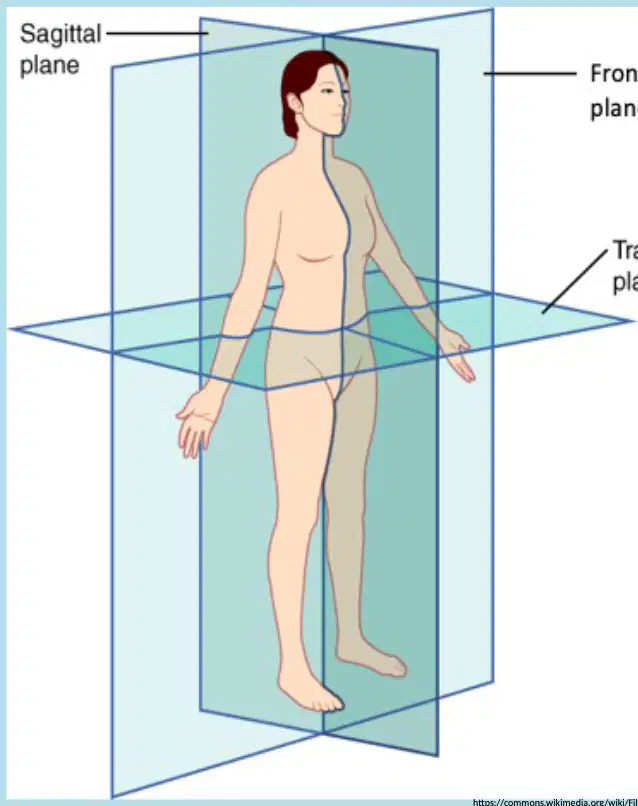
What does the transverse plane do to the body?
Passes through the body vertically and divides it into left and right halves.
Passes through the body horizontally and divides it into top and bottom halves.
Passes through the body vertically and divides it into front and back halves.
Passes through the body diagonally and divides it into four equal parts.

What is the longitudinal axis in terms of body movement?
It passes from side to side through the body.
It passes from front to back through the body.
It passes from top to bottom through the centre of the body.
It passes diagonally through the body.
Which of the following is an example of movement around the longitudinal axis?
A gymnast performing a cartwheel.
An ice skater spinning.
A runner sprinting forward.
A swimmer doing a backstroke.
During Exhalation, which of the following is incorrect
The External Intercostals Relax
The Diaphragm relate and returns to its dome shape
Lung volume decreases
The Diaphragm contracts and flattens
During Inspiration, the diaphragm (a) and (b) . The intercostal muscles (c) and lift the ribcage up. This (d) the volume inside the lungs, and therefore air pressure in the lungs (e) and air is drawn in.
The right atrium receives (a) from the superior and inferior vena cava. It goes through the (b) and then to the (c) . It exits to be oxygenated in the lungs via the (d) . Oxygenated blood returns from the lungs through the pulmonary vein, where it enters the left atrium, then left ventricle, and is sent to the rest of the body via the (e)
Classify the following somatotypes
Dumpy, narrow shoulders, wide hips. High fat mass with short limbs
endomorph
Muscular, broad shoulders and narrow hips
mesomorph
Tall and thin with long limbs and very little muscle or fat mass.
ectomorph
classify the 3 types of muscles
cardiac
Heart muscle, involuntary
skeletal
muscles of skeleton, voluntary
smooth
organs, involuntary
Which is not a function of the circulatory system?
Transporting O2, water and nutrients to the body's cells
Maintaining body temperature
attaching to bones for movement
White blood cells which fight infection

