wayground logo

Free Printable Worksheets

Font size

S
M
L
XL
Worksheets

Quiz Nuclear Review

Total questions: 60

Worksheet time: 2hrs 31mins

Name
Class
Date
1.
A nuclear reaction where a nucleus splits into two smaller nuclei is... 
a)
Fission
b)
Fusion
c)
Gamma decay
d)
Beta decay
2.
What would two different isotopes of an atom have in common?
a)
Number of neutrons 
b)
Number of protons
c)
Atomic weight 
d)
Atomic mass
3.
What happens when the number of protons in an atom changes? 
a)
The number of electrons changes too 
b)
Usually nothing happens, unless the atom is radioactive 
c)
The atomic nucleus explodes
d)
It becomes a completely different atom, with different properties 
4.
What element is the ?
a)
Ag-115
b)
Cd-115
c)
Pd-115
d)
Not Listed
5.
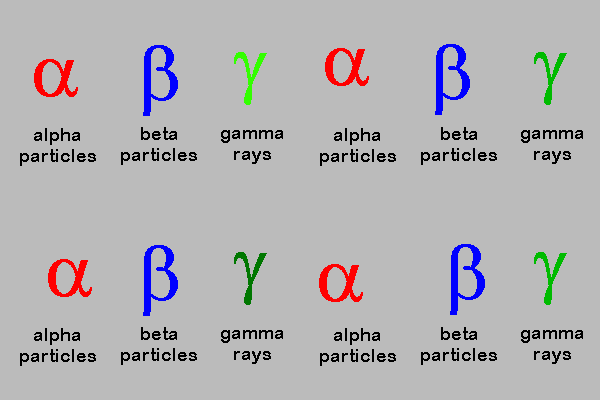
Which type of nuclear radiation is being emitted here?
a)
alpha
b)
beta
c)
gamma
d)
none
6.
Which type of nuclear radiation is being emitted here?
a)
Alpha
b)
beta
c)
gamma 
d)
none
7.
Balance the following equation:
146C --> 0-1e + ________
a)
145B
b)
146C
c)
147N
d)
42He
8.
Balance the following equation:
146C --> 0-1e + ________
a)
145B
b)
146C
c)
147N
d)
42He
9.
Two or more nuclei combine to form one larger nucleus in the process of nuclear _____.
a)
Fusion
b)
Fission
c)
Tracing
d)
Decay
10.
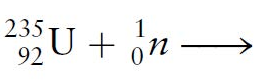
This is an example of...
a)
Fission  reaction
b)
Fusion reaction
c)
Decomposition reaction
d)
Combustion
11.
When nuclei decay, massive amounts of __________ is released.
a)
energy
b)
jello
c)
protons
d)
neutrons
12.

The three types of nuclear radiation are _______ radiation, _________radiation, and _____________ radiation.

a)

alpha, beta, and gamma

b)

theta, beta, and kappa

c)

alpha, beta, positron

13.

When the isotope 5024X releases a beta particle we get another element, Y, that looks like

a)

5023Y

b)

4622Y

c)

5025Y

d)

5024Y

14.

Which type of radioactive decay gives off energy only (no particles)?

a)

alpha

b)

beta

c)

gamma

15.
Alpha particles have a _____ charge.
a)
+2
b)
0
c)
+1
d)
-1
16.

Which type of radioactive decay gives off energy only (no particles)?

a)

alpha

b)

beta

c)

gamma

17.
What is the missing isotope that will balance the following nuclear equation?
94Be  +  11H →  _____  +  42He
a)
105B
b)
105Ne
c)
63Li
d)
63C
18.
Has the highest penetrating power.  Can penetrate our body.  Even several cm thick of lead or several meters thick of concrete cannot stop all of it.
a)
Alpha
b)
Beta
c)
Gamma
19.

The conversion of an atom of one element to an atom of another element is called (a)   .

20.

In a(n) ___________, particles released from one nuclear reaction collide with other particles and cause more nuclear reactions.

a)

nuclear fission reaction

b)

nuclear fusion reaction

21.
Why does an atom undergo beta decay?
a)
It has too many electrons.
b)
It has an atomic number greater than 83
c)
It has more neutrons than protons
d)
It has more protons than neutrons
22.

Arrange in order of increasing ability to penetrate matter.

a)

Beta, gamma, alpha

b)

Alpha, gamma, beta

c)

Gamma, beta, alpha

d)

Alpha, beta, gamma

23.
Balance the following equation:
146C --> 0-1e + ________
a)
145B
b)
146C
c)
147N
d)
42He
24.
What is the missing isotope that will balance the following nuclear equation?
94Be  +  11H →  _____  +  42He
a)
105B
b)
105Ne
c)
63Li
d)
63C
25.
What is an advantage  of nuclear energy?
a)
radioactive waste
b)
no pollution
c)
we will never run out
d)
it is the safest way to make energy
26.

Reaction involving the nucleus

a)

Electron

b)

Nuclear Reaction

c)

Potential Energy

d)

Kinetic Energy

27.
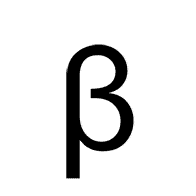
Has the symbol
a)
Alpha
b)
Beta
c)
Gamma
28.
Gamma rays have a _____ charge
a)
0
b)
+1
c)
-1
d)
+2
29.
Which is not a part of an atom's nucleus?
a)
Neutron
b)
Proton
c)
Electron
d)
All are part of the nucleus
30.
An isotope has a different number of
a)
electrons
b)
neutrons
c)
protons
d)
positrons
31.

In order of most to least penetrating radiation we have

a)

Alpha , Beta, Gamma

b)

Beta , Gamma , Alpha

c)

Gamma, Beta, Alpha

d)

Gamma, Alpha, Beta

32.

Which of these processes describes a nuclear fusion reaction?

a)

A nucleus absorbs energy to produce lighter nuclei.

b)

A nucleus splits to produce energy and lighter nuclei

c)

Two nuclei bind together to produce energy and heavier nuclei.

d)

Two nuclei bind together to produce energy and a lighter nuclei.

33.

Of the main types of radiation emitted from naturally radioactive isotopes, which is the hardest to block?

a)

Alpha deca

b)

Gamma Decay

c)

Beta decay

d)

They are all blocked using the same method
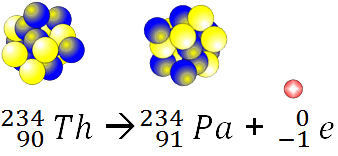
34.
What is emitted during Beta Radiation?
a)
A high-energy Electron.
b)
Protons.
c)
Neutrons.
d)
Nuclei
35.
TRUE or FALSE: gamma changes the atomic number.
a)
True
b)
False
36.
Which type of nuclear radiation is being emitted here?
a)
Alpha
b)
beta
c)
gamma 
d)
none
37.
When does radioactive decay occur?
a)
When the nucleus of an isotope is unstable
b)
When the nucleus of an isotope is stable
c)
When the electrons of an isotope are spinning
d)
When the electrons of an isotope are shared with another isotope
38.
How many protons does gold atom have?
a)
197
b)
79
c)
118
d)
276
39.
What element is the ?
a)
Ag-115
b)
Cd-115
c)
Pd-115
d)
Not Listed
40.
Which type of nuclear radiation is being emitted here?
a)
Alpha
b)
beta
c)
gamma 
d)
none
41.
Balance the following equation:
146C --> 0-1e + ________
a)
145B
b)
146C
c)
147N
d)
42He
42.
Two or more nuclei combine to form one larger nucleus in the process of nuclear _____.
a)
Fusion
b)
Fission
c)
Tracing
d)
Decay
43.
This is an example of...
a)
Fission  reaction
b)
Fusion reaction
c)
Decomposition reaction
d)
Combustion
44.
When nuclei decay, massive amounts of __________ is released.
a)
energy
b)
jello
c)
protons
d)
neutrons
45.
What type of reaction is this?
a)
alpha
b)
beta
c)
gamma
d)
quiet
46.
Gamma rays damage human cells/tissue.
a)
True
b)
False
47.
What is the missing isotope that will balance the following nuclear equation?
94Be  +  11H →  _____  +  42He
a)
105B
b)
105Ne
c)
63Li
d)
63C
48.

What is likely to happen to unstable nuclei with too many, or too few, neutrons?

a)

They will decay by emitting radiation.

b)

They will loose all their electrons.

c)

They will bond with other atoms.

49.

if Phosphorus-32 decay into beta reaction the result will be:

a)

Sulfur- 28

b)

Sulfur-32

c)

Al-32

50.

if Thorium-228 decay into alpha reaction the result will be

a)

Pa-228

b)

Ac-228

c)

Ra-224

51.

if Thorium-228 decay into beta reaction the result will be

a)

Pa-232

b)

Ac-228

c)

Ra-224

52.

what it will be the result if Ga-70 decay into beta reaction

(a)  

53.

What does the 238 represent in plutonium-238?

a)

the mass number

b)

the atomic number

c)

the number of neutrons

d)

mass defect

54.

What particle is emitted in an alpha decay?

a)

photon

b)

electron

c)

helium nucleus

d)

proton

55.
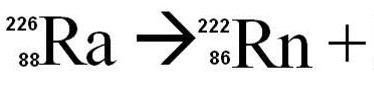
What particle completes this reaction?
a)
alpha particle
b)
beta particle
c)
gamma particle
d)
neutron
56.
Complete the nuclear equation and determine the type of decay that is occurring in this reaction. 
a)
alpha
b)
beta
c)
gamma
d)
none
57.
What is the missing isotope that will balance the following nuclear equation?
94Be  +  11H →  _____  +  42He
a)
105B
b)
105Ne
c)
63Li
d)
63C
58.
Balance the following equation:
146C --> 0-1e + ________
a)
145B
b)
146C
c)
147N
d)
42He
59.
a)
23692U
b)
23693U
c)
23492Np
d)
23493Np
60.

Complete the nuclear reaction

85209At = ___ + 24He

a)

83205Bi

b)

86209Rn

c)

81207Tl

d)

85208At