Wayground logo

Free Printable Worksheets

Font size

S
M
L
XL
Worksheets

Function & Story Graph Test

Total questions: 30

Worksheet time: 6hrs 12mins

Name
Class
Date
1.
a)
F
b)
G
c)
H
d)
J
2.
a)
F
b)
H
c)
G
d)
I
3.
a)
F
b)
G
c)
H
d)
J
4.
a)

Opposite Tom's home is a hill. Tom climbed slowly up the hill, walked across the top, and then ran quickly down the other side.

b)

Tom walked home then he stopped and waited to watch the sky. After that, he ran to get home .

c)

Tom was walking to the park. He stopped and waited so the baby chicks could pass.

5.
What happened during O to A point?
a)
not moving
b)
constant speed
c)
accelerating
d)
decelerating
6.

What is a plausible story for this graph?

a)

A student was jogging from school to home. She stopped to tie her shoe and take a drink from her water bottle, then continued at the same pace as before.

b)

A student was jogging from school to home. She walked for a while, then continued jogging.

c)

A sled rider was going down a hill. The hill was steep at first, then kind of flat. At the end, it was steep again.

d)

A car was slowing down, then contued moving at a constant rate. Finally, it slowed to a stop,
7.

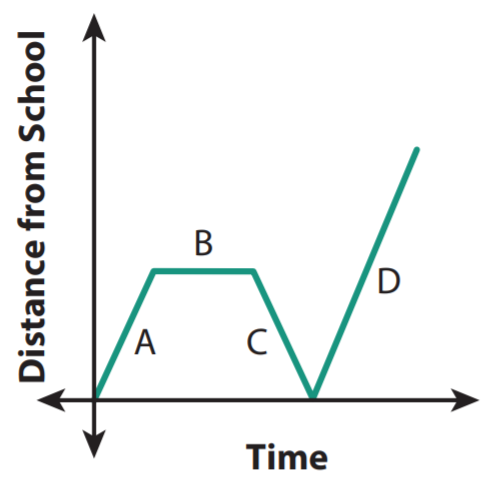
The graph shows Timmy's distance he is as he leaves school one afternoon. What happens in section C? Why is the distance from school decreasing?

a)

Timmy is walking back to school because he forgot his math book.

b)

Timmy is talking to a friend and not walking.

c)

Timmy is walking faster home.

d)

Timmy is dancing in the street.

8.

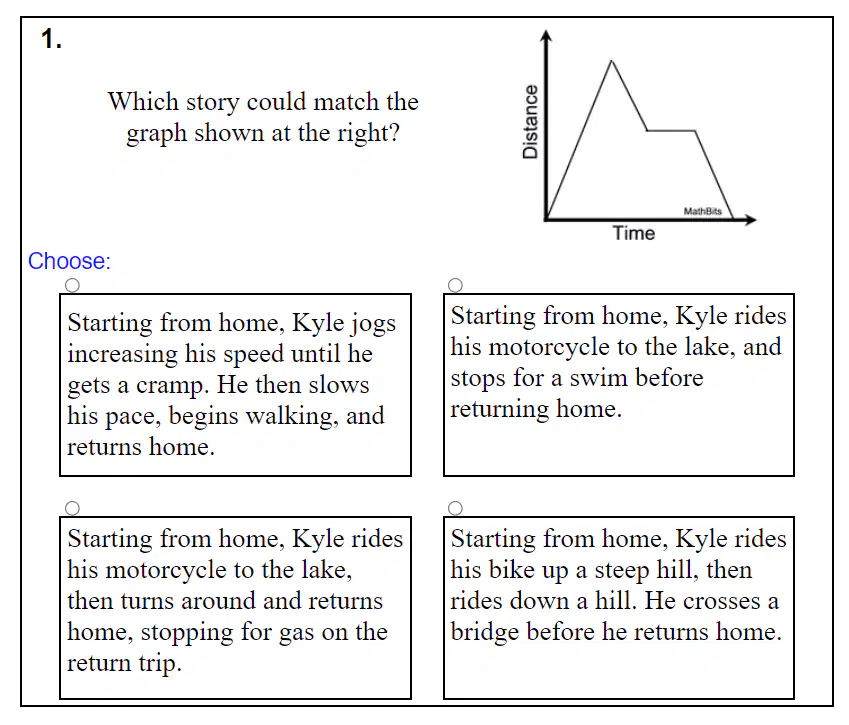
Choose the correct answer.

a)

Starting from home, Kyle jogs increasing his speed until he gets a cramp. He then slows his pace, begins walking, and returns home.

b)

Starting from home, Kyle rides his motorcycle to the lake, and stops for a swim before returning home.

c)

Starting from home, Kyle rides his motorcycle to the lake, then turns around and returns home, stopping for gas on the return trip.

d)

Starting from home, Kyle rides his bike up a steep hill, then rides down a hill. He crosses a bridge before he returns home.

9.
The distance-time graphs shown represent the motion of a car. Which of the following graphs represents the car at constant speed?
a)

graph A

b)

graph B

c)

graph C

d)

graph D

10.
What happened during C to D point?
a)
not moving
b)
increasing speed at a constant rate
c)
moving at a constant speed
d)
moving at 0 m/s2 acceleration
11.
Which set of values is a function?
a)
(9,5) (10,5) (9,-5) (10,-5)
b)
(3,4) (4,-3) (7,4) (3, 8)
c)
(6,-5) (7, -3) (8, -1) (9, 1)
d)
(2, -2) (5, 9) (5, -7) (1, 4)
12.
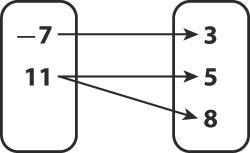
Is the relation a function? Why.
a)
Yes, because the x-value 11 has two y-values pair with it.
b)
Yes, because each x-value has only one y-value paired with it.
c)
No, because the x-value 11 has two y-values pair with it.
d)
No, because each x-value has only one y-value paired with it.
13.
Is this table a function or not a function? 
a)
Function
b)
Not a Function
14.
Is this table a function or not a function? 
a)
Function
b)
Not a Function 
15.
a)
Function
b)
Not a Function
16.
a)
Function
b)
Not a Function
17.
Is this a function? Explain.
a)
Yes; it passes the horizontal line test.
b)
No; it is not a straight line.
c)
Yes; it passes the vertical line test.
d)
No; there is a line connecting the dots.
18.
What is the definition of function?
a)
Has inputs and outputs
b)
Every input has only ONE output
c)
Inputs have different outputs every time
d)
x-values and y-values
19.
.
a)
Function
b)
Not a Function
20.

Is this a function?

a)

Yes, it is a function.

b)

No, it is not a function.

21.
Which set of values is a function?
a)
(9,5) (10,5) (9,-5) (10,-5)
b)
(3,4) (4,-3) (7,4) (3, 8)
c)
(6,-5) (7, -3) (8, -1) (9, 1)
d)
(2, -2) (5, 9) (5, -7) (1, 4)
22.
Is the relation a function? Why.
a)
Yes, because the x-value 11 has two y-values pair with it.
b)
Yes, because each x-value has only one y-value paired with it.
c)
No, because the x-value 11 has two y-values pair with it.
d)
No, because each x-value has only one y-value paired with it.
23.
Is this table a function or not a function? 
a)
Function
b)
Not a Function
24.
Is this table a function or not a function? 
a)
Function
b)
Not a Function 
25.
a)
Function
b)
Not a Function
26.
a)
Function
b)
Not a Function
27.
Is this a function? Explain.
a)
Yes; it passes the horizontal line test.
b)
No; it is not a straight line.
c)
Yes; it passes the vertical line test.
d)
No; there is a line connecting the dots.
28.
What is the definition of function?
a)
Has inputs and outputs
b)
Every input has only ONE output
c)
Inputs have different outputs every time
d)
x-values and y-values
29.
.
a)
Function
b)
Not a Function
30.

Is this a function?

a)

Yes, it is a function.

b)

No, it is not a function.