
 Worksheets
FLUVIAL PROCESSES
Total questions: 24
Worksheet time: 6hrs 0mins

Water that flows along Earth's surface to eventually return to the ocean is called ___.
runoff
storm drain
tributary
groundwater

What is a tributary?
a small stream that flows into a larger stream
all the lakes in an area
a map of the hills and valleys in an area
a measurement of the amount of salt in water

A ___________________ is the area of land that collects runoff and channels it into a main river.
peninsula
tributary
groundwater
watershed
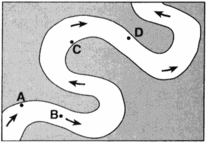
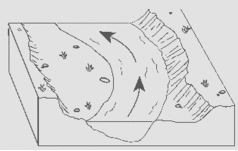

The greatest stream velocity are found closest to points
A and B
B and C
C and A
D and A

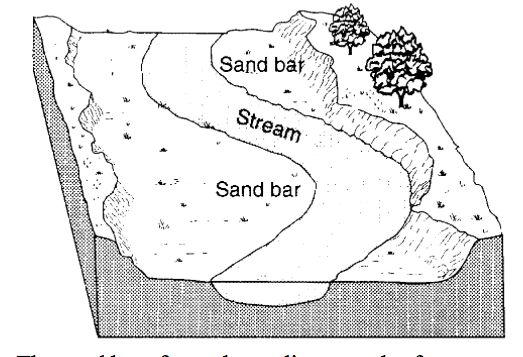
The diagram below shows the path of a river. What is the U-shaped feature called?
an alluvial fan
a delta
a meander
an oxbow lake

What kind of river produces meanders like the ones in the image?
Young River
Old River
Age does not matter
Both Young Rivers and Old Rivers

The diagram represents a stream as it travels from the mountains across the plains and into the ocean. Image C indicates a triangular-shaped depositional feature where the stream enters the ocean. What is this feature called?
floodplane
delta
meander
channel
In the Youthful Stage of a river (in the mountains), what shape valley does the river cut into the hillside?
"S" shape
"U" shape
"L" shape
"V" shape
_________ is where streams/rivers meet each other.
Confluence
Tributary
Mouth
Watershed
A river starts at the?
Mouth
Tributary
Source
Delta
What is a perennial stream
A stream that flows year round
A stream that become dry for a week or longer each year
A stream that flows only following rainfall
A stream that gains water from springs
Which statement is correct?
As rivers reach their lower course they widen, the gradient decreases and the discharge increases
As rivers reach their lower course they widen, the gradient decreases and the discharge decreases
As rivers reach their lower course they get narrower, the gradient decreases and the discharge increases
As rivers reach their lower course they get narrower, the gradient decreases and the discharge decreases
Which of the following is a source of rivers in Belize?
snow
lakes
rain
mountains
Which of the following is a tributary of the Belize River?
Mopan
Macal
Sarstoon
Sibun
Which part of the river has steep slopes and fast flowing water?
Upper course
Middle course
Lower course
waterfall
Which two of the following statements are correct about Strahler ordering of watersheds?
When a lower-order stream joins a higher-order stream, the order of the resulting stream increases by one
When a lower-order stream joins a higher-order stream, the order of the resulting stream stays the same
When two streams of the same order join, the order of the resulting stream increases by one
. By definition, streams of the same order cannot join

The diagram shows the river process of erosion. In a fast-flowing rive, water is forced into cracks in the bank. Over time this breaks the bank up. It is called _______________ .
Attrition
Hydraulic action
Solution
Abrasion

In the process of river transport, when small stones and pebbles are leaped or skipped along by the river current, this is called _____________ .
Suspension
Solution
Saltation
Traction

Looking at the long profile of the river's course, where does most erosion occur?
Upper course
Middle course
Lower course
The mouth

