
 Worksheets
Genetics Unit CSA 2025*
Total questions: 10
Worksheet time: 5mins
Name
Class
Date
1.
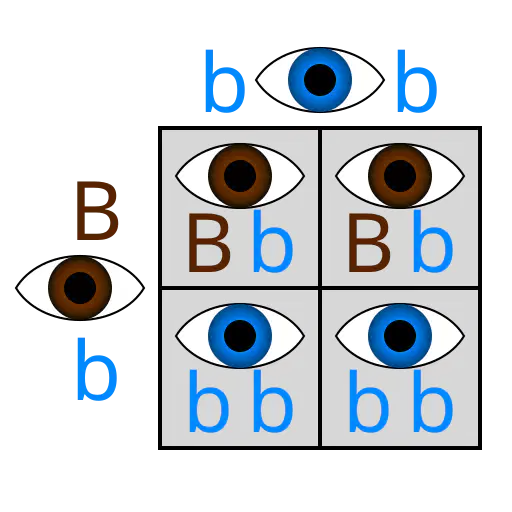
1. The genotype of an organism is the...
a)
genes that includes the pair of alleles an individual inherits from parents.
b)
visible traits that are expressed (or seen) in an organism.
c)
same exact genes of both parents of that organism.
d)
recessive alleles that can only be passed by a dominant gene.
2.

2. Tall pea plants are dominant to short pea plants. A tall pea plant (TT) is crossed with a short pea plant (tt).
What percent of the offspring will be heterozygous?
a)
Only 67% of the offspring will be heterozygous.
b)
Only 38% of the offspring will be heterozygous.
c)
Only 10% of the offspring will be mixed and heterozygous.
d)
100% of the offspring will be tall and heterozygous.
3.

3. If a Parent Spider carries two dominant alleles, then...
a)
the only physical feature passed on to offspring will be the dominant trait.
b)
the only genes that can be passed to the offspring is the recessive trait.
c)
the offspring will carry the genotype of only that one parent.
d)
only the recessive trait will be seen as a physical feature.
4.
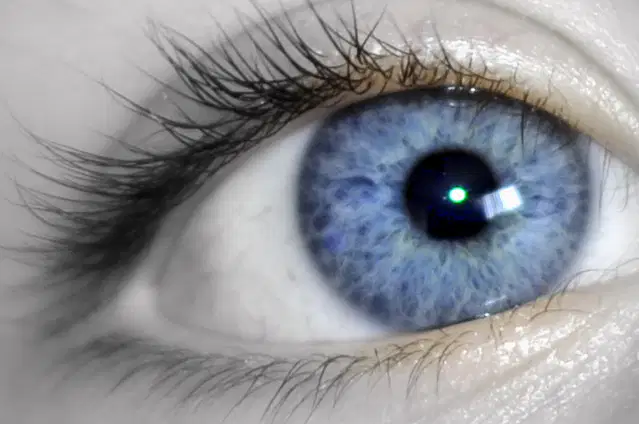
4. To express a recessive trait in the phenotype of an organism...
a)
both of the alleles must have proteins that code for the recessive trait.
b)
both alleles of the proteins must be dominant.
c)
there must be both a recessive trait together with a dominant trait.
d)
only one allele needs to be recessive proteins in the offspring.
5.
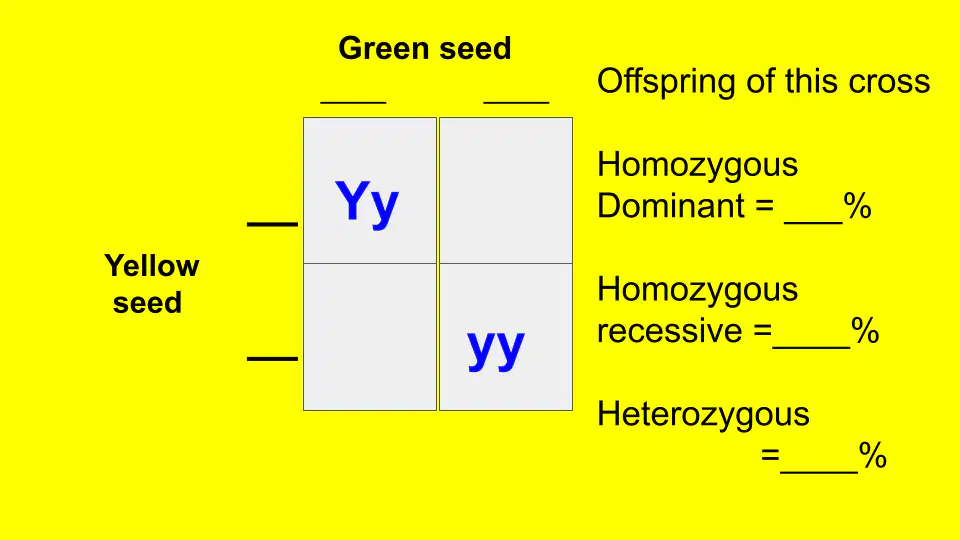
5. In pea plants, yellow seeds are dominant to green seeds. A heterozygous yellow-seeded pea plant (Yy) is crossed with a plant that has green seeds (yy). Select a true statement about this cross.
a)
Heterozygous 50% probability
b)
Heterozygous 10%
c)
Homozygous 40%
d)
Dominant 5%
6.

6.Sherry reads an article about a family of wildcats. One of them had a mutation for tooth shape. Which of these statements about the wildcat with the mutation is true?
a)
There must have been a change in the wildcat’s genes.
b)
The wildcat must have more teeth.
c)
There will be no change to the wildcat’s teeth.
d)
The wildcat must have less teeth.
7.

7. A father sheep has curly wool while a mother sheep has straight wool. Which of these statements explains why one of their baby lambs has curly wool?
a)
The baby lamb inherited its copies of the gene from only the mother
b)
The baby lamb inherited its curly gene from the mother and the father
c)
The baby lamb inherited a dominant curly allele from it's father
d)
The baby lamb inherited homozygous recessive genes from the mother
8.

8. Henry is studying a family of tree frogs that have poisonous skin, and he finds one frog with a mutation on the gene for poison. Which of these statements about the tree frog with the mutation is true?
a)
There will be no change to the frog’s poison
b)
The frog must be more poisonous than other frogs
c)
The frog must be less poisonous than other frogs
d)
There must have been a change in the frog’s genes
9.

9. Two fruit flies have different parents. One fruit fly has white eyes while the other has red eyes. Why do the fruit flies have different eye colors?
a)
Fruit Flies have multiple genes for phenotypes and genotypes of eyes.
b)
The heterozygous genes and dominant genes code for red eyes.
c)
The white eyes are a dominant gene that all flies have.
d)
The recessive white genes are expressed only in red eyes.
10.

10. In one dragonfly, the proteins for wing genes mutated, but the function was not affected. What happened in that dragonfly?
a)
That type of protein changed, but its function doesn’t change
b)
The changed protein connects differently, but its function changed.
c)
The changed protein connects differently, so its function changes
d)
The changed protein connects the same, but its function changes.
100 %

