
 Worksheets
Module 3 Test Review
Total questions: 19
Worksheet time: 13mins
What happens to air pressure as altitude increases?
Air pressure increases
Air pressure decreases
Air pressure remains the same
Air pressure fluctuates randomly

Which of the following is a contributing factor to the uneven warming of Earth’s surface?
The sun’s rays hit the surface of the earth at the same angles
all surfaces retain energy the same
all surfaces warm at the same rates
the sun’s rays hit the surface of the earth at different angles
Which of the following best explains why the Earth's surface is heated unequally?
The Earth is flat
The Earth rotates on its axis
The Earth is closer to the sun at the equator
The Earth has different types of surfaces that absorb heat differently
Describe how energy is transferred from the sun to the Earth.
Through conduction
Through convection
Through radiation
Through evaporation
Which type of rock is formed from the cooling and solidification of magma or lava?
Sedimentary rock
Metamorphic rock
Igneous rock
Fossil rock

True or False: Igneous Rocks form from Sediment
True
False
Explain how sedimentary rocks are formed.
By the cooling of magma
By the accumulation and compaction of sediments
By the transformation of existing rock types
By the evaporation of water
Earth’s surface is heated...
unequally
equally
not at all

The heat transferred from the Sun to the Earth by waves is called ________.
conduction
radiation
convection
What happens to air pressure as altitude increases?
air pressure is greatest
air pressure is the least
What is the correct order of the layers of Earth's interior from the outermost to the innermost?
Crust, Mantle, Outer Core, Inner Core
Mantle, Crust, Inner Core, Outer Core
Inner Core, Outer Core, Mantle, Crust
Outer Core, Inner Core, Mantle, Crust
How does the water cycle contribute to the distribution of Earth's water resources?
It keeps water in the oceans only
It moves water between the atmosphere, land, and oceans
It prevents water from evaporating
It only affects freshwater sources

Which city is about to experience a cold front?
Denver
Chicago
Predict what might happen to global weather patterns if the Earth's surface absorbed more solar energy.
There would be no change in weather patterns
Global temperatures would decrease
Weather patterns would become more extreme
The Earth would stop rotating
Analyze how the unequal heating of Earth's surface affects wind patterns.
It causes wind to blow in a straight line
It creates high and low-pressure areas that drive wind movement
It has no effect on wind patterns
It causes wind to stop completely

A student draws a model to represent the precesses involved in the water cycle, as shown. To which process is the formation of clouds related?
Condensation
Evaporation
Freezing
Melting


Rocks formed through heat and pressure
Igneous
Metamorphic
Sedimentary
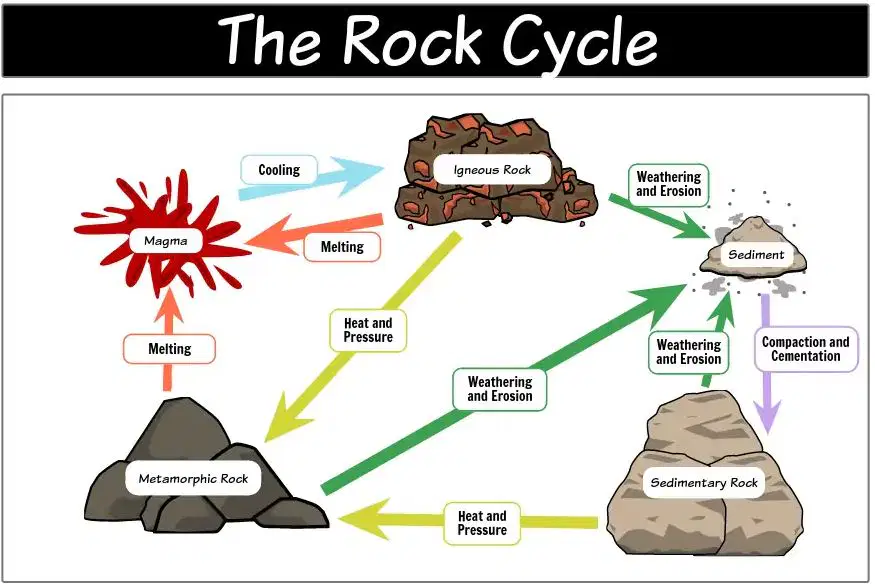
You have 2 rocks formed at the same time. One rock was formed from small pieces of rock and the other was formed from liquid rock in a different place. Would these rocks be the same or different types of rock? Why?
the same type because they are both formed from rock material.
the same type because they formed at the same time
different types because they formed in different ways
different types because they formed in different places

