
Font size
 Worksheets
(Savvas 17.4) Ch. 17.4 Sound and Hearing
Total questions: 19
Worksheet time: 10mins
Ultrasound is sound at frequencies that are lower than most people are capable of hearing.
True
False
The Doppler effect is a change in sound frequency caused by motion of the sound source, motion of the listener, or both.
True
False
For a stationary observer, as a moving sound source approaches, the observer will first hear a(n) _______ frequency of sound and then a(n) _______ frequency as the source moves away.
higher, lower
lower, higher
Oops. The frequency of the sound will not change.
Many musical instruments vary pitch by changing the frequency of standing waves.
True
False
A "dead spot" in a theater refers to a location with reduced volume, which is caused by the ________ of sound waves.
destructive interference
constructive interference
diffraction
absorption
The sympathetic response of a standing wave to another wave of the same frequency is called _______.
resonance.
interference.
diffraction.
reflection.
It makes the sound louder.
It makes the sound travel faster.
It increases the wavelength of the sound.
It increases the pitch of the sound.
What does the loudness of sound depend on? (Mark all correct answers.)
Frequency of the sound wave
Amplitude of the sound wave
Distance from the source of sound
Velocity of the sound wave
High pitched sounds have a relatively large
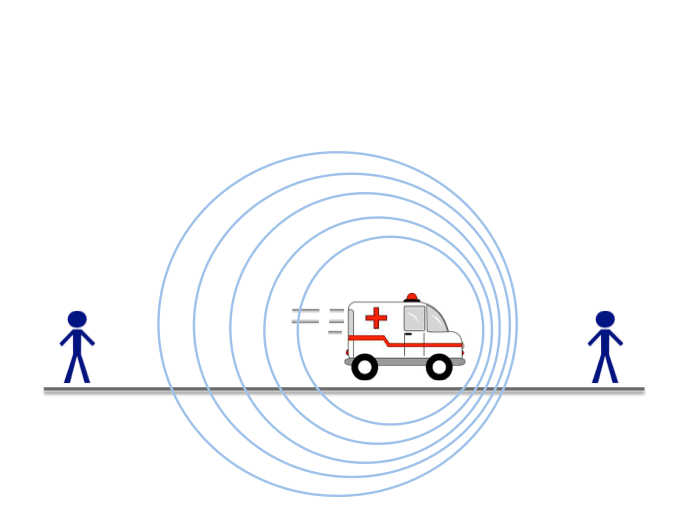
When the car moves away from you, its horn seems...
Low pitched
High pitched
Normal
The speed of sound is faster in air than in water.
True
False
What is the relationship between frequency and pitch?
Higher frequency means lower pitch
Higher frequency means higher pitch
Frequency does not affect pitch
Lower frequency means higher pitch

If the two wavs shown are moving towards each other, what will happen when they meet?
They will cancel each other out due to constructive interference.
They will add together and become larger due to constructive interference.
They will add together and become larger due to destructive interference.
They will cancel each other out due to destructive interference.
Sound usually travels fastest through
solids.
liquids.
gases.
a vacuum.
Sound waves are which type of waves?
Sound waves are longitudinal mechanical waves.
Sound waves are transverse mechanical waves.
Sound waves are electromagnetic waves.
Which type of sound travels fastest through the air?
High pitch sounds travel faster than low pitch sounds.
Loud sounds travel faster than quiet sounds.
All sounds travel through air at the same speed.
The intensity of sound is commonly measured in which units?
hertz (Hz)
decibels (dB)
joules (J)
newtons (N)
The pitch of sound is commonly measured in which units?
hertz (Hz)
decibels (dB)
joules (J)
newtons (N)

