
Font size
 Worksheets
NHA Final Practice Test
Total questions: 120
Worksheet time: 2hrs 0mins
Which of the following actions should a PCT take when preparing to transfer a patient from a bed to a stretcher?
Elevate the bed to a position equal to the height of the stretcher
Elevate the bed to a position lower than the height of the stretcher
Reach across the stretcher to assist the patient
Elevate the bed to a position higher than the height of the stretcher
A PCT is obtaining a patient's apical pulse. The technician should measure this pulse at which of the following locations?
The first intercostal space
The fifth intercostal space
The seventh intercostal space
The tenth intercostal space
A PCT should identify which rhythms should be reported to a nurse because it indicates that a patient might become unresponsive?
Junctional tachycardia
Ventricular tachycardia
Sinus tachycardia
Premature atrial complexes
A PCT is caring for a patient who's unable to void her bladder & crying in pain. Her attending provider has not made rounds & her primary nurse is unavailable. Which of the following actions should the technician take?
Immediately insert a straight catheter to alleviate the patient's pain
Report the patient's pain to the charge nurse
Ask another nurse for permission to catheterize the patient
Contact the patient's on call provider
A PCT obtains a sputum specimen from a patient. The technician should expect the specimen to have which of the following characteristics?
Pink-tinged
Yellow - color
Watery consistency
Thick consistency
A PCT is caring for a patient who has an ostomy. The technician should expect the fecal material to be more solid and less irritating to the skin if the stoma is placed in which of the following locations?
In the ileum
In the ascending colon
In the sigmoid colon
In the cecum
A PCT is preparing to dispose of a dressing that is heavily soiled and leaking fluid. In which of the following locations should the technician dispose of the dressing?
Toilet
Biohazard bag
Sink
Trash can
A PCT is preparing to perform passive range of motion exercises on a patient’s knee. Which of the following types of exercise should the technician perform?
Abduction
Extension
Inversion
External rotation
A PCT is asked by a nurse to complete a task that is outside his scope of practice. After discussing his concern with the nurse and failing to come to a resolution, the technician should report his concern to which of the following individuals?
The attending provider
The charge nurse
The case management nurse
Another PCT
A PCT is caring for a number of patients following a shift change. Which of the following patients should the technician assess first?
A patient who has a temperature of 37.3 °C (99.1 °F).
A patient who is disoriented
A patient who is comatose
A patient who is incontinent
A PCT is caring for a group of older adults. The technician should recognize that which of the following types of injury poses the greatest risk for accidental death in this age group?
Burns
Falls
Entrapment
Poisoning
Two PCTs are transferring a patient who is deceased from bed to a morgue gurney. To avoid injury, the technicians should use which of the following body mechanics?
Roll the patient gently from the bed to the gurney
Use a draw sheet to lift the patient
Have one technician lift the head, the other lift the feet, and allow the momentum to move the patient
Use a mechanical lift with a sling to move the body
A PCT is caring for a patient following the application of an immobility splint. Which of the following actions should the technician take to ensure the patient’s safety?
Lower the bed’s side rails
Raise the bed to the technician’s working height
Ensure that the splint remains moist
Place the call light within the patient’s reach
A PCT is preparing to collect and transport a bilirubin blood specimen. The technician should use a tube that is which of the following colors?
Light blue
Amber
Green
Yellow
A PCT is caring for a patient who is 24 hour postoperative following a total hip arthroplasty and has a surgical wound. Which of the following findings should the technician identify as an indication of potential wound infection?
Seranguineous drainage
General discomfort at the incision site
Oral temperature 36.8 °C (98.2 °F)
Increased warmth around the incision site
A PCT is preparing to discontinue a patient’s peripheral IV. The technician assembles all the needed equipment and performs hand hygiene. Which of the following actions should the technician take next?
Explain the procedure to the patient
Remove any overlying tape
Turn the IV roller clamp off
Apply pressure to the IV site for 2-3 min.
A PCT is applying sequential compression devices (SCDs) to a patient who is postoperative. The technician should identify that SCDs are used to reduce the risk for which of the following conditions?
Edema
Deep vein thrombosis
Varicose veins
Pneumonia
A PCT should identify which of the following tasks requires the use of sterile gloves?
Emptying indwelling urinary drainage bag
Inserting an intermittent urinary catheter
Applying a condom catheter
Removing an indwelling urinary catheter
A PCT is lifting boxes from a cart into a patient’s room. Which of the following actions should the technician take to ensure proper body mechanics?
Hold the boxes close to the body
Maintain a narrow base of support
Bend at the waist to pick up the boxes
Twist at the torso when turning to pick up the boxes
A PCT is preparing to perform a venipuncture for a patient who speaks a different language than the technician. Which of the following actions should the technician take?
Use a loud tone when speaking to the patient
Anticipate the patient’s response
Interpret the patient nodding as an indication of understanding
Provide the patient with a professional translator
A PCT attended an inservice about performing CPR on a patient. When performing CPR, which of the following actions should the technician take?
Apply 60 to 80 compressions followed by two slow breaths
Apply 100 to 120 compressions per minute followed by four slow breaths
Apply 100 to 120 compressions per minute followed by two slow breaths
Apply 60 to 80 compressions per minute, followed by four slow breaths
A nurse asks a PCT to empty a patient’s ostomy bag. The technician is unfamiliar with this task. Which of the following actions should the technician take?
Ask for instructions from the nurse before attempting the task
Ask another technician how to perform the task
Refuse to perform the task
Perform the task as requested by the nurse
A PCT is documenting in a patient’s electronic health record. The technician should identify which of the following abbreviations is on the Joint Commission’s approved list of abbreviations?
NPO
U
IU
MgSO4
A PCT obtains an EKG and notes the presence of a wandering baseline. Which of the following actions should the technician take?
Move the patient’s bed away from the wall
Clean the patient’s skin under the electrodes with alcohol and gauze
Ask the patient to take slow deep breaths
Instruct the patient to place their hands palms down under buttocks
A PCT tears their gloves while cleaning a soiled mattress and gets some of the cleaning solution on their hands. After cleaning their hands, which of the following actions should the technician take next?
Seek medical attention
File a worker’s compensation claim
Review the safety data sheet (SDS) for the cleaning solution
Submit a report to the occupational safety and health administration (OSHA)
A PCT is caring for a patient who is terminally ill. Which of the following actions should the technician take?
Encourage the patient to remain optimistic about their diagnosis
Determine how the patient’s family is coping
Evaluate the patient’s mental health
Inform the nurse if the patient expresses feelings of grief
A PCT is preparing to obtain a 12 lead EKG for a patient who had left arm amputation. In which of the following locations should the technician attach the left arm lead?
Right sternal border
On the amputation site
Anterior axillary line
Left deltoid
Which of the following devices should a PCT use to help a patient maintain balance while being weighed on a scale?
Walker
Cane
Crutches
Wheelchair
A PCT is teaching a newly hired technician about percutaneous endoscopic gastrostomy (PEG) tubes. Which of the following statements should the technician make?
PEG tubes are easier to dislodge than nasogastric tubes
Patients who are disoriented or confused are less likely to dislodge the tube
Patients who are receiving enteral nutrition via a PEG tube have an increased risk for aspiration
If a patient requires enteral nutrition for more than 2 weeks, a nasogastric tube should be used
A PCT is performing an EKG for a pediatric patient. In which of the following locations should the technician place lead V6?
On the anterior axillary line
On the midaxillary line
Halfway between Ids V2 and V4
On the fourth intercostal space, left sternal border
A PCT is reinforcing teaching with a patient who has a Holter monitor. Which of the following statements should the technician make?
Remove the wires at bedtime
Take tub baths instead of showers
Avoid adjusting the electrodes during the monitoring period
Set the time on the digital clock at the beginning of the monitoring period
A PCT is preparing to disinfect a contaminated piece of equipment. Which of the following actions should the technician take?
Scrub the equipment with a bleach solution
Rinse the equipment with warm water
Process the equipment in an autoclave
Soak the equipment in cold water
A PCT has assisted a patient into bed. In which of the following locations should the technician place the drainage bag for the patient’s indwelling urinary catheter?
Resting on the floor
Secured to a side rail
Hanging from the IV pole
Secured to the frame of the bed
A PCT is preparing to open a sterile package. Which of the following actions should the technician take first?
Perform hand hygiene
Remove the seal
Place the item in the center of the work surface
Grasp the outer surface of the outermost flap’s tip
A PCT is wearing gloves while assisting to insert a urinary catheter. Which of the following parts of the chain of infection is the technician interrupting?
Reservoir
Infectious agent
Portal of entry
Susceptible host
A PCT is assisting with the care of a patient who is on strict I & O. How often should the technician record the patient's I & O?
Every 1 hour
Every 2 hour
Every 8 hour
Every 6 hour
A PCT is caring for a patient who has vision loss. Which of the following actions should the technician take when assisting the patient with meals?
Offer to feed the patient
Cut all solid items into small pieces
Withhold liquids until after the patient has finished eating
Describe the location of food on the tray using the face of a clock as a reference
A PCT is about to perform a venipuncture for a patient. Which of the following equipment should the technician use to prevent hemolysis of the blood sample?
A small volume tube with a 21 gauge butterfly needle
A large volume tube with a 23 gauge butterfly needle
A large volume syringe with a 25 gauge needle
A small volume syringe with a 25 gauge needle
A PCT is caring for a 75-year-old patient who was admitted for malnutrition. The patient's family manages the finances and grocery shopping for the patient. Which of the following hospital departments should the technician expect to intervene in this patient's care?
Dietician
Pastoral care
Social worker
Occupational therapy
A patient care technician is assisting a patient to perform passive range-of-motion exercises. Which of the following actions should the technician take?
Position the patient's bed at the lowest level.
Instruct the patient to flex his head.
Place the patient in high-Fowler's position.
Move the patient's arm away from the side of his body.
Which of the following provides specific definitions about the scope of practice for patient care technicians?
The Health Insurance Portability and Accountability Act of 1996 (HIPAA)
The doctrine of informed consent
The Patient Self-Determination Act (PSDA)
The state nurse practice acts
A patient care technician is caring for a patient who is to receive continuous tube feedings. The technician should place the patient into which of the following positions?
Supine position
Prone position
Semi-Fowler's position
Trendelenburg position
Which of the following can reduce abnormal marks on an EKG tracing that are caused by patient movement or muscle tremors?
Speed control
Calibration
Artifact filter
Gain control
A patient care technician in a facility sustained a needlestick injury. Which of the following should the technician notify following the incident?
The nurse
The National Institute for Occupational Safety and Health (NIOSH)
The patient
The Centers for Disease Control and Prevention (CDC)
A patient care technician should identify that a bed scale should be used for a patient who has which of the following conditions?
Fractured ankle
Above-the-knee amputation
Total hip dislocation
Venous stasis ulcers
A patient care technician receives a needlestick injury during a routine venipuncture. Which of the following actions should the technician take first?
Report the incident to the supervisor.
See a provider for evaluation.
Wash the site with antimicrobial soap.
Get tested for HIV infection.
A patient care technician should identify that the provider will stop an exercise stress test if a patient develops which of the following symptoms?
Mild fatigue
Syncope
Perspiration
Increased respiratory rate
A patient care technician is preparing to perform a venipuncture for a patient. The patient states, "I'm pretty anxious about this since it's my first time having blood drawn." Which of the following actions should the technician take?
Explain the reason the provider prescribed the test in detail.
Inform the patient about all possible complications.
Prepare an ammonia inhalant for the patient.
Describe the procedure to the patient.
A patient care technician is preparing to document information in a patient's electronic health record (EHR). Which of the following actions should the technician plan to take?
Record care before it is provided.
Note patient response to an analgesic
Record the patient's vital signs as reported by the nurse.
Use generalized phrases when documenting
A PCT overhears a nurse say to a patient who has cognitive impairment, “I’m so tired of you ringing the call bell.” The technician should identify that the nurse’s action violates which of the following parts of the Patient’s Bill of Rights?
Right to be free of psychological abuse
Right to be free of physical abuse
Right to refuse treatment
Right to make decisions about plan of care.
A PCT is documenting a patient’s intake and output. Which of the following measurements should the technician include when recording output for the end of shift totals?
Serous fluid on a wound dressing
Nasogastric suction volume
Solid stool from a colostomy
Total parenteral nutrition (TPN) administered.
A PCT is caring for a patient who has end stage pancreatic cancer. The patient’s family expresses concern because the patient has refused admission to the hospice program and is seeking additional medical treatment. Which of the following actions should the technician take?
Encourage the patient to enter the hospice program
Tell the patient that further treatment is not an option
Acknowledge the family’s concern and notify the nurse
Recommend alternative treatment options for the patient.
A PCT is assisting with the care of a patient who is on strict I & O. How often should the technician record the patient’s I & O?
Every 1 hour
Every 2 hour
Every 8 hour
Every 6 hour
A PCT obtains a stool sample specimen from a patient. Which of the following actions should the technician take when labeling the specimen?
Apply the label to the side of the specimen container
Apply the label to the lid of the specimen container
Apply the label to seal the lid onto the specimen container
Apply the label to the outside of the sealed biohazard bag that holds the specimen container.
Which of the following is a consequence of mislabeling a blood bank specimen?
A HIPAA violation
A transfusion reaction
A medical transcription error
A pharmaceutical reaction.
A PCT notices that a patient cut his foot while ambulating and is bleeding. Which of the following should the technician take?
Activate the emergency response team
Instruct the patient to remain in a standing position
Place the affected extremity below the level of the heart
Apply steady pressure to the wound
A PCT in a hospice setting is caring for a patient who has terminal cancer and states: I need to live long enough to see my child get married. The technician should identify that the patient is in which of the following stages of grief?
Bargaining
Denial
Acceptance
Anger
Which of the following findings should a PCT report to a nurse?
A 1 year old patient who has a pulse rate of 50/min
A 12 year old patient who has a pulse rate of 76/min
A 40 year old patient who has a pulse rate of 88/min
An 89 year old patient who has a pulse rate of 85/min
A PCT should identify that which of the following patients requires droplet precautions?
A patient who has influenza
A patient who has scabies
A patient who has pediculosis
A patient who has hepatitis A
A PCT is performing ostomy care for a patient. Which of the following findings should the technician report to the nurse?
The stoma has a small amount of bloody drainage
The stoma is red in color
The stoma is leaking around the wafer
The stoma remains the same size
A PCT is caring for a patient who has COPD and is receiving oxygen therapy. The technician notes that the patient appears restless and is short of breath. Which of the following actions should the technician take?
Increase the flow of oxygen to the patient
Notify the nurse immediately
Assist the patient to ambulate
Lower the head of the bed
When collecting a multi draw venous sample which of the following sites should the PCT attempt to draw from first?
Median cubital
Basilic
Cephalic
Radial
A PCT should recognize that which of the following statements regarding skin preparation for blood cultures is correct?
I will cleanse the area with 70% ethyl alcohol
I will cleanse the area with sodium hypochlorite
I will cleanse the area with chlorhexidine gluconate
I will cleanse the area with sterile saline
A PCT is performing an EKG for a patient who has a pacemaker. Which of the following controls should be adjusted to ensure an accurate EKG tracing?
Lead selector
Artifact filter
Heart rate limits
Speed
A PCT is preparing to obtain a 12 lead EKG for a patient who is being evaluated for chest pain in the emergency department. Which of the following actions should the technician take if the patient expresses fear of the procedure?
Advise the patient that the test is painless
Require the patient to remove all clothing
Inform the patient that refusal is not an option due to the presenting symptom
Caution the patient that jewelry near the wires and electrodes might cause sparks.
A PCT is transporting a patient using a wheelchair. Which of the following actions should the technician take?
Ensure the patient’s feet are placed on the footrests
Place a loose blanket over the patient’s legs
Fasten the seat belt loosely around the patient’s waist
Pull the back wheels onto the curb first when going up a curb.
A PCT is preparing to ambulate a patient who requires the use of a gait belt. Which of the following actions should the technician take?
Walk on the patient’s stronger side while ambulating
Walk slightly in front of the patient while ambulating
Apply the gait belt over the patient’s clothing at the waist
Grasp the gait belt on each side with palms facing downward.
A PCT should identify that adjusting a patient’s bed to be between 60° and 90° will place the patient in which of the following positions?
Fowler’s
Orthopneic
Semi-Fowler’s
High Fowler’s
Which of the following blood specimens should a PCT keep chilled during transfer to the laboratory?
Ammonia
Bilirubin
Glucose
Potassium
A PCT is to perform a venous blood draw for a 91 year old patient. The technician should use which of the following methods?
Butterfly needle and syringe
Hand draw
Capillary collection
Vacutainer collection
A PCT enters the patient's room and is approached by visitor’s requesting test results. Which of the following responses by the technician is appropriate?
The doctor needs to give you that information
The lab values were all within the expected reference range
I’m sorry but I can’t give you that information
I’ll ask the nurse to give you that information
A PCT is collecting a patient’s sputum specimen. Which of the following actions should the technician take?
Instruct the patient to perform shallow coughs
Collect a minimum of 5 tsp of sputum
Have the patient use an alcohol based mouthwash prior to collection
Obtain the specimen first thing in the morning
A PCT is caring for a patient following the application of an immobility splint. Which of the following actions should the technician make to ensure the patient’s safety?
lower bed side rails
raise bed to technician working height
ensure splint remains moist
place call light within patients reach
A PCT is performing postmortem care of a patient. Which of the following is a correct technique for preparing the body?
Remove any dentures as soon as possible
Place the body supine, with one hand crossed over the other
Ensure all tubes, drains, and bandages are removed
Place a folded towel under the head
A PCT is caring for a patient who has a two piece colostomy system in place. Which of the following should the technician take when providing ostomy care?
Apply pressure for 30 seconds when applying the skin barrier wafer
Cut the skin barrier wafer to be 0.64 cm (0.25 in) larger than the stoma
Verify the stoma is moist and reddish-pink in color
Cleanse the skin around the stoma with hot, soapy water
A PCT is caring for a patient who is nonverbal. The technician should identify that which of the following findings can indicate the patient is experiencing pain?
decreased temperature
Restlessness
Change in level of consciousness
Dry skin
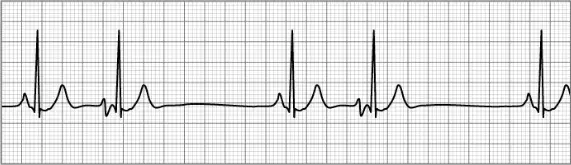
Which of the following arrhythmias is represented in the tracing below?
Atrial premature contraction
Atrial fibrillation
Wandering atrial pacemaker
Ectopic atrial tachycardia
A PCT should report which of the following as possible elder abuse or neglect?
A patient who refuses to take prescribed medications
A patient who reports receiving phone calls from family but never any visits
A patient who reports his checking account is being mismanaged by his adult grandchild
A patient whose provider has refused to sign paperwork to allow for renewal of the patient’s driver’s license
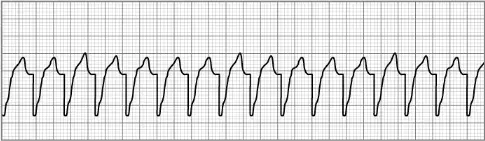
Identify the arrhythmia in the tracing below.
Junctional tachycardia
Ventricular tachycardia
Sinus tachycardia
Accelerated idioventricular rhythm
A PCT is collecting a urine specimen and accidently spills it on the floor. Which of the following actions should the technician take to clean the spill?
Use a clean, dry towel
Use a disinfectant that contains bleach
Call the hazardous materials team
Use a mop with hot, soapy water
The choice to perform a capillary puncture is best determined by which of the following factors?
Patient weight
Patient diagnosis
Test results
Test ordered
A PCT is assisting with the physical examination of a patient. Which of the following identifiers should the technician use to verify the patient’s identity?
Age
Date of birth
Room number
Diagnosis
A PCT is performing perineal care for a patient who is at risk for skin breakdown. Which of the following products should the technician use to prevent skin breakdown?
Barrier cream
Silver sulfadiazine cream
Moisturizing cream
Permethrin cream
A PCT is caring for a patient who has right sided heart failure. Which of the following findings should the technician expect?
Hypertension
Pallor
Tachycardia
Swelling of the legs
A PCT is preparing to obtain and process a urine drug test for a patient. Which of the following actions should the technician plan to take?
Seal the specimen lid with the label from the chain of custody form
Check the specimen’s temperature within 10 min of receiving the specimen
Ship the specimen to the testing laboratory the next day
Instruct the patient to flush the toilet following voiding
A PCT is transferring a non weight bearing patient from the bed to a wheelchair. Which of the following actions should the technician take?
Keep the bed at the most comfortable working height
Place hands under the patient’s arms to provide support
Lock the wheels of the bed and wheelchair
Instruct the patient to remove socks and shoes
A PCT is caring for a new patient. The technician should recognize that which of the following procedures requires medical aseptic or clean techniques?
Assisting to apply a sterile dressing
Inserting a urinary catheter
Changing bed linens
Cleaning an operating room
Which of the following is the most important action a PT can take to help prevent the spread of infection?
Wearing PPE
Performing hand hygiene between contact with patients
Covering the mouth and nose when sneezing or coughing
Disposing of all used needles in the sharps container.
A PCT is using massage to stimulate circulation for a patient who is immobile. Which of the following areas should the technician massage?
The patient’s back
The patient’s lower legs
Reddened areas
Bony prominences
A PCT in a long term care facility is caring for a patient who requires restraints. For which of the following reasons should a technician expect a provider to prescribe restraints?
To prevent patients from injuring themselves or others
To prevent patients from falling out of bed
To provide convenience for the nursing staff
To allow patients to independently reposition themselves
A PCT is performing a 12 lead EKG for a patient who has tachycardia. Which of the following paper speed settings should the technician expect the provider to prescribe?
50 mm/sec
25 mm/sec
5 mm/sec
10 mm/sec
A PCT is assisting with the care of a patient who has diabetes mellitus. The technician should know which of the following is a sign of hyperglycemia?
Cool, clammy skin
Fever
Frequent urination
Rapid, shallow respirations
A PCT is caring for a patient who had a cerebrovascular accident and is non ambulatory. Which of the following findings should the technician report to the nurse immediately?
Skin discoloration that subsides with repositioning
Chronic loss of feeling in one extremity
One episode of incontinence
Change in size and shape of a pressure ulcer
Which of the following is the purpose of using standard precautions in the healthcare setting?
To ensure that all healthcare workers receive the necessary immunizations
To protect staff and patients from airborne illnesses
To guarantee that patients understand infection control guidelines before signing informed consent
To reduce the transmission of bloodborne pathogens when providing care
A PCT is caring for a patient and notices a fire in the waste basket. Which of the following actions should the technician take first?
Close all the doors to the patient’s room
Remove the patient from the room
Activate the emergency alarm
Extinguish the fire
A PCT should identify that which of the following patients requires contact precautions?
A patient who has rotavirus
A patient who has tuberculosis
A patient who has measles
A patient who has influenza
A PCT is assisting with the care of a patient who has active tuberculosis (TB). Which of the following types of masks should the technician wear when in the patient’s room?
Face mask
N95 respirator mask
Venturi respirator mask
Nonrebreather respirator mask
A PCT is preparing to perform urinary catheter care for a female patient. Which of the following actions should the technician take?
Clean around the meatus with antiseptic solution
Tape the cleaned catheter snugly to the lower leg
Use normal saline to cleanse the meatus
Place the patient supine with thighs slightly abducted
A PCT is obtaining a blood specimen for coagulation testing. The technician should select a tube that contains which of the following additives?
Ethylenediaminetetraacetic acid (EDT
Sodium citrate
Heparin
Potassium oxalate
A PCT receives a needlestick injury. The technician should report this injury at which of the following times?
Within 72-96 hours
Before the start of the next shift
By the end of the documented pay period
Before leaving the facility at the end of their shift
A PCT is planning for a patient who is on contact precautions. When entering the patient’s room, the technician should apply which of the following?
N95 respirator
Gown
Surgical mask
Shoe covers
A PCT is instructed to measure a patient’s pulse manually. Which of the following actions should the technician take?
Place the center of the palm over the patient’s chest and count each pulse felt for 2 min
Locate the brachial pulse using the thumb, count pulses felt fo 30 seconds, and multiply by 2
Locate the radial artery, feel for the pulse with the index and middle fingers and count pulse felt for 1 minute
Locate the radial artery and use the thumb to count each pulse felt for minute
A PCT is performing an EKG and the patient reports chest pain and discomfort. Which of the following actions should the technician take?
Reposition the patient’s chest electrodes
Perform another EKG recording
Notify the patient’s provider
Check the patient and the room for causes of artifact interference
A PCT is assisting a nurse to set up suction equipment for a patient who has a tracheostomy. Which of the following actions should the technician take to maintain the sterility of the equipment?
Use clean gloves to open the suction catheter kit
Place a prepackaged drape under the tracheostomy site
Open the suction catheter kit and place the tip of the catheter on a towel
Use the dominant hand to turn on the suction machine
A PCT should recognize that which of the following scenarios requires an aseptic dressing change?
Changing the surgical wound dressing of a patient who is 1 day postoperative
Changing a patient’s triple lumen catheter dressing
Changing the dressing of a patient who has a deep wound drain
Changing the dressing of a patient who has superficial decubiti
A CT schedules hygiene care measures to be performed at the same time as other care measures. Which of the following best describes the technician’s action?
Continuity of care
Care plan
Coordination of care
Hygiene care schedule
A PCT is preparing to perform venipuncture for a patient using the antecubital area. At which of the following angles should the technician insert the needle?
40 ° to 45°
5 ° to 10°
15 ° to 30°
50 ° to 60°
A PCT is preparing a patient for hospital discharge. The patient states, I’m afraid to go back home to my partner. Which of the following responses by the technician is appropriate?
Would you like to speak with a police officer?
If your partner is abusing you at home, would you tell me immediately?
Your partner loves you, and you have no reason to be afraid
Can you tell me if something happened that made you feel unsafe?
A PCT is measuring an adult’s blood pressure electronically. Which of the following readings should be reported to the nurse?
130/81
119/76
116/78
98/60
A PCT is preparing to assist in performing an EKG for a toddler. Which of the following leads can be placed in mirror image to typical placement to prevent crowding of the electrodes?
Lead V2
Lead V1
Lead V5
Lead V3
A PCT should identify that which of the following actions can create shearing force and impair skin integrity?
Use a lift device to reposition a patient
Assisting a patient to the bathroom frequently
Repositioning a patient every 2 hours
Elevating the head of a patient’s bed to 45 °
A PCT should recognize that health care facilities are required by which of the following entities to keep safety data sheets (SDS) available?
OSHA
TJC
CLIA
Clinical and Laboratory Standards Institute (CLSI)
Which of the following organizations provides guidelines for identifying and preventing the spread of communicable diseases?
CDC
OSHA
FDA
NIOSH
. A PCT is asked to leave a patient’s medical record in a designated area for the provider to view.Which of the following actions should the technician take to adhere to HIPAA guidelines?
Stay with the record until the provider arrives
Check the record for accuracy
Obtain any missing signatures on consent forms
Ensure that no identifiable patient information is visible
A PCT is caring for a patient who has to undergo a blood transfusion. The technician should recognize which of the following vital signs should be reported to the nurse immediately?
Pulse rate 85/min
Respiratory rate 17/min
Temperature 38.8 ° C (101.8 ℉)
Blood pressure 118/79 mm Hg
A PCT is reinforcing teaching with a patient who is using an incentive spirometer. Which of the following statements should the technician take?
Lie flat on the bed while using the spirometer
Inhale forcefully through the long tube to raise the balls in the chamber
Take a deep breath and exhale through the long tube for 10 seconds
Remove the long tube from the spirometer and breathe directly into the chamber
Which of the following procedural steps for a finger stick should a PCT do first?
Cleanse the site with an antiseptic wipe
Position the blade of the lancet actress the lines of the fingertip
Select the appropriate part of the third or fourth finger
Confirm the correct identity of the patient
A PCT is transferring a patient from the bed to a wheelchair. In which of the following positions should the technician stand during the transfer?
Facing the patient
Behind the wheelchair
On the patient’s weak side
With one leg between the patient’s legs
A PCT is assisting a patient who is postoperative with deep-breathing exercises. The technician should recognize that these exercises can be prescribed for which of the following reasons?
To treat respiratory arrest
To prevent respiratory complications
To prevent wound dehiscence
To treat cardiac arrest
After drawing 6 vials of blood for a patient, a PCT finds that two of the six vials should the technician take?
Notify the manufacturer
Discard the expired vials
Submit the vials for testing with a supervisor
Place new expiration date labels on the expired