
Font size
 Worksheets
Revision Paper A
Total questions: 90
Worksheet time: 45mins
Who does the Health and Safety at Work etc. Act, 1974 make responsible for the health of everyone at work?
Only the employer
Only the employees
Both the employer and employees
The government
To what extent does the Health and Safety at Work etc. Act 1974 compel employers to remove all risk from the workplace?
Employers must remove all risks completely
Employers must reduce risks to the lowest reasonably practicable level
Employers are not required to address risks
Employers must only address risks if an accident occurs
Which should come first, writing the SOPs or preparing the risk assessment?
Writing the SOPs
Preparing the risk assessment
Both should be done simultaneously
It does not matter which comes first
Which of the regulations, W to Z, are relevant in the situation where a company that does not handle hazardous materials needs to update its health and safety policies?
W: Management of Health and Safety at Work Regulations 1999
X: Control of Substances Hazardous to Health (COSHH) Regulations 2002
Y: Environmental Protection Act (EPA) 1990
Z: Special Waste Regulations 1996
Which of the regulations, W to Z, are relevant in the situation where a technician in a school laboratory needs to dispose of old chemicals?
W: Management of Health and Safety at Work Regulations 1999
X: Control of Substances Hazardous to Health (COSHH) Regulations 2002
Y: Environmental Protection Act (EPA) 1990
Z: Special Waste Regulations 1996
A company is reviewing its training policy. All new employees undergo a half-day induction process that includes health and safety training. Half-day refresher courses are offered to all staff every five years. Evaluate this policy and suggest how it could be improved and why.
Increase the frequency of refresher courses to annually
Extend the induction process to a full day
Offer refresher courses every two years
No improvement needed
A new company has developed an approach to health and safety that includes the following: The human resources department has the responsibility for carrying out all risk assessments. The production department has the responsibility for preparing all SOPs. Risk assessments and SOPs are made available on the company intranet. Assess what might be missing from the company’s approach to risk assessment and SOPs.
Involvement of employees in risk assessments
Regular updates to SOPs
Training on SOPs for all employees
All of the above
Explain why the use of personal protective equipment should be considered only when all other steps have been taken to reduce risk.
PPE is the most effective way to eliminate risk
PPE is a last resort after other controls have been applied
PPE is not necessary if other controls are in place
PPE is too expensive to be used regularly
You have been asked to dispose of large drums of solid and liquid chemical waste. Describe what the Environmental Protection Act (EPA) 1990 would require the process to include.
Ensure waste is disposed of in a manner that prevents harm to the environment
Dispose of waste in any available landfill
Burn the waste to eliminate it
Store the waste indefinitely
You have been asked to dispose of large drums of solid and liquid chemical waste. Describe what the Control of Substances Hazardous to Health (COSHH) Regulations 2002 would require the process to include.
Identify and assess the risks associated with the waste
Dispose of waste without any assessment
Use any available method to dispose of waste
Ignore the waste if it is not causing immediate harm
You have been asked to dispose of large drums of solid and liquid chemical waste. Describe what the Manual Handling Operations Regulations 1992 would require the process to include.
Ensure safe manual handling techniques are used
Use any available method to move the waste
Ignore manual handling if machinery is available
Allow only trained personnel to handle the waste
A company kept an accident book that was used to record all accidents that led to an employee being off work for more than seven days. Describe what the Reporting of Injuries, Diseases and Dangerous Occurrences Regulations 2013 (RIDDOR) requires in terms of recording and reporting accidents.
Record and report all accidents, regardless of severity
Only record accidents that result in fatalities
Record and report accidents that result in more than seven days off work
No requirement to record or report accidents
What is the primary purpose of legislation and regulations in the health and science sector?
To increase the workload of employees
To ensure safety and minimise risks
To generate revenue for the government
To complicate workplace procedures
How can health and safety at work be promoted effectively?
By ignoring minor safety issues
Through regular training and awareness programs
By focusing only on major hazards
By leaving safety to individual discretion
How should situations that can occur in a health or science environment that could cause harm to self or others be dealt with?
By ignoring them if they seem minor
By reporting and addressing them immediately
By waiting for management to notice
By handling them without any formal procedure
What is the main reason we must adhere to good scientific and clinical practice standards and procedures?
To ensure that the work is completed quickly.
To avoid disastrous consequences from errors.
To make the work more enjoyable.
To reduce the cost of scientific research.
According to the learning outcomes, why is it important to follow SOPs?
Because it is a legal requirement.
To ensure consistent and reliable results.
To make the procedures more complex.
To increase the time spent on experiments.
What does A7.5 refer to in the learning outcomes?
The importance of maintaining personal hygiene.
The potential impacts of not regularly cleaning and preparing work areas for use.
The benefits of having a clean work environment.
The consequences of using outdated equipment.
What is the potential consequence of not maintaining, cleaning, and servicing equipment as mentioned in A7.6?
Improved efficiency of the equipment.
Extended lifespan of the equipment.
The equipment might not be fit for use.
Decreased costs for equipment maintenance.
What does A7.10 highlight as a learning outcome?
The importance of regular staff training.
The potential consequences of incorrectly storing products, materials, and equipment.
The need for frequent equipment upgrades.
The benefits of having a diverse range of equipment.
What is the main reason we must all follow Standard Operating Procedures (SOPs) ?
To ensure that the process or activity is done correctly and consistently.
To avoid legal consequences in some organizations.
To prevent being fired from the job.
To ensure that the product is always of poor quality.
Which of the following is NOT a principle of good practice in scientific and clinical settings?
Predictability
Reproducibility
Inconsistency
Reliability
What is an SOP intended to standardize?
The approach to a process or action.
The payment of invoices only.
The legal consequences of actions.
The quality of the products being poor.
What is a key word mentioned in the text that an SOP should ensure?
Flexibility
Standard
Complexity
Inconsistency
What is essential to reduce harm to employees, the public, or the environment?
Ignoring SOPs
Performing a proper risk assessment
Maintaining poor quality products
Changing the SOPs frequently
What is the purpose of having good-quality Standard Operating Procedures (SOPs) in the science and healthcare sectors?
To ensure that any applicable laws are followed
To reduce the cost of clinical trials
To increase the speed of regulatory approval
To eliminate the need for professional standards
Which of the following is NOT a reason for requiring SOPs?
Cleaning staff wanting their tasks on a chart
Storing and disposing of hazardous waste
Carrying out clinical trials of new medicines or therapies
Obtaining regulatory approval for new medicines, medical devices or treatments
Who may supervise regulated activities such as the production of pharmaceuticals?
A qualified person (QP)
A general practitioner (GP)
A registered nurse (RN)
A laboratory technician
What is a consequence of not following an SOP?
Increased efficiency in the workplace
Improved personal relationships at work
Documentation for regulatory bodies
It may be considered as not doing something properly
Where might SOPs be held in an organization?
Exclusively in electronic format on personal devices
Only in paper-based index
In departments to which they relate or that are used infrequently
On a public website for general access
What is a recommended method for finding SOPs if they are not readily available?
Asking colleagues informally
Conducting detailed index searches via intranet or manual
Waiting for annual audits to reveal them
Ignoring the need for SOPs and proceeding without them
What is an important aspect of staff induction and ongoing training?
Learning about the history of the organization
Understanding the importance of SOPs
Focusing on individual achievements
Avoiding detailed explanations of procedures
Why is it important to ensure that an SOP is the most up-to-date version?
Older versions are easier to understand.
Outdated versions can be more comprehensive.
Methods, equipment, regulations, and roles may have changed.
Older versions are more accessible to staff.
What is a method of version control for SOPs?
Only allowing senior staff to access SOPs.
Controlling the production and distribution of SOPs.
Requiring all staff to memorize SOPs.
Limiting SOP access to certain departments.
What is the purpose of maintaining a central deposit for SOPs?
To ensure that only the most recent SOPs are used.
To create a backup in case of system failure.
To reduce the need for training new employees.
To prevent unauthorized changes to SOPs.
Why is good documentation essential in a workplace?
It helps to reduce the amount of training required.
It ensures that tasks are done correctly and provides an audit trail.
It simplifies the process of updating SOPs.
It decreases the need for version control systems.
What is the impact of not regularly cleaning and preparing work areas for use?
It can lead to a decrease in productivity.
It can result in an increase in staff morale.
It can cause a spread of infection.
It can improve the efficiency of SOPs.
Which of the following is not a way that micro-organisms can spread infection according to the text?
Through aerosols produced by breathing, coughing, or sneezing
By contact with fomites like door handles and mobile phones
Through accumulation of waste and rubbish
By consuming contaminated food
What is the main reason aseptic technique is used in microbiology?
To speed up chemical reactions
To prevent contamination of bacterial cultures
To reduce the cost of experiments
To increase the speed of pathogen growth
What can be a consequence of a pathogen contaminating a culture in a laboratory?
Faster results of the experiment
Improved accuracy of the experiment
Invalid results of the experiment
More cost-effective research
What is a potential risk when 'foreign' DNA is introduced in a polymerase chain reaction (PCR)?
The reaction will be faster
The DNA evidence in a criminal trial could be invalidated
The cost of the PCR will decrease
The PCR will require less technical expertise
What is suggested to minimize the risk of contamination when working with PCR?
Increasing the temperature of the reaction
Using less reagent in the reaction
Thinking about the use of SOPs and staff training
Reducing the number of PCR cycles
What are the consequences of not following an SOP (Standard Operating Procedure) for equipment maintenance?
Decreased risk of injury
Reduced spread of infection
Increased repair or replacement costs
Improved efficiency in completing tasks
What is a potential risk to health and safety due to not maintaining, cleaning, and servicing equipment properly?
Decreased risk of injury
Increased risk of injury
Better performance of equipment
Longer lifespan of equipment
How can inadequate cleaning of equipment lead to invalid results?
By increasing the efficiency of the equipment
By reducing the risk of cross-contamination
By ensuring the equipment is always available
By causing contamination or cross-contamination
Why are endoscopes considered to be at a higher risk of microbial contamination than other types of medical devices?
They are not used inside the body
They are heat-sensitive and cannot be steam sterilised
They are less delicate than other medical devices
They do not come into contact with pathogens
What is the impact of lack of proper maintenance on the lifespan of equipment?
It has no impact on the lifespan of equipment
It increases the lifespan of equipment
It leads to a decreased lifespan of equipment
It ensures equipment is always in service
What is the true value of a measurement?
The value that is closest to the standard reference
The value obtained after calibration
The ideal or perfect value
The value with the least uncertainty
Why is calibration required for any instrument with moving parts, such as an analogue ammeter or voltmeter?
To ensure the readings are precise
To prevent cross-contamination of standard solutions
To adjust the balance of the instrument which can be affected by temperature changes
To comply with legal requirements for all measuring equipment
What is the main reason calibration is only as good as the reference standard used?
Because it ensures the equipment will last longer
Because it helps in meeting legal requirements
To prevent cross-contamination of standard solutions, corrosion of standard masses, etc.
To ensure the accuracy of measurements
What is the purpose of calibrating and testing equipment as part of a preventative maintenance program?
To comply with legal requirements
To ensure the accuracy of measurements
To extend the useful life of the equipment
To adjust the balance of the instrument
What is the legal requirement for all measuring equipment used in trade?
To be calibrated before each use
To be certified to meet certain standards
To ensure consumer confidence in their purchases
To prevent cross-contamination of standard solutions
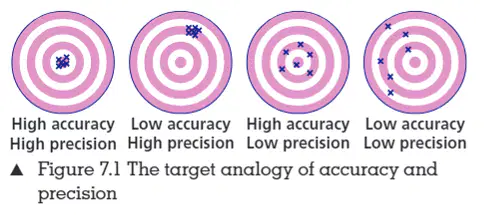
What does the analogy of shooting at a target illustrate in Figure 7.1?
The difference between accuracy and precision
The process of calibration
The importance of using a reference standard
The legal requirements for measuring equipment
Which legislation might be relevant when considering the calibration requirements of measuring equipment used at the workplace?
Weights and Measures Act 1985
National or International Standards such as BSI or ISO
Control of Substances Hazardous to Health (COSHH) Regulations 2002
Environmental Protection Act 1990
What should be done if a piece of equipment like a pH meter or thermometer is found to be out of calibration or specification?
Continue using the equipment and find a replacement when convenient
Stop using it immediately and find another one
Label the equipment as being out of use
Report the issue to a safety officer or manager
What is a key reason for documenting concerns about equipment being fit for purpose?
To cover your back in case of any repercussions
To ensure that everyone using the equipment is aware of any issues
To keep a personal record of your actions
To avoid responsibility for equipment maintenance
What might a log for key equipment include?
Who used the equipment
What the equipment was used for
Any routine calibration or maintenance carried out
All of the above
What action should be taken if equipment is labeled as being out of use?
Ignore the label and continue using the equipment
Make sure the label is prominent and cannot be easily overlooked or removed
Remove the label and use the equipment if it seems fine
Report the labeled equipment as a safety hazard
Who should be informed of any issues that could have an impact on safety?
The person using the equipment
A safety officer or manager
The equipment manufacturer
The person responsible for equipment calibration
What was the main reason for the shortage of blood collection tubes in August 2021, as mentioned in the case study?
A) A recall of defective blood collection tubes
B) An increased demand for COVID-19 tests
C) A change in the manufacturer of the tubes
D) A new regulation for blood testing procedures
According to the case study, what were GP surgeries and hospitals in Wales told to do due to the shortage of blood collection tubes?
A) Order as many tubes as possible to stock up
B) Temporarily stop some blood testing
C) Send all blood samples to a central laboratory
D) Increase the price of blood tests
What were practice managers in GP surgeries asked to do in response to the blood tube shortage?
A) Increase the number of blood tests conducted
B) Review their local stocks to ensure a maximum of 3–7 days' supply
C) Dispose of any unused blood collection tubes
D) Order double the usual amount to prevent future shortages
What is the lesson from the exceptional situation described in the case study for proper ordering and managing of stock?
A) To always have a surplus of stock for emergencies
B) To rely on central stores for all stock management
C) To maintain normal stock control despite external factors
D) To have a contingency plan for worldwide and local factors
Why is it important to have access to sufficient stocks of consumables and materials, as mentioned in the section "Why it is important to order and manage stock"?
A) To ensure that you can carry out your work without being responsible for purchasing
B) To avoid having to use stores or ensuring you have your own stock in your work area
C) To prevent the need for calibration of equipment
D) To ensure that you can carry out your work and have everything you need
What is the impact of using materials past their 'best before' or 'use by' dates in a healthcare environment?
It may result in a less effective medicine, meaning the patient does not receive the full dose.
It can lead to a surplus of stock and increased storage costs.
It will improve the efficiency and productivity of the healthcare facility.
It ensures that the stock is safely looked after and is more secure.
Which of the following is a consequence of poor stock control in a work environment?
Increased efficiency in the use of materials.
Reduced costs for consumables and materials.
A drain on resources and less budget available for essentials.
Longer shelf life for products and materials.
What is the relationship between efficiency and productivity according to the text?
Being more efficient always means being more productive.
Being productive means working quickly without regard for mistakes.
Being efficient means taking longer to complete tasks to avoid mistakes.
Being efficient does not necessarily mean being quick, as it also involves being careful to avoid mistakes.
Which of the following items in a healthcare setting is likely to have an expiry date that must be respected?
A pack of self-adhesive envelopes.
A bottle of cleaning fluid that is used frequently.
Packs of fluids, swabs, dressings, etc., that must remain sterile.
Consumables like paper towels and gloves that are used daily.
What is the required storage temperature for the Pfizer COVID-19 vaccine?
Room temperature
Up to +4°C
-70°C
+25°C
Which COVID-19 vaccine can be stored at up to +4°C?
Pfizer vaccine
Moderna vaccine
Oxford/AstraZeneca vaccine
Johnson & Johnson vaccine
Why is it important to store light-sensitive products in brown glass bottles?
To prevent contamination
To maintain a constant temperature
To protect them from light
To ensure they are easily identifiable
What is the consequence of not following proper stock rotation?
Increased risk of cross-contamination
Products may exceed their expiry dates
Breakdown of limited stability products
Loss of samples or degradation of reagents
What can happen to cells in the blood that are not refrigerated at the correct temperature?
They can multiply rapidly
They can become more potent
They can start to break down and release substances
They can freeze and become unusable
What is the benefit of cooking raw meat thoroughly?
It enhances the flavor
It destroys harmful bacteria
It extends the shelf life
It makes the meat tender
According to the World Health Organization (WHO), microbiological analysis of water samples should ideally be performed within how many hours after sample collection to ensure the results are valid?
6 hours or no later than 12 hours
6 hours or no later than 24 hours
12 hours or no later than 24 hours
24 hours or no later than 48 hours
Why should blood samples not be frozen before analysis?
To prevent contamination
To avoid damage to cells
To ensure accurate labeling
To maintain the correct pH level
What is the risk of storing solid reagents from a fridge or particularly a freezer?
The risk of the reagents becoming radioactive
The risk of the reagents losing their color
The risk of condensation forming on the powder when the bottle is opened
The risk of the reagents spontaneously combusting
What is a practice point to avoid when handling products that require storage at low temperatures?
Avoiding the use of aliquoting
Making sure the aliquoting process does not introduce contamination
Storing products at room temperature only
Allowing freeze-thaw cycles
What can be a consequence of incorrect storage of cultures or samples containing pathogens?
Improved efficiency of the pathogens
Reduced risk of spreading infection
Release of the pathogens leading to spread of infection
Enhanced stability of the pathogens
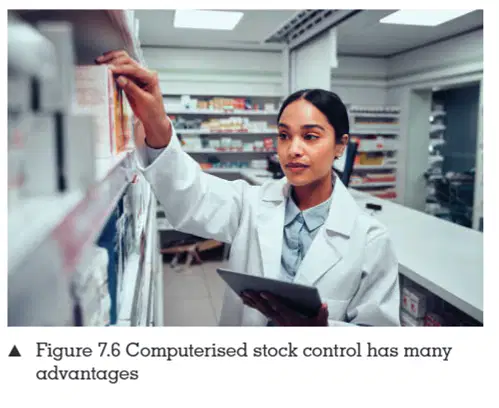
What is an advantage of computerised stock control as shown in Figure 7.6?
It increases the risk of stock misplacement
It makes it harder to locate items
It helps in finding things easily
It requires more staff training
What are the main principles of good practice in scientific and clinical settings?
Accuracy and speed
Compliance and efficiency
Safety and reliability
Documentation and confidentiality
Give two advantages and one disadvantage of keeping all SOPs on an organisation’s intranet/computer network.
Advantages: Easy access and centralized control; Disadvantage: Risk of cyber attacks
Advantages: Increased security and data backup; Disadvantage: Difficult to update
Advantages: Cost-effective and eco-friendly; Disadvantage: Requires constant internet connection
Advantages: Streamlines training and updates; Disadvantage: Limited to users with access rights
You notice that an SOP does not include a procedure for calibrating an important piece of measuring equipment. Justify why it should be included in a revised SOP.
To ensure consistent and accurate measurements
To comply with industry standards only
To reduce the need for staff training
To increase the lifespan of the equipment
Which of the following is the correct course of action if you find a piece of equipment is not performing correctly?
Put a note on the door of the room containing the equipment.
Unplug the equipment, stick a label on the front saying 'Do not use' and inform your line manager.
Inform the safety officer when you next meet them.
Put a note in the equipment log to say that it is not working correctly.
Amir and Sofia are arguing about the terms 'precision' and 'accuracy'. Amir says that calibrating a piece of equipment makes the results more precise, but Sofia says this makes the results more accurate. Who is correct?
Amir is correct because calibration makes results more precise.
Sofia is correct because calibration makes results more accurate.
Both are correct because calibration makes results both more precise and more accurate.
Neither is correct because calibration does not affect precision or accuracy.
A package arrives by next-day courier containing several bottles of a therapeutic enzyme. Explain what should happen to the package.
The package should be stored at room temperature immediately.
The package should be opened in a non-sterile environment to check contents.
The package should be checked for damage and stored according to manufacturer's instructions.
The package should be discarded if not requested by the laboratory.
A healthcare practitioner is supporting a patient with reduced immunity during chemotherapy. The patient has complained of feeling unwell and the practitioner is taking the patient's temperature and blood pressure. Give two reasons why this is important.
To check for signs of infection and monitor the patient's overall health.
To ensure the patient is comfortable and feels cared for.
To prepare the patient for discharge from the healthcare facility.
To comply with the healthcare facility's administrative requirements.
What precautions would you take when preparing blood samples for transfer to an analytical laboratory?
Ensure the samples are at room temperature.
Label the samples with the patient's name and date of birth.
Use the same container for multiple samples to save resources.
Send the samples without any form of refrigeration or special handling.
You have been asked to review the way in which stocks of consumables are handled in a large care home. Each floor has a supervisor who is responsible for ordering and maintaining stocks of cleaning materials, hygiene products and some patient medications such as insulin. Identify two weaknesses in the current approach.
Supervisors may not have adequate training in stock management.
Having a single supplier for all products ensures consistency.
Patients may have access to the storage areas, leading to potential misuse.
A centralized stock system is more efficient and reduces errors.
Explain the importance of proper stock control.
It is not important as long as the care home has enough budget.
Proper stock control is only necessary for medication, not for cleaning materials.
Proper stock control ensures that products are available when needed and helps to prevent waste.
Stock control is solely the responsibility of the care home manager and does not affect other staff.

