wayground logo

Free Printable Worksheets

Font size

S
M
L
XL
Worksheets

3rd Nine weeks Physics

Total questions: 100

Worksheet time: 1hrs 15mins

Name
Class
Date
1.
Momentum is a ____________________ quantity
a)
science
b)
scalar
c)
vector
d)
energy
2.

The momentum of an object depends upon the object's ___________&_____________.

a)

size and shape

b)

mass and speed

c)

mass and veloctiy

d)

mass and energy

3.
The equation to calculate momentum is
a)
p=mv
b)
p=1/2mv2
c)
p=mgh
d)
p=mg
4.
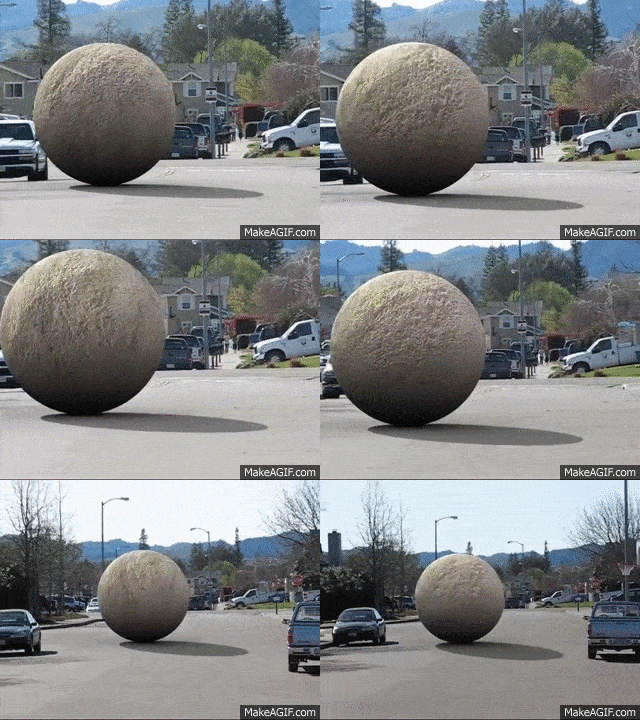
Which of the following images has more momentum?
a)
Object A
b)
Object B 
c)
They are the same
5.
In any collision (crash) the ______ is ALWAYS constant
a)
Total Momentum
b)
total speed
c)
total Velocity
d)
Energy
6.
What is the unit for momentum?
a)
m/sec
b)
kg/sec
c)
kg/m
d)
kg m/sec
7.

A 50 kg ball rolls east down the street at 5 m/s. Calculate the momentum of the ball. 

a)

55 kg*m/s east

b)

10 kg*m/s east

c)

250 kg*m/s east

d)

500 kg*m/s east

8.
In this type of collision, objects tend to "stick" together.
a)
elastic
b)
inelastic 
c)
recoil
9.
When the speed of an object is doubled, its momentum
a)
remains unchanged in accord with the conservation of momentum.
b)
doubles
c)
quadruples
d)
decreases
10.
A bug flies into the windshield of a car going the opposite way. Which of the following are true.
a)
the force of impact is the same for both
b)
the impulse is the same for both
c)
the acceleration of the bug is larger than the truck
d)
A, B, and C are all true
11.
The purpose of crumble zones on a car is to
a)
decrease time of impact.
b)
increase force of impact.
c)
increase the time of impact.
d)
decrease the impulse during impact.
12.
A(n) _________________ causes and is equal to a change in momentum
a)
impulse
b)
force
c)
joule
d)
watt
13.

A 5 N force is applied to a 3 kg ball to change its velocity from +9 m/s to +3 m/s. The impulse on the ball is ______ N s.

a)

-2.5

b)

-10

c)

-18

d)

-45

14.
A 40-kilogram mass is moving across a horizontal surface at 5.0 m/s.  What is the magnitude of the net force required to bring the mass to a stop in 8.0 seconds?
a)
1 N
b)
40 N
c)
25 N
d)
5 N
15.
A runner has a momentum of 670 kg m/s and is travelling at a velocity of 9 m/s. What is his mass?
a)
6030 kg
b)
0.0134 kg
c)
74.4 kg
d)
80 kg
16.
A runner has a momentum of 670 kg m/s and is travelling at a velocity of 9 m/s. What is his mass?
a)
6030 kg
b)
0.0134 kg
c)
74.4 kg
d)
80 kg
17.
The difference between a car hitting a wall vs. a car hitting a hay stack is
a)
the Impulse on the car hitting the wall is greater
b)
the change in momentum of the car hitting the wall is greater
c)
the force on the car hitting the hay stack is greater
d)
the collision time of the car hitting the hay stack is greater
18.

An insect applies 1.5 N of force to a windshield of a moving car. How much force does the windshield apply to the insect?

a)

15,000 N

b)

1.5 N

c)

0.5 N

d)

Not enough information

19.

Inertia is ...

a)

When two objects hit each other with force.

b)

A measurement on how easy it will be to stop a moving object.

c)

The tendency of an object at rest to stay at rest or an object in motion to stay in motion.

20.

Collisions where objects BOUNCE apart.

a)

inelastic collisions

b)

elastic collisions

c)

explosions

d)

none of these

21.

A 2200kg car travelling at 30m/s collides with another 2200kg car that is at rest. The two bumpers lock and he cars move forward together. What is their final velocity?

a)

30 m/s

b)

15 m/s

c)

0 m/s

d)

12.5 m/s

22.

A 10kg ball moving at 13 m/s strikes a 20kg ball at rest. After the collision the 10kg ball is moving with a velocity of 7 m/s. What is the velocity of the second ball?

a)

3 m/s

b)

12 m/s

c)

6 m/s

d)

4 m/s

23.

A piece of silly putty is dropped onto a skateboard as it rolls by. The putty sticks to the skateboard and moves the direction the board is moving. What type of collision is this?

a)

Inelastic collision

b)

Elastic Collision

c)

Perfectly Inelastic collision

d)

No collision

24.

Two cars collide in a car crash. During the crash the cars bumpers became dented and some thermal energy was given off in the crash. Was Total Kinetic Energy conserved in the crash?

a)

No

b)

Yes

25.

Two cars collide in a car crash. During the crash the cars bumpers became dented and some thermal energy was given off in the crash. Was momentum conserved in the crash?

a)

No

b)

Yes

26.

A swimmer with a mass of 75kg dives off a raft with a mass of 500kg. If the swimmer's speed is 4m/s immediately after leaving the raft, what is the speed of the raft? (Hint: The swimmer and the raft are connected ans not moving and then they seperate).

a)

0.06 m/s

b)

6 m/s

c)

0.6m/s

d)

2m/s

27.

A baseball hits a bat and both move in opposite directions after the collision. What type of collision is it?

a)

Elastic

b)

Inelastic

28.

What are the key differences between elastic and inelastic collisions?

a)

Momentum conservation

b)

Potential energy conservation

c)

Kinetic energy conservation

d)

No difference between the two

29.
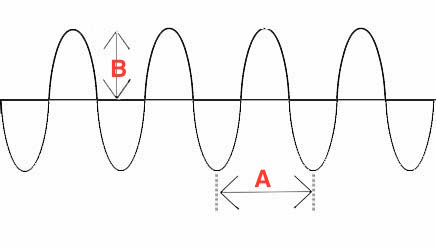
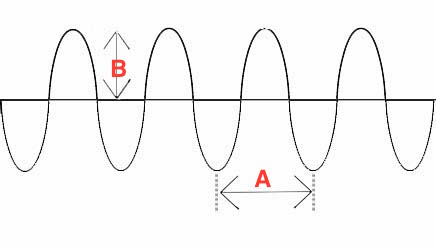
What property of this wave is represented by the letter "A"
a)
amplitude
b)
crest
c)
trough
d)
wavelength
30.
What property of the wave is represented by the letter "B"?
a)
amplitude
b)
crest
c)
trough
d)
wavelength
31.
The highest point on a wave is:
a)
the crest
b)
the trough
c)
the top
d)
the coast 
32.
The lowest point on a wave is the:
a)
Amplitude
b)
Crest
c)
Trough
d)
Wavelength
33.
What types of waves carry energy at a right angle or perpendicular to the direction of the energy flow?
a)
Longitudinal waves
b)
Transverse waves
c)
Sound waves
d)
P-waves
34.
What do waves carry from place to place?
a)
Energy, but not matter or particles
b)
Energy and matter or particles
c)
Matter or particles but not energy
d)
Neither energy nor matter or particles
35.
The most dense part of a longitudinal wave.
a)
Density
b)
Compression
c)
Rarefaction
d)
Amplitude
36.
What are the parts of a longitudinal wave?
a)
Compressions and rarefactions
b)
Crests and troughs
c)
Compressions and crests
d)
Rarefactions and troughs
37.
Which wave is pictured?
a)
Transverse
b)
Longitudinal
c)
Both
d)
Neither
38.
Sound is an example of which type of wave?
a)
Transverse
b)
Longitudinal
c)
Both
d)
Neither
39.
Light is an example of which type of wave?
a)
Transverse
b)
Longitudinal
c)
Both
d)
Neither
40.
Which wave travels parallel in relation to a medium?
a)
Transverse
b)
Longitudinal
c)
Both
d)
Neither
41.

What types of waves can travel through empty space AND mediums? (a)  

Choose from the below words
Longitudinal
Mechanical
Electromagnetic
42.

 A wave has frequency of 50 Hz and a wavelength of 10 m. What is the speed of the wave? (a)  

Choose from the below words
500 m/s
50 m/s
5 m/s
0.5 m/s
43.

2. What property of a wave is represented by letter B? (a)  

Choose from the below words
A. Wavelength
B. Amplitude
C. Speed
D. Frequency
44.
7. Which of the following occurs as the frequency of a wave decreases?
a)
A. The wavelength increases
b)
B. The wavelength decreases
c)
C. The wavelength increases and then decreases
d)
D. The wavelength remains the same
45.

9. The frequency of a wave is measured in (a)   .
Choose from the below words
Hertz
Crest
Trough
Compression
Rarefaction
46.
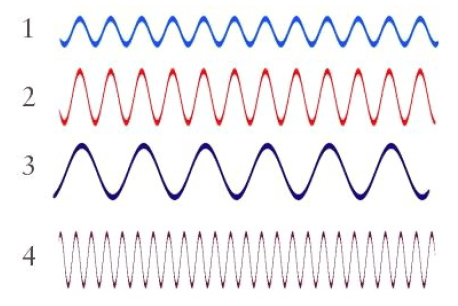
Which wave in the diagram has the greatest frequency?
47.
When the sound source moves, the frequency changes
ex. police car siren sounding lower pitch after the car passes
a)
pitch
b)
frequency
c)
Doppler Effect
d)
medium
48.

Electromagnetic waves include the following except

a)

radio waves

b)

X-rays

c)

ocean waves

d)

microwaves

49.
What does pitch depend on?
a)
amplitude 
b)
frequency
c)
intensity 
d)
volume of sound
50.

A mosquito's buzz is often rated with a decibel rating of 40 dB. Normal conversation is often rated at 60 dB. How many times more intense is normal conversation compared to a mosquito's buzz?

a)

2

b)

20

c)

100

d)

200

e)

400

51.
Question Image

The table represents the decibel level for several sound sources. Use the table to make comparisons of the intensities of the following sounds.

How many times more intense is the front row of a Smashin' Pumpkins concert than ...

a)

the 15th row of the same concert?

1.

10x

b)

the average factory?

2.

100x

c)

normal speech?

3.

100,000x

d)

the library after school?

4.

10,000,000x

e)

the sound that most humans can just barely hear?

5.

100,000,000,000x

52.

An automatic focus camera is able to focus on objects by use of an ultrasonic sound wave. The camera sends out sound waves that reflect off distant objects and return to the camera. A sensor detects the time it takes for the waves to return and then determines the distance an object is from the camera. If a sound wave (speed = 340. m/s) returns to the camera 0.150 seconds after leaving the camera, how far away is the object?

a)

25.5 m

b)

51 m

c)

2,270 m

d)

1,130 m

53.

On a hot summer day, a pesky little mosquito produced its warning sound near your ear. The sound is produced by the beating of its wings at a rate of about 600 wing beats per second.

What is the frequency of the sound wave?

a)

600 Hz

b)

0.0016 Hz

c)

60 m/s

d)

600 m/s

54.

Playing middle C on the piano keyboard produces a sound with a frequency of 256 Hz. Assuming the speed of sound in air is 345 m/s, determine the wavelength of the sound corresponding to the note of middle C.

a)

1.35 meters

b)

2.70 meters

c)

0.742 meters

d)

88,320 meters

55.

Two musical notes that have a frequency ratio of 2:1 are said to be separated by an octave. A musical note that is separated by an octave from middle C (256 Hz) has a frequency of _____.


a)

128 Hz

b)

254 Hz

c)

258 Hz

d)

345 Hz

56.
The speed of sound at 20 degrees celcius is:
a)
331 m/s
b)
365 m/s
c)
621 m/s
d)
343 m/s
57.
The volume of a sound is measured in units called ________
a)
decibels
b)
liters
c)
sound waves
d)
inches per minute
58.
A wave has wavelength of 10 m and a speed of 340 m/s. What is the frequency of the wave?
a)
34 m/s
b)
3400 Hz
c)
3400 m/s
d)
34 Hz
59.

A guitar string vibrates with a frequency of 320 hz. If the wavelength of the vibration is 0.23 meters what is the speed of the wave?

a)

320.23 m/s

b)

1391.3 hz

c)

73.6 m/hz

d)

73.6 m/s

60.
1.  Frieda the fly flaps its wings back and forth 121 times each second. The period of the wing flapping is 
a)
0.008 Hz
b)
0.008 s
c)
121 Hz
d)
121 s
61.
When an ambulance move TOWARD you it sounds ________ pitched. 
a)
high
b)
low
c)
medium
62.
The Doppler effect is seen when a wave-making source moves toward an observer. 
a)
True
b)
False
63.

Assuming the speed of sound is 340 m/s, what is the most likely speed of the jet shown below?

a)

200 m/s

b)

500 m/s

c)

100 m/s

d)

340 m/s

64.

Observer A listens to source of sound moving at 60 ms-1 towards her. If the frequency of the sound to an observer stationary relative to the sound is 500 Hz what is the frequncy to A. The speed of sound is 340 ms-1

a)

607 Hz

b)

425 Hz

c)

2800 Hz

d)

800 Hz

65.

The observer throws the 500 Hz sound source back at a speed of 40 ms-1 . The frequency of the source as observed by A is now

a)

447 Hz

b)

358 Hz

c)

320 Hz

d)

300 Hz

66.

Which EM waves have the longest wavelength?

a)

radio

b)

x-rays

c)

ultraviolet

d)

gamma rays

67.

Which EM waves have the shortest wavelength?

a)

radio

b)

x-rays

c)

ultraviolet

d)

gamma rays

68.

Which EM waves are have a SHORTER wavelength than visible?

a)

radio

b)

none

c)

infrared

d)

x-rays

69.

Which EM waves are have the highest energy & are the most dangerous?

a)

radio

b)

gamma rays

c)

infrared

d)

x-rays

70.

Which color waves have the lowest frequency?

a)

red

b)

yellow

c)

green

d)

violet

71.

Which color waves have the shortest wavelength?

a)

red

b)

yellow

c)

green

d)

violet

72.

The diagram shows a person observing a thunderstorm located several kilometers away. The person hears the thunder several seconds after seeing the lightning. Which statement accurately explains the difference in observations of sound and light by the observer?


a)

Human eyes see light faster than their ears can hear sound.

b)

The medium the waves are traveling through is different for each type of wave.

c)

Light waves travel faster than sound waves.

d)

Sound waves travel faster than light waves.

73.

Reorder the following types of radiation in order of increasing energy

a)

radio waves

b)

infrared

c)

visible light

d)

x rays

e)

gamma rays

1)
2)
3)
4)
5)
74.
Does the rose reflect or absorb red?
a)
Reflect
b)
Absorb
75.
Why do we see objects as white?
a)
They absorb all light
b)
They reflect all light
c)
They absorb some light and reflect some light
76.
What is happening
a)
The object is absorbing all colors because it is transparent
b)
The object is reflecting all colors because it is black
c)
The object is transmitting all objects because it is white
d)
The object is absorbing all colors because it is black
77.

The sky is blue because...

a)

blue is the color most scattered or reflected by our atmosphere.

b)

red is the color most scattered or reflected by our atmosphere.

c)

blue is the color most absorbed by our atmosphere.

d)

blue is complimentary to orange.

78.

Light is made up of...

a)

electricity and waves

b)

magnetism and waves

c)

electricity and magnetism

d)

electricity and energy

79.

The speed of light is:

a)

300,000 km/sec

b)

343 m/s

c)

3.00e10 m/s

d)

3,000,000 m/s

80.

Which Scientist used v = d/t to determine the speed of light?

a)

Michelson

b)

Einstein

c)

Doppler

d)

Wiener

81.

Complementary colors of light combine to give white light. Which one of the following pairs are complementary.

a)

Red and Cyan

b)

Green and Blue

c)

Cyan and Green

d)

Red and Blue

82.

What are the three primary colors of light?

a)

Red,Yellow,Blue

b)

Red,Green,Yellow

c)

Red,Green,Blue

d)

Yellow,Blue,Green

83.
Light travels
a)
around corners
b)
in a straight line
84.
Which of the following is not a primary color of light?
a)
Blue
b)
Red
c)
Yellow
d)
Green
85.
The line that passes through the center of a curved mirror is called
a)
focal point
b)
center of curvature 
c)
principle axis
d)
light ray
86.
The focal length is equal to the:
a)
radius of curvature
b)
diameter of curvature
c)
half radius of curvature
d)
half diameter of curvature
87.
The concave mirror has it's reflected area 
a)
inwards 
b)
outwards
88.
According to the Law of reflection, a light ray striking a mirror
a)
continues moving through the mirror in the same direction
b)
moves into the mirror at a slightly different angle
c)
bounces off the mirror toward the direction it came from
d)
bounces off the mirror at the same angle it hits.
89.
Concave lenses, like the ones found in the peepholes of a door, always produce images that are .....
a)
Virtual, upright, smaller
b)
Real, inverted, larger
c)
Real, inverted, smaller
d)
Virtual, upright, larger
90.
If I were to stand in front of a flat mirror 5m away how many would I appear on the flat mirror
a)
10m
b)
5m
c)
0m
d)
1m/s
91.

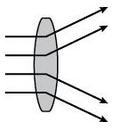
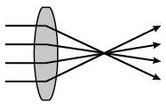
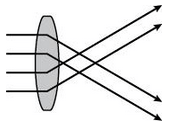
Which figure represents the path light takes through a converging lens?
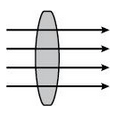
a)
b)
c)
d)
92.
If a light ray is shown on a plane mirror with an angle of incidence of 45 degrees, what is the angle of reflection?
a)
15
b)
30
c)
45
d)
90
93.

If you're standing 12 meters in front of a plane mirror, how far away is your image from you?

a)

6

b)

12

c)

18

d)

24

94.

Type of mirror used as a side mirror on a vehicle to provide a wide angle view...

a)

Plane

b)

Convex

c)

Concave

95.
The following is a picture of what type of mirror? 
a)
Convex (diverging) mirror
b)
Concave (converging) mirror
c)
Plane Mirror
d)
Flat Mirror
96.
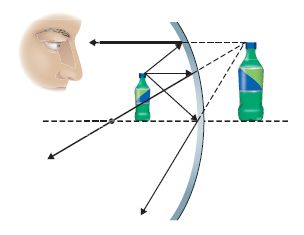
Which terms describe the reflection seen in this image?
a)
virtual, upright
b)
virtual, inverted
c)
real, upright
d)
real, inverted
97.

A real image is always

a)

virtual

b)

upright

c)

behind the mirror

d)

in front of the mirror

98.

A virtual image is always

a)

virtual

b)

upright

c)

behind the mirror

d)

in front of the mirror

99.

The image formed by this converging mirror is

a)

upright, same size, virtual

b)

inverted, same size, real

c)

inverted, larger, virtual

d)

upright, smaller, real

100.

The image formed by this diverging mirror is

a)

upright, smaller, real

b)

inverted, larger, virtual

c)

upright, smaller, virtual

d)

inverted, smaller, real