
 Worksheets
Q3 Benchmark REVIEW 2024-25
Total questions: 28
Worksheet time: 15mins
Ryan observed that his jacket is stuffed with feathers which keep him warm during cold weather. Which statement correctly categorizes Ryan’s jacket as a conductor or an insulator?
A. Ryan’s jacket is an insulator since it allows cold to flow from the external environment to the thin layer of air that is trapped close to Ryan’s body.
B. Ryan’s jacket is a conductor since it allows heat to flow from the external environment to the thin layer of air that is trapped close to Ryan’s body.
C. Ryan’s jacket is a conductor since it helps to prevent cold from flowing from the external environment to the thin layer of air that is trapped close to Ryan’s body.
D. Ryan’s jacket is an insulator since it helps to prevent heat from flowing from the thin layer of air that is trapped close to Ryan’s body.

What can be concluded from the investigation?
Cup S is a better insulator of heat than Cup P.
Cup R is a better insulator of heat than Cup S.
Cup Q is a better insulator of heat than Cup R.
Cup P is a better insulator of heat than Cup R.

A student selects three identical Styrofoam cups (1, 2, and 3), paints one white and one black, and covers the outside of the third with aluminum foil, as shown. The student fills each cup with an equal volume of water at room temperature and places the cups in sunlight. After three hours, the student observes that the water in cup 3 is the coolest. Which statement correctly explains the student’s observation?
A) The aluminum foil does not let light pass through it.
B) The aluminum foil is too thin to absorb heat.
C) The aluminum foil absorbs heat from the surroundings.
D) The aluminum foil reflects the light back toward the atmosphere.

The table gives information about conductors and insulators. Which material is best to use in the design of a handle on a cooking utensil?
copper
iron
plastic
silver
Two metal containers full of ice are on a table. A waiter wraps one container with layers of cloth. They do not wrap the other container. What most likely happens?
A. Ice melts faster in the wrapped container.
B. Ice melts faster in the unwrapped container.
C. Ice melts at the same time in both containers.
D. Ice melts in the unwrapped container but not in the wrapped container.

What can be concluded from the experiment?
A. Sound waves are transverse waves.
B. Sound waves do not carry energy when they are transmitted.
C. Sound waves do not transmit through material mediums.
D. Sound waves transfer energy through the vibration of particles in mediums.
A sound-proof window has two panes of glass with a vacuum in between. Why is sound unable to travel through the window while light can still shine through?
Sound has a different frequency than light, so it cannot pass through the window.
Sound has a different wavelength than light, so it cannot pass through the window.
Light can travel through both the glass and the vacuum, but sound can travel only through the glass.
Light can travel through both the glass and the vacuum, but sound can travel only through the vacuum.
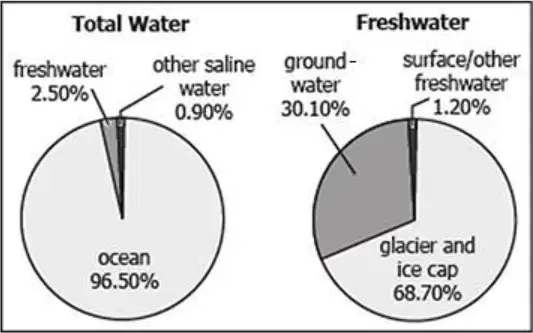
The pie charts show the distribution of the total amount of water on Earth. What can be inferred from the information?
A. Most of the water available on Earth is frozen.
B. Most of the freshwater available on Earth is frozen.
C. Freshwater forms most of the water available on Earth.
D. Groundwater forms most of the water available on Earth.

Examine the diagram of the water cycle. What process is represented by the letter Y?
A) condensation
B) evaporation
C) percolation
D) precipitation
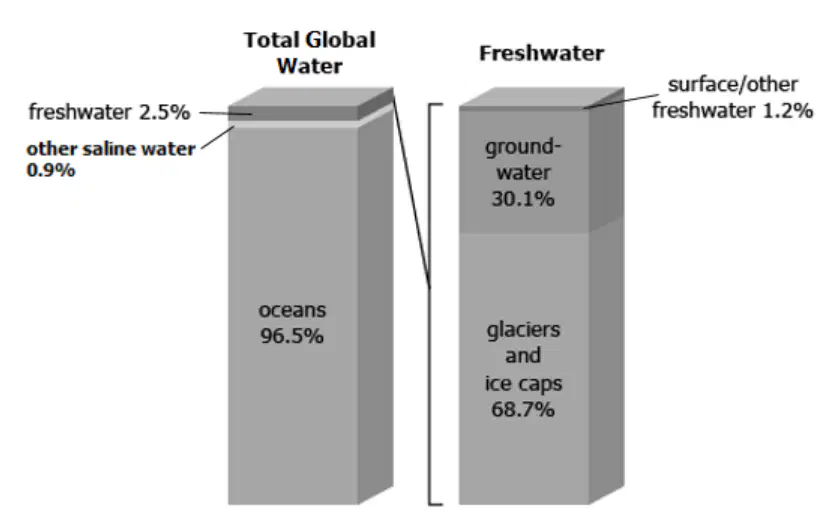
The diagram shows the distribution of total global water and freshwater on Earth. What can be concluded from the diagram?
Most of the freshwater on Earth is in the oceans.
Most of the water available on Earth is freshwater.
Most of the water available on Earth is not drinkable.
Most of the groundwater is in the form of salt water.

Harry fills a plastic cup three-fourths full with water and covers the mouth of the cup tightly with plastic wrap. Harry then makes three holes in the plastic wrap and places the setup near the window. After an hour, the water level in the cup is lower. What part of the water cycle is responsible for the change?
condensation
evaporation
precipitation
transpiration

Catherine creates a diagram demonstrating the water cycle. She labels a stage X on the diagram as shown. What are the next two stages in the water cycle that would immediately follow the stage marked X?
A. condensation and precipitation
B. transpiration and precipitation
C. condensation and runoff
D. precipitation and runoff

This diagram shows a cross section of land. Numbers show four zones in this diagram. What is represented by #1?
groundwater zone
surface water
unsaturated zone
water table
This diagram shows a cross section of land. Numbers show four zones in this diagram. What is represented by #2?
groundwater zone
surface water
unsaturated zone
water table
This diagram shows a cross section of land. Numbers show four zones in this diagram. What is represented by #3?
groundwater zone
surface water
unsaturated zone
water table
This diagram shows a cross section of land. Numbers show four zones in this diagram. What is represented by #4?
groundwater zone
surface water
unsaturated zone
water table
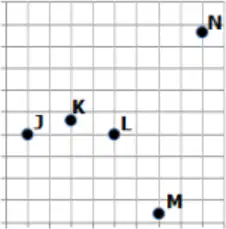
The graph shows the average yearly temperature and average yearly precipitation for locations J-N on Earth. Which location is warm and humid?
location K
location L
location M
location N

The map of the United States shows two fronts approaching Denver and Miami. What will likely happen to the air temperatures in Denver and Miami after the fronts pass?
A) Denver: Air temperature will increase. Miami: Air temperature will decrease.
B) Denver: Air temperature will decrease. Miami: Air temperature will increase.
C) Denver: Air temperature will increase. Miami: Air temperature will increase.
D) Denver: Air temperature will decrease. Miami: Air temperature will decrease.
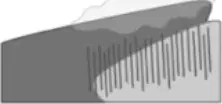
Which image represents the air mass movement associated with a stationary front?

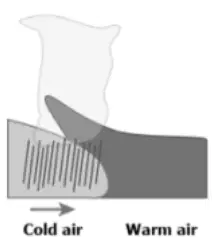
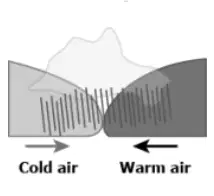
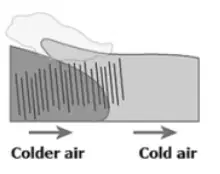

In mid-March, meteorologists predicted that a storm system would move through the area and produce heavy rains, after which it would begin to clear up. The computer model forecasted the rainfall, wind speed, and surface barometric pressure over a five-day period.
What is a correct description of the predicted weather resulting from the passing of this storm system?
A. Wind speed will be the greatest when it is raining.
B. Wind speed will be the greatest when surface pressure is lowest.
C. Surface pressure will decrease steadily as wind speed increases.
D. Surface pressure will increase leading up to the rain.
A student notices a very large drop in air pressure during the course of a few hours on a summer day. What weather conditions will likely occur at the student’s location in the next 6 to 8 hours?
rainy and windy
partly cloudy and breezy
sunny and calm
partly sunny and breezy

The table shows the weather for a city at different times of the day.
Based on the data, the weather conditions experienced in the city at 6:00 p.m. will most likely be (a) and wetter compared to 4:00 p.m.

If a hurricane forms at the X on the map, what conclusion can be drawn about where the hurricane will likely make landfall?
Trade winds will carry the hurricane southeast where it will make landfall near point 2.
Westerlies will carry the hurricane southeast where it will make landfall near point 2.
Trade winds will carry the hurricane northwest where it will make landfall near point 1.
Westerlies will carry the hurricane northwest where it will make landfall near point 1.
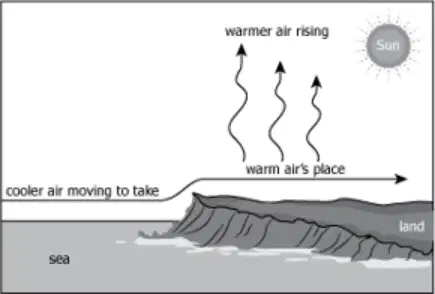
Why is the air over the sea cooler even on a hot, sunny day?
A) Water has the ability to regulate its own temperature.
B) Water keeps flowing which prevents the water from heating up at all.
C) Water needs to absorb a lot of solar energy to warm up.
D) Water absorbs the Sun’s energy but does not transmit it.
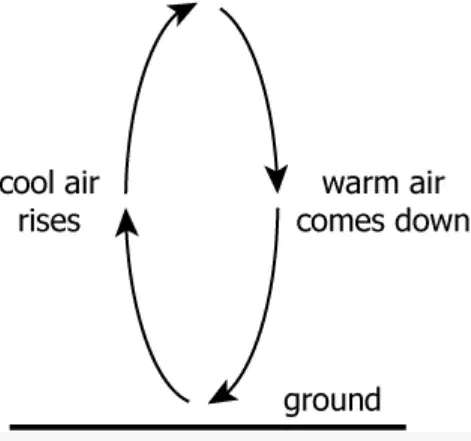
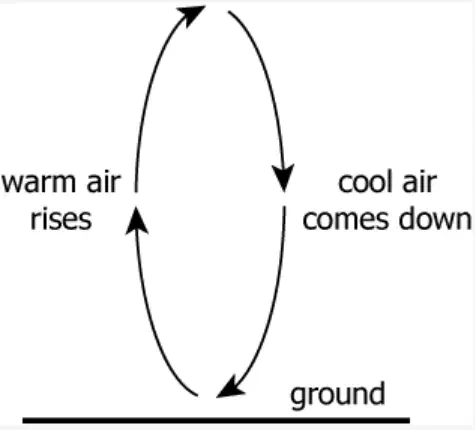
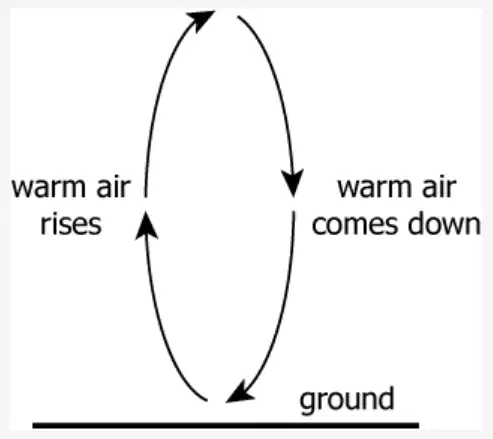
Which pattern of air movement shows a convection current?

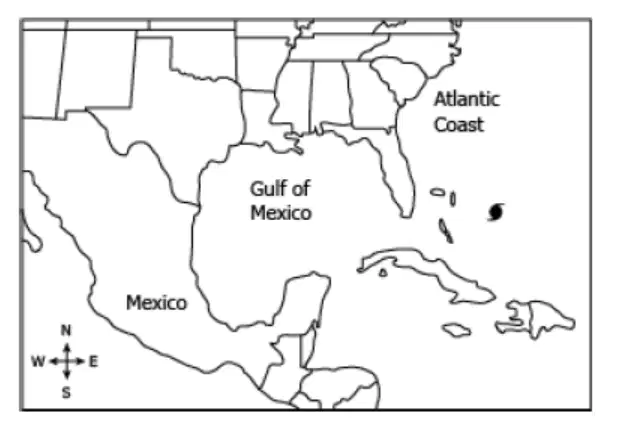
The map shows the location of a hurricane formed in the Atlantic Ocean between 25°N and 30°N latitude in the month of August.
The hurricane is moving in a northwest direction. Which statement best predicts the likelihood of landfall of the hurricane on the Atlantic Coast?
The hurricane will make landfall along the Atlantic Coast, as the trade winds will likely move it west.
The hurricane will not make landfall along the Atlantic Coast, as the low water temperature will not sustain the hurricane.
The hurricane will make landfall along the Atlantic Coast, as the cold Arctic air will likely force it northwest.
The hurricane will not make landfall along the Atlantic Coast, as the warm water current will move it to the Gulf of Mexico.

A student sets up an experiment to show how convection affects ocean currents. The student fills a glass tray with water, places the arrangement on a stand until the water is still, and lights a candle below the center of the tray. Using an eye dropper, the student adds three drops of food coloring at positions X and Y, as shown in the image.
The student observes that the drops of food coloring at position X rise upward and disperse toward position Y, while at position Y, they sink to the bottom of the glass tray and move toward position X. Which statement correctly relates the student’s observations with convection affecting ocean currents?
The observation at position X represents cold water sinking at a polar region and circulating only within tropical regions.
The observation at position Y represents warm water rising at the equator and circulating only within tropical regions.
The observation at position X represents warm water rising at the equator and circulating toward the polar regions.
The observation at position Y represents cold water sinking at a polar region and circulating only within temperate regions.
Which statement correctly explains the formation of wind?
The rotation of Earth results in the creation of wind.
The Sun’s energy heats the air and influences its movement to create wind.
Warm ocean currents evaporate and condense into clouds to form wind.
The movement of objects such as trees all over Earth generates wind.

