
 Worksheets
Gas Laws and Solutions
Total questions: 21
Worksheet time: 11mins
If the volume of a gas increases what will happen to the pressure?
Pressure increases
Pressure decreases
Pressure stays the same
Can not be determined
If the temperature of a gas decreases, what will happen to the volume?
Volume increases
Volume decreases
Volume stays the same
Can not be determined
If the pressure of a gas decreases due to a change in temperature, what happened to the temperature?
The temperature went up
The temperature went down
The temperature stayed the same
Can not be determined
The pressure of a gas is 9.99 atm with a volume of 4.00 liters. If the volume of the gas expands to 7.73 liters, what is the new pressure?
12.8 atm
8.44 atm
5.17 atm
4.88 atm
The pressure of a gas is 45.3 kPa at a temperature of 133 degrees kelvin. What is the new pressure if the temperature is increased to 178 degrees kelvin?
60.6 kPa
23.4 kPa
83.2 kPa
101 kPa
A gas has a volume of 44.0 liters at a temperature of 400 degrees kelvin. If the volume of the gas changes to 23.0 liters due to a change in temperature, what is the new temperature?
166 degrees kelvin
375 degrees kelvin
311 degrees kelvin
209 degrees kelvin
A sample of bromine gas has a volume of 0.850 liters with a pressure of 29.9 kPa and a temperature of 340 degrees kelvin. If the temperature of the sample of gas changes to 370 kelvin and the volume changes to 1.20 liters, what is the new pressure?
32.2 kPa
45.0 kPa
23.0 kPa
26.5 kPa
A gas in a container has a pressure of 2.08 atm and a volume of 15.5 liters at a temperature of 395 degrees kelvin. How many moles of gas are present?
0.994 moles
3.05 moles
1.34 moles
0.665 moles
25.0 moles of hydrogen gas occupy a 350 liter container at a temperature of 299 degrees kelvin. What is the pressure of this gas, in kPa?
199 kPa
178 kPa
123 kPa
98.5 kPa
What is the molarity of a solution containing 34 moles of solute in 198 liters of solution?
0.17 M
1.7 M
17 M
14.6 M
1.46 M
How many moles of LiF are in 0.30 liters of a 0.80 molar NaCl solution?
0.375 moles
24 moles
0.24 moles
2.4 moles
2.67 M
A person adds 42 grams of Calcium Bromide to 735 grams of water. What is the percent by mass of this solution?
10%
12%
7.8%
5.4%
18%
The (a) is the substance being dissolved in a solution.
The (a) is the substance doing the dissolving in a solution.
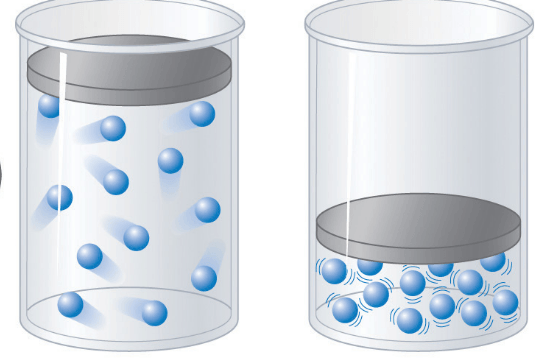
345 mL of solution contains 105 mL of solute. What is the percent by volume of this solution?
56%
14.6%
23.3%
30.4%
A scientist adds water to 5.0 liters of a 3.5 molar solution so that it is now 8.0 liters. What is the new molarity?
1.14 M
2.2 M
5.6 M
11.4 M
0.114 M
Salt is added to a container of water. What will happen to the freezing point of the water?
It will increase
It will decrease
It will stay the same
Can not be determined
A scientist adds Ca(ClO3)2 to a container of water. What can the scientist expect to happen to the boiling point of the water?
The boiling point will increase
The boiling point will decrease
The boiling point will stay the same
Can not be determined
Which of these compounds would have the greatest colligative effects on a solution?
SO3
Li3P
Li2O
LiF
A scientist adds water to a 0.750 molar solution that was originally 6.00 liters. She finds that the new molarity is 0.375. What is the new volume of the solution?
12.0 Liters
10.0 Liters
4.00 Liters
3.00 Liters
0.05 Liters

