
Font size
 Worksheets
Unit 3: Earth's Weather and the Atmosphere Study Guide
Total questions: 20
Worksheet time: 12mins
The Earth’s core is more ______, ______, and made up of more ______ when compared to the Earth's crust.
dense, hotter, iron
less dense, cooler, silicon
lighter, colder, aluminum
less dense, warmer, magnesium
The relationship between air masses and ocean currents is that ______ ocean currents ______ the air masses ______ them.
(warm, warm, above)
(cold, cool, below)
(hot, heat, under)
(cool, chill, over)
A hurricane is considered to be a ______ storm because it can cause extensive damage to property.
severe
mild
gentle
calm
Scientists determine the properties of a ______ by looking at the color, luster, cleavage, streak, and hardness.
mineral
animal
plant
rock
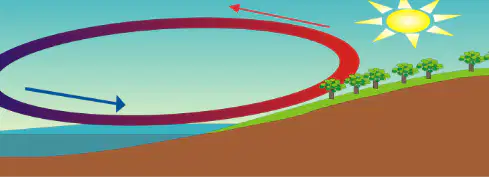
Land and sea breezes wind patterns are affected by ____.
Temperature differences
Humidity levels
Ocean currents
Earth's rotation
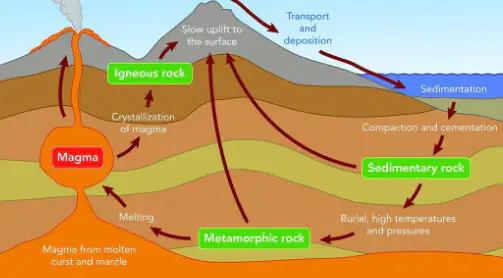
How is matter affected through the rock cycle?
Matter is created and destroyed.
Matter changes form but is neither created nor destroyed.
Matter remains unchanged.
Matter is only destroyed.
Earth’s inner core is composed primarily of which material?
Iron and nickel
Silicon and oxygen
Carbon and hydrogen
Magnesium and aluminum
Which of the following best illustrates the water cycle?
A diagram showing evaporation, condensation, precipitation, and collection
A diagram showing only evaporation and precipitation
A diagram showing only condensation and collection
A diagram showing only precipitation and evaporation
What happens after a rock is weathered?
It gets pressed or compacted and creates sedimentary rock.
It melts and forms magma.
It evaporates into the atmosphere.
It turns into a gas.
Meteorologists depend on accurate weather forecasts to help:
make great predictions
prepare for severe weather
become better meteorologist
farmers know when to plant and harvest
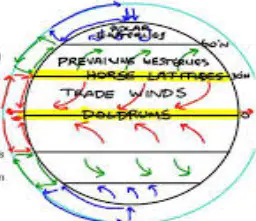
Global and local wind patterns are affected by:
Coriolis effect
Earth’s rotation
Where does weather occur in Earth’s atmosphere?
Troposphere
Stratosphere
Mesosphere
Exosphere
Earth’s land and water is heated by the sun’s radiation.
Solar panels
Wind turbines
Geothermal energy
Sun's radiation
Explain why the air rises.
The doldrums are warmed by the heating of the sun at the equator.
The air is cooled by the polar ice caps.
The air is pushed down by the mountains.
The air is absorbed by the ocean currents.
Uneven heating creates global winds over a large area which causes convection currents due to the cooling and warming of Earth's atmosphere.
Uneven heating causes local winds.
Global winds are caused by ocean currents.
Convection currents are unrelated to Earth's atmosphere.
Uneven heating creates global winds over a large area which causes convection currents due to the cooling and warming of Earth's atmosphere.
What is the process by which water evaporates from a substance to grow minerals by rearranging the material’s structure?
Crystallization
Evaporation
Sublimation
Condensation
How does heat energy affect the density of materials moving during convection?
It causes dense material to sink and less dense material to rise.
It causes less dense material to sink and dense material to rise.
It has no effect on the density of materials.
It causes all materials to move at the same rate regardless of density.
This rock is formed when molten material cools and hardens on or beneath the surface of the Earth. What type of rock am I?
Igneous rock
Sedimentary rock
Metamorphic rock
Limestone
Match the following processes with their descriptions.
erosion
carrying away rock particles
weathering
breaking/wearing down rock particles into smaller pieces
deposition
drops material and forms new material.

What is the correct order of the processes?
they all happen at the same time
erosion, weathering, deposition
weathering, erosion, deposition
weathering, deposition, erosion

