
Font size
 Worksheets
Economics Outline
Total questions: 100
Worksheet time: 58mins
In my country, business is based on competition. Success comes from doing something better and cheaper than your competitors.
Traditional
Command
Market
Mixed
In my country, central planners decide when we should expand old factories and build new ones.
Traditional
Command
Market
Mixed
In my country, I know that all my needs will be met, but not my wants.
Traditional
Command
Market
Mixed
In my country my job is the same one that my family has done over the past 200 years.
Traditional
Command
Market
Mixed
In my country, the government controls the economy. It assigns jobs, sets production goals, and decides wages.
Traditional
Command
Market
Mixed
In my country producers decide what and how much to make based on what people want to buy.
Traidtional
Command
Market
Mixed
In my country, the government has some involvement in the economy.
Traditional
Command
Market
Mixed
In my country, the government makes all the economic decisions.
Traditional
Command
Market
Mixed
,In my country, the government tells me where to work.
Traditional
Command
Market
Mixed
In my country we have no need for money. By custom, some of us hunt, others farm, and we are all taken care of.
Traditional
Command
Market
Mixed
In my country there is a private sector and a public sector.
Traditional
Command
Market
Mixed
In my country, profits are the incentives for production.
Traditional
Command
Market
Mixed
In my country, consumers are very powerful in economic decision-making.
Traiditional
Command
Market
Mixed
In my country, consumers don't have a lot of choice in what they can buy.
Traditional
Command
Market
Mixed
In my country, there is little economic growth because we do not use any new technologies.
Traditional
Command
Market
Mixed
How many hours did a typical worker work in a factory during the industrial revolution?
12-14 hours per day
What best describes "enclosures" during the Industrial Revolution?
Enclosing lands for commercial farming
What did the British factory act of 1833 do?
What were working conditions like during the Industrial Revolution?
Safe and well-regulated
Flexible work hours with high pay
Long hours with low pay in dangerous conditions
Workers had a lot of vacation time
Why did cities grow rapidly during the Industrial Revolution?
People were attracted to the cultural activities in cities
There was a decrease in agricultural jobs, pushing people towards cities
Cities offered free housing
The weather was better in cities
What does Laissez-fair capitalism mean?
An economic system with very little government interference.
What countries are examples of social democracies in Northern Europe?
What German philosophers ideas became the basis of Communism?
What county had a communist revolution in 1917?
Who wrote, "It was the best of times, it was the worst of times"?
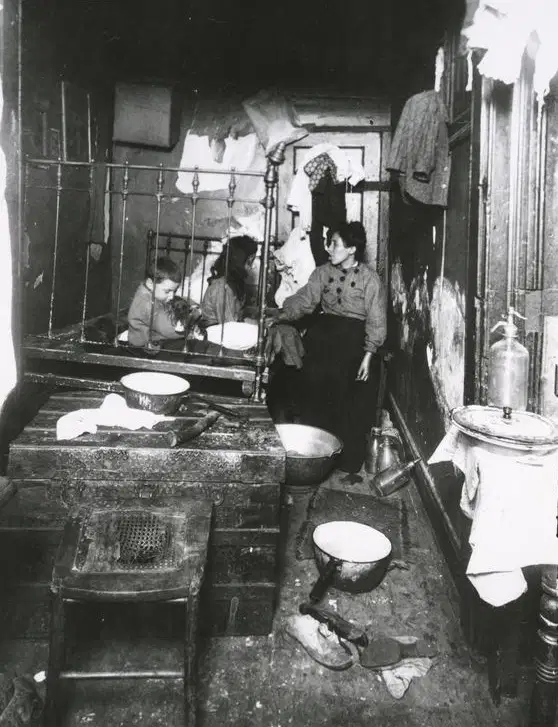
These small cramped and overcrowded city dwellings became home for many urban laborers and immigrants throughout Industrialization.
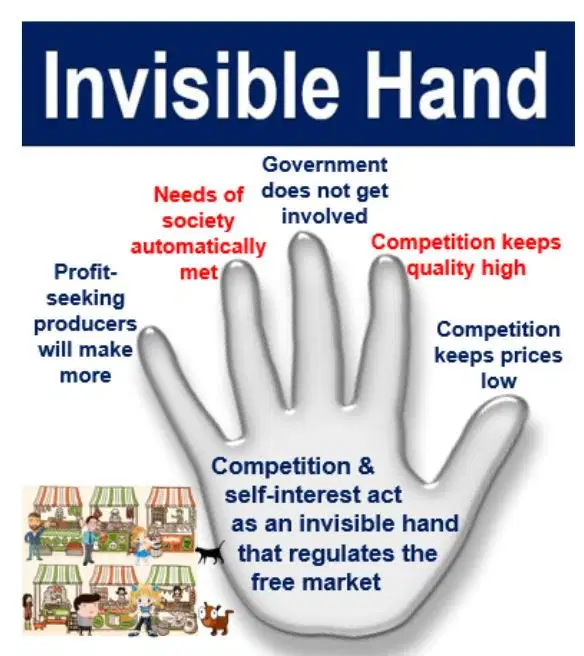
This Chart would BEST reflect the economic beliefs of what thinker?
John Stuart Mill
Fredrich Engels
In his Iron Law of Wages, David Ricardo argued that a high _________ drove down wages and caused poverty.
Immigration
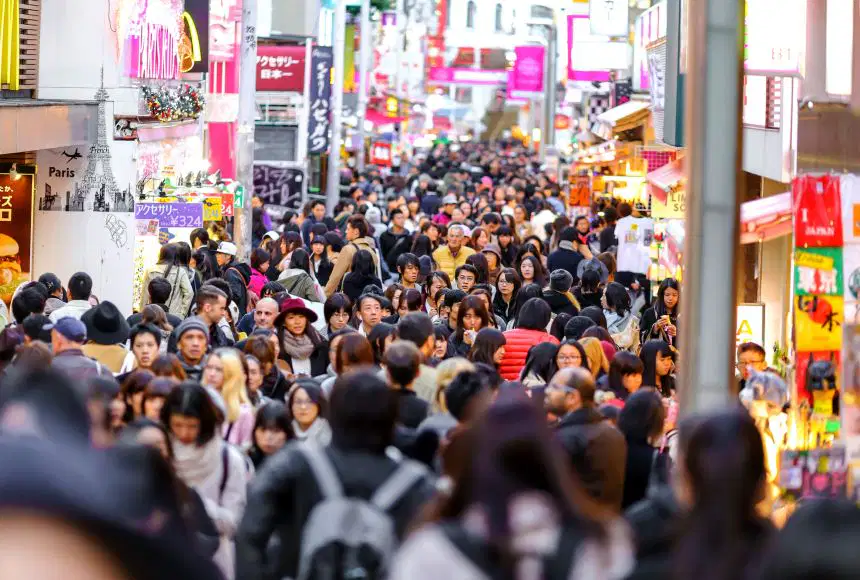
This photo BEST reflects what migratory pattern?
Rural Movement
Immigration
Migration
Urbanization
The Industrial Workers of the World (IWW) fought for over 9000 members in the US to gain better working conditions. This BEST explains what type of organization?
The People's Party of the Government just seized all of the automobile factories and began to regulate the entire industry. This action would be praised the MOST by which economic thinker?
Thomas Malthus
According to Utilitarianism, right actions and laws are those that, _________.
Result in best possible outcome for the good of the people involved.
Bring order and structure to society
Repress freedoms and enslave the underclass.
Result in the Best outcome for only the wealthy.
This 18th Century economic philosophy emphasizes little to no government intervention.

The early Industrial Revolution workers faced all these conditions EXCEPT:
miserable working conditions
dangerous working conditions
minimal pay for long hours
control over seasonal schedule
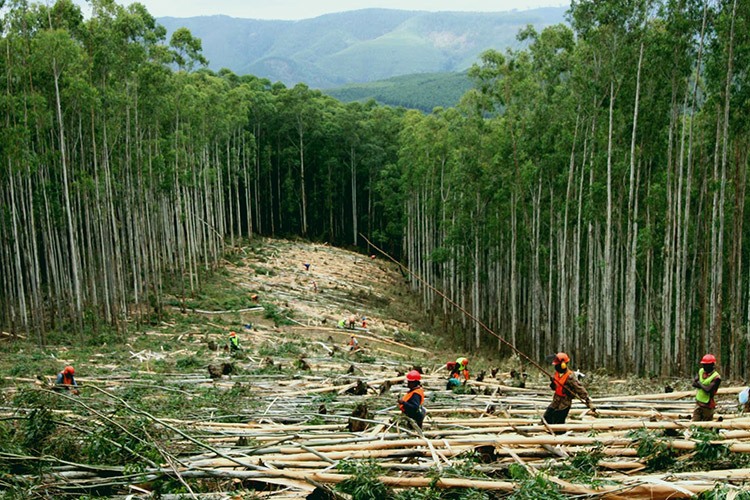
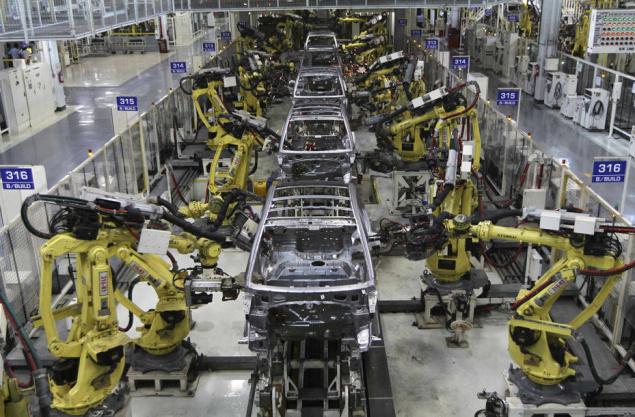
This image represents which economic sector?
Tertiary Sector
Secondary Sector
Primary Sector
Quaternary Sector

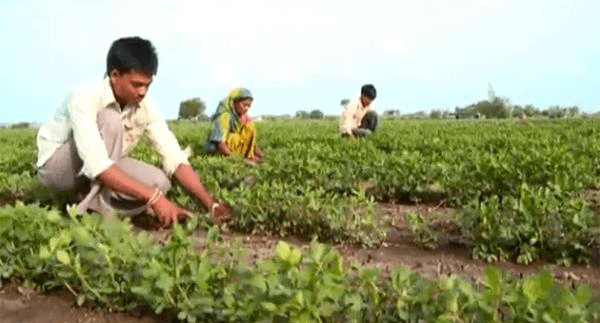
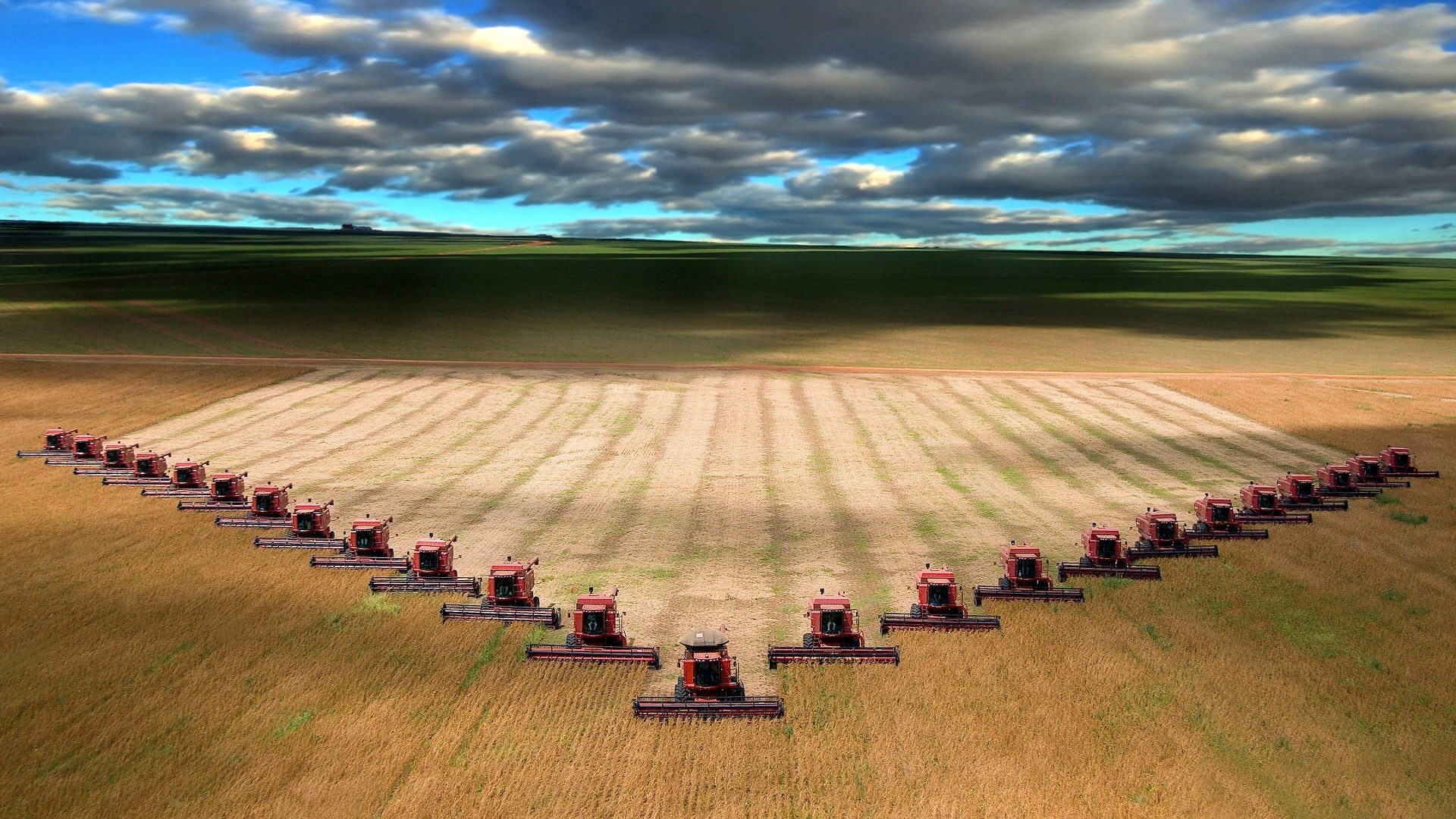
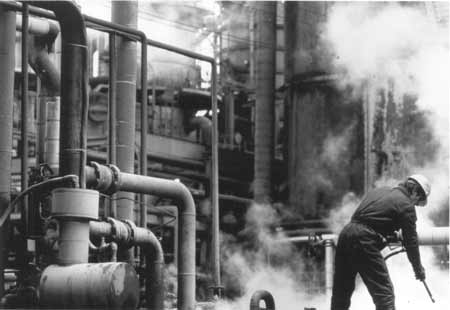
This image represents which economic sector?
Primary Sector
Quinary Sector
Secondary Sector
Tertiary Sector
What is the Human Development Index?
The health of an individual.
A set of statistics or numbers that rank countries by their development.
The country a person lives in,
The number of preventable diseases in a country.
What's development?
The closer the HDI is to 0, the _____ developed the country is.
less
more
Which one is NOT a factor when determining the HDI of a country?
Education
Health
Income
Miltary Size

Angola has a life expectancy age of 44, literacy (can read and write) is at 58% of the population and an average income of $4,941 a year. What type of country is Angola?
Developed Country (Most developed)
Developing Country (Middle)
Less Developed Country (Least developed)
Japan has an HDI score of 0.884. The life expectancy is 79, literacy is 100%, and the income of an average family is $34,000. Japan would be classified as a less developed country.
True
False

GDP per capita would best be described as highest in this Region
Sub-Sahara Africa
Latin America
North America
South Asia

Changing the Scale of Analysis to a national perspective...Which state has the highest GDP per capita?
Texas
Illinois
Florida
California
GDP per Capita can best be described as a _______ Human Development Index Indicator
Economic
Social / Educational
Health

Which region has the highest Life Expectancy rate?
Latin America
Sub-Sahara Africa
South Asia
Western Europe + Japan

Changing the Scale of Analysis to a National Level...What state has the highest Life Expectancy Rates?
Texas
Illinois
Florida
California

Changing the Scale of Analysis to a County Level...what region of the United States has the lowest Life Expectancy Levels?
West Coast not including Alaska
Southern
Great Lakes
Northeast

Changing the Scale of Analysis to a Census Track Level...What region of the United States has the lowest Life Expectancy Rates?
West Coast not Including Alaska or the Native American Reservations
Southern
Great Lakes
Northeast
Life Expectancy can best be described as a _______ Human Development Index Indicator
Economic
Social / Educational
Health

What region of the world has the highest Literacy Rate?
Western Europe
South Asia
Latin America
Sub-Sahara Africa
Literacy Rate can best be described as a _______ Human Development Index Indicator
Economic
Social / Educational
Health

Changing the Scale of Analysis...which state has the lowest Literacy Rate
Illinois
Mississippi
Alabama
Arkansas
What factor would have the greatest effect on the Development Measure of Literacy Rate?
Job Sectors
Life Expectancy
Physician Availability
Years of Schooling

A farmer operates in which industry sector?
Primary
Secondary
Quaternary
Quinary
Toyota car manufacturer operates in which industry sector?
Primary
Secondary
Quaternary
Quinary
A Fireman and Policeman (or women) operate in which industry sector?
Primary
Secondary
Quaternary
Tertiary
The dollar value of all goods and services produced or provided in a country is the
GNI
GDP
GNP
GDP per capita
The dollar value of goods and services produced in a country and in businesses owned by a country's citizens outside the country is called
GDP
GNP
GNI
GII
What is the Gender Inequality Index (GII)?
The comparison of income of women to men.
The equal amount of genders in a state.
A measure of the extent of each country's gender inequality.
A measure of the extent of each state's gender inequality.
_________ is the amount of people in a country who can read and write
Standard of Living
Gross Domestic Product
Literacy Rate
GDP per Capital
Which class lived outside the city and usually inherited their money?
Upper Class
Middle Class (white collar)
Working Class (blue collar)
Which class owned and/or managed businesses, had large homes, enjoyed leisure activities all paid for with profits from the industrial revolution?
Upper Class
Middle Class (white collar)
Working Class (blue collar)
Victorian Morality dictated that men and women live in different spheres - men did what? Women did what?
Business, homemaker
Both were factory workers
Factory worker, homemaker
Business, Waitress
Which class of women would work a couple years then married?
Upper Class
Middle Class (white collar)
Working Class (blue collar)
Victorian morality applied to which two classes?
Upper Class
Middle Class (white collar)
Working Class (blue collar)
Which class of women were involved in the reform movement?
Upper Class
Middle Class (white collar)
Working Class (blue collar)
Which class lived in the overcrowded cities and small, poorly built housing, and worked long hours?
Upper Class
Middle Class (white collar)
Working Class (blue collar)
Typical work days in the factories were how long?
8 hours
4-5 hours
14-16 hours
15 minutes
How young were children who started to work in the factories?
4-5 years old
7-10 years old
11-15 years old
16 and older
Which reform movements did the middle class women become involved in (select all that apply)?
Abolition (end of slavery)
Prohibition
Child Labor
Women suffrage
Housing development

… “Keep ancient lands, your storied pomp!” cries she With silent lips. “Give me your tired, your poor, Your huddled masses yearning to breathe free, The wretched refuse of your teeming shore. Send these, the homeless, tempest-tost [tossed] to me, I lift my lamp beside the golden door!” -Emma Lazarus, “The New Colossus”
In this poem, the phrase “homeless, tempest-tost” refers to
… “Keep ancient lands, your storied pomp!” cries she With silent lips. “Give me your tired, your poor, Your huddled masses yearning to breathe free, The wretched refuse of your teeming shore. Send these, the homeless, tempest-tost [tossed] to me, I lift my lamp beside the golden door!” -Emma Lazarus, “The New Colossus”
This poem is found on which national landmark?

