
Font size
 Worksheets
Ancient Greece Part 2
Total questions: 27
Worksheet time: 16mins
How did the Peloponnesian Wars impact the city-states of Greece?
they weakened the city-states which allowed them to be conquered by the Macedonians
they strengthened the city-states and united them into the Delian League
they encouraged the city-states to find allies and explore new lands
they prevented the city-states from trading and building wealth
What name was given to the 27 year war between Athens and Sparta?
Punic War
Trojan War
Peloponnesian War
Persian War
What happened that weakened Athens during the Peloponnesian War?
many of their ships were sunk during a storm
they were attacked by the Persians
there was a plague in the city that killed many people including their leader Pericles
much of the wall protecting the city collapsed due to poor construction
What new power was rising in the north as Athens and Sparta were fighting?
Rome
Macedonia
Persia
Thebes
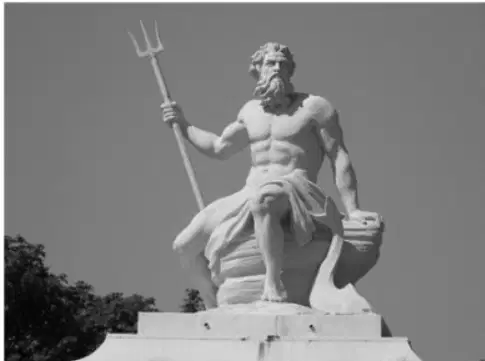
This is a statue of the Greek god Poseidon. What statement about Greek gods can be made by analyzing this sculpture?
greek gods did not interact with humans
greek gods were violent
greek gods took human form
greek gods controlled the elements
What was the PRIMARY goal of the ancient Olympic games?
to promote peace in Greece
to create Spartan soldiers
to spread Athenian philosophy
to honor the Greek gods
In what way was Greek mythology unique from other early religions?
it had no temples or places of worship
it did not provide understanding about how the world worked
it celebrated gods that had human traits
it preached the belief in one god
Which term identifies the stories and tales through which many Greek values and beliefs were shared?
history
mythology
philosophy
theology
Why are "The Iliad" and "The Odyssey" historically significant?
they describe the lives of traders on the silk road
they provide translations of the Code of Hammurabi
they give insight into ancient Greek culture
they explain the basic concepts of Buddhism
I was a great poet in ancient Greece and authored "The Iliad" and "The Odyssey". What was my name?
Plato
Euclid
Homer
Socrates
What values did Greek epics give young readers?
smart and strong
military skill and leadership
acting and discussion
courage and bravery

How does this quote relate to the life and philosophy of Socrates?
Socrates believed in aligning ones life to the will of other people and to the government
Socrates made people abandon their beliefs and then told them what to believe
Socrates taught through questioning and reflection and encouraged people to draw their own conclusions
Socrates discouraged people from spending too much time reflecting on their roles in society

According to Aristotle, the best form of government is one ruled by what?
the king
the law
the needy
the wealthy

Which professionals still take this oath?
doctors
lawyers
professors
students
Plato was best known for his contributions in what field?
explorations
mathematics
politics
science
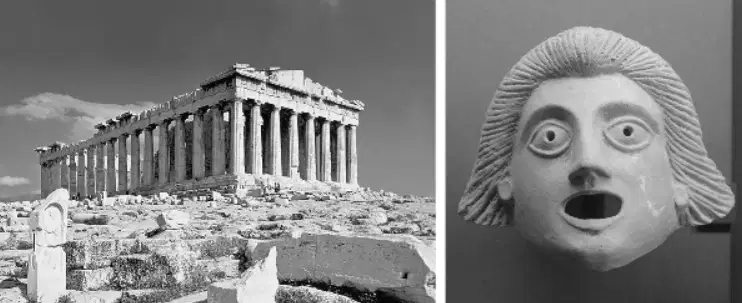
These images show that the ancient Greeks had great accomplishments in which areas?
architecture and theater
medicine and astronomy
monotheism and metalworking
science and civics
Why was the Parthenon built in Athens?
to defend against Macedonian invaders
to act as a market for traders from Carthage
to honor the goddess Athena
to house the polis of Athenian democracy

What ancient Greek monument is shown in the image?
acropolis
aqueduct
coliseum
parthenon
Which ancient Greek city feature had a fort and temple at the top of its hill?
agora
acropolis
Aristotle
peloponnesus
What role did Alexander the Great play in spreading Greek culture and ideas throughout the Middle East?
he allowed his empire to be conquered by the Persians and they spread Greek culture
he was a peacekeeper who encouraged Middle Eastern cultures to study in Greece
he conquered territories and created an empire spreading Greek culture
he traveled to the Middle East to teach Greek ideas
How did the rule of Philip II of Macedonia impact the Greek city-states?
it led to the destruction of the rival city-states of Athens and Sparta
it increased the power of city-states by developing representative democracy
it limited the power of city-states by naming generals as political leaders
it led to the unification of all Greek city-states
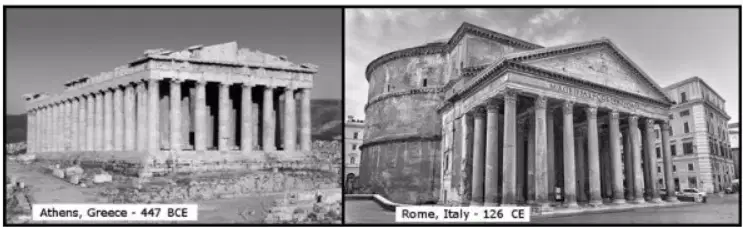
Look at the dates of the construction of these two buildings. What conclusion can be made about the influence of Hellenistic culture?
Hellenistic culture had little effect on neighboring civilizations
Hellenistic culture affected the language and religion of nearby groups
Hellenistic culture greatly affected the architecture of other civilizations
Hellenistic culture resulted in the ultimate failure of multiple ancient civilizations
A time when Greek culture spread to non-Greek peoples. The (a) Era
King Philip II son was named (a)
Macedonian admirer of Greek ideas who used their military skills against them
(a)
city founded by Alexander in Egypt
(a)
when knowledge, innovation, language or cultural characteristics are spread and blended between culture and communities = cultural (a)

