Worksheets
Unit 2: Astronomy Test
Total questions: 128
Worksheet time: 1hrs 21mins


The diagram below represents a simple geocentric model. Which object is represented by the letter X?
Earth
Sun
Moon
Polaris
What is the primary component of the Sun?
Carbon
Hydrogen
Oxygen
Helium
What is the primary cause of Earth's seasons?
The distance of Earth from the Sun
The tilt of Earth's axis
The rotation of Earth on its axis
The gravitational pull of the Moon
What is the primary reason for the phases of the Moon?
The Earth's shadow falling on the Moon
The Moon's distance from the Earth
The Moon's rotation on its axis
The relative positions of the Earth, Moon, and Sun
What is the main characteristic of a black hole?
It is a large, bright star
It emits a lot of light
It has a gravitational pull so strong that not even light can escape
It has a strong magnetic field
What is the Oort Cloud?
A spherical shell of icy objects surrounding the solar system
A type of nebula found in distant galaxies
A region of space filled with asteroids between Mars and Jupiter
A dense cluster of stars in the Milky Way
The Moon phase during a solar eclipse is _____
New Moon
Full Moon
Waxing Crescent
Waning Crescent
The Moon phase during a lunar eclipse is _____
New Moon
Full Moon
Waxing Crescent
Waning Crescent

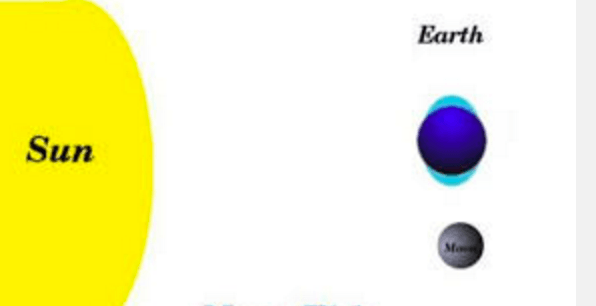
In the diagram a ______________ eclipse is occurring.
Solar
Lunar

In the diagram above, a _______________ eclipse is occurring.
Lunar
Solar


What type of tide would this arrangement of earth-moon-sun create?

What do we call the type of tide with small tidal ranges that happen when the sun and moon are at right angles to each other?
The reason we have seasons on our planet is because...
we are closer to the sun during the winter and further during the winter.
the tilt of Earth's axis allows for more direct sunlight in the summer and less direct sunlight in the winter.
seasonal wind patterns carry warmer winds during the summer and colder winds during the winter.
the Earth's orbit becomes more like an oval to give us different seasons.

Which of the following best describes the tilt of the earth during the spring and fall equinoxes?
The earth is tilted away from the sun (Northern hemisphere)
The earth is tilted neither toward or away from the sun (tilt is side to side)
The earth is tilted toward the sun (Northern hemisphere)
The earth is not tilted during spring and fall
What is the term used to describe the motion of the Earth around the Sun?
Resolution
Rotation
Revolution
Round
What does it take the Earth one year to complete?
tilting its axis north or south
a revolution around the sun
receiving energy from the sun
a rotation around its axis

At what position will it be summer in the Southern hemisphere.
1
2
3
4
The start of fall and spring is called
The equinox
The solstice
A leap year
day lights savings
Determine the tide that each region would be experiencing:
High tide
Low tide

The tide in the picture is a (a) .
During this tide, the high/low tides will be (b) than usual.
Spot The Low Tide (s)

Neap tides will occur at (a) and (b) .

The Earth experiences the rise and fall of ocean water, which is called (a) , because of the pull of gravity of the (b) .
Which model shows a SPRING Tide?
Determine the tide that region B & C would be experiencing:
High tide
Low tide

The moon would be place in position (a) and (b) for a Spring (c)


sort of cool, dim (not too much light), and red?
How is the life cycle of a star determined?
by fusion
by its mass
by the color
by the tempature
Which type of star has a longer life span
High Mass Star
Small/Medium Star
Which type of star has a shorter life span
High Mass Stars
Small/ Medium Stars
What is a Nebula?
an enormous cloud of gas and dust
A type of planet
A cloud of helium and hydrogen
a ball of heat and energy
What is protostar
a diagram of a star
a ball of heat, a baby 'star'
Whats left over from the fusion
a ball that emits no light or heat, basically a ball of carbon
a large red super giant ends up as
a neutron star
a black hole
a black dwarf
a white dwarf
a planetary nebula
a small red super giant ends up as
a black hole
a neutron star
a white dwarf
a black dwarf
a planetary nebula
what is the main sequence
the main part of a stars lifecycle
The end of a stars lifecycle
The first part of a stars lifecycle
How much time does the main sequence take up of a stars lifecycle
The most time; is in this stage for the longest part of it's life cycle
The shortest; is in this stage for the shortest part of it's life cycle
When does red giant begin
When it runs out of helium to fuss to hydrogen
When it runs out of hydrogen to fuss to helium
When it starts fussing hydrogen to helium
When it starts fussing helium to hydrogen
What happens during the red giant phase
The surface of the star expands away form the core
The surface of the star moves towards the core
The star explodes
What forms a planetary nebula
The surface gas continuing to move away from the core and soon drifting into space
The surface gas exploding
a supernova
What is a White Dwarf
The core thats left over from the star; still emits heat and glow from leftover fusion
The core thats left over from the star; doesn't emit heat and glow from leftover fusion
The end of a small/medium stars life
The core of the star; doesn't emit heat or light; basically a ball of carbon
What is a black dwarf
comes after the white dwarfs emits all leftover glow and heat; basically a ball of carbon; end of small/medium stars life
comes before the white dwarfs emits all leftover glow and heat; basically a ball of carbon; end of small/medium stars life
What happens during a super nova ( in high mass stars) ( select all that apply )
The outer layer of the star expands but the core is still big enough and hot enough for fusion to continue so heavier elements are created
The core has enough gravity to pull the outer layers back in and when it does they 'bounce' off with an explosive force
The star explodes and dies
What is neutron star
The core left over from the super nova; for high mass stars
The core left over from the super nova; for super massive stars
The ending of a super massive star; the gravity of the core is so strong the core collapses on itself creating a gravitational pull so strong nothing including light can escape it

What is a black hole
The core left over from the super nova; for high mass stars
The core left over from the super nova; for super massive stars
The ending of a super massive star; the gravity of the core is so strong the core collapses on itself creating a gravitational pull so strong nothing including light can escape it

This occurs when one object in space moves into the shadow cast by another object
tidal range
eclipse
lunar eclipse
What are the phases of the Moon during neap tides?
new and full
first and third quarter
waning and waxing gibbous