
 Worksheets
Chapter 6 Lesson 2 Branches of Government
Total questions: 38
Worksheet time: 27mins
Which branch of government is responsible for making laws?
A) Legislative
B) Executive
C) Judicial
Which branch of government is responsible for enforcing laws?
A) Legislative
B) Executive
C) Judicial
Which branch of government is responsible for interpreting laws?
A) Legislative
B) Executive
C) Judicial
The basic structure of the U.S. Constitution consists of a preamble, seven articles, and amendments. 美国宪法的基本结构由序言、七篇正文及修正案构成。
It consists of a preamble, seven articles, and twenty-seven amendments.
It consists solely of a preamble and seven articles.
It is an unstructured document.
It is entirely symbolic with no defined structure.
The Constitution created a national government that shares power with the states and protects the rights of whom?
the people
the federal government
the states
the judiciary
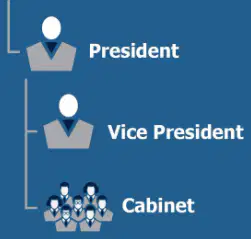
Who is part of the Executive branch of the U.S. government?
What is the role of the Judicial branch of the U.S. government?
To interpret and apply the law
To create laws
To enforce laws
To veto laws
Which article of the U.S. Constitution establishes the Legislative branch?
Article I
Article II
Article III
Article IV
Which branch of the U.S. government is associated with Article I?
A) Executive
B) Legislative
C) Judicial
What is the structure of the Legislative Branch?
Unicameral
Bicameral
Tricameral
None of the above.
The bicameral legislature mentioned in Article I consists of the House of Representatives and the Senate.
House of Representatives and Senate
House of Commons and House of Lords
Senate and National Assembly
Upper House and Lower House
The Legislative Branch according to Article I has the power to make laws.
Power to make laws
Power to execute laws
Power to interpret laws
None of the above

What is the leader of the House of Representatives called?
For how many years are Senate members elected?
2 years
4 years
6 years
8 years
How many senators are there in total?
50
100
200
435
The House of Representatives has a total of ___ members.
435.
436.
434.
400.
Who do the members of the Senate represent?
The entire state
The district
The city
The country
The process of becoming a law involves how a bill becomes a law.
It is debated and voted by both legislative houses and signed by the President.
It is passed by one house and automatically becomes a law.
It requires only a majority vote in one chamber.
It is reviewed solely by the Supreme Court.

What is the first step in the process of a bill becoming a law?
Introduction of the bill in Congress
Committee review
Voting in the Senate
Presidential signature
Where does a bill go after it is introduced in the House or Senate?
It is referred to the appropriate committee
It is sent back to the originating district
It goes immediately to the Senate Majority Leader
It becomes law after a vote on the floor
True or False: A bill must pass both the House of Representatives and the Senate before going to the President.
True
False
What can Congress do if the President vetoes a bill?
Override the veto.
Send the bill back to the President for revision.
Approve the vetoed bill automatically.
Let the Supreme Court decide on the veto.
One of the roles of the Executive Branch is to enforce laws.
Enforce laws
Interpret laws
Create laws
Finance laws
Which of the following is a power of the president?
Serving as Commander-In-Chief of armed forces
Directing foreign policy
Naming ambassadors
Negotiating treaties with other nations
What are the qualifications to be the President of the United States?
Must be a natural-born citizen, at least 35 years old, and a resident for at least 14 years.
Must be a citizen for at least 20 years regardless of birthplace.
Must be a resident for exactly 7 years and at least 40 years old.
Must be elected by Congress before running for presidency.
Which of the following is included in the Executive Branch?
President
Vice President
Cabinet
All of the above
The role which involves proposing laws and giving the State of the Union Address.
President
Senator
Congressman
Governor
If the President dies, is incapacitated, resigns, or is impeached, then the Vice President becomes President.
The Vice President becomes President.
The Speaker of the House becomes President.
The Secretary of State takes over.
A new election is held immediately.
What process was started by the Constitution related to the election of the President?
The creation of the Electoral College
Direct popular vote
The system of primaries
The use of an advisory council
How do we vote for the President according to the Electoral College system?
Through your state's selected electors who then cast votes for president.
Directly vote for the President in a national popular vote.
Vote for a slate of candidates on a single unified ballot.
Vote for the President using a referendum style system.
Why was the direct election of the President considered too chaotic?
It fostered political fragmentation and allowed too many candidates to split the vote.
It consolidated power among a few dominant political parties.
It ensured that only the most experienced politicians could run.
It prevented regional voters from having any influence.
How are electors assigned in the Electoral College?
Based on the number of Senators and Representatives in each state
By a direct popular vote across the nation
Evenly distributed among the states regardless of population
Randomly allocated by the issuing authorities
In California, how many electoral votes are there based on the number of Senators and Representatives?
California has 55 electoral votes.
California has 50 electoral votes.
California has 60 electoral votes.
California has 80 electoral votes.
Which courts has Congress created?
Congress has the power to establish inferior federal courts as provided by Article III.
It can establish inferior federal courts.
It can abolish the Supreme Court.
It can establish international courts.
It can appoint Supreme Court justices.
Which court case established the Court’s right to interpret laws(Judical Review)?
Brown v. Board of Education
Marbury v. Madison
Roe v. Wade
Plessy v. Ferguson
Due Process is the legal requirement that the state must respect all legal rights that are promised to a person. Which option best explains 'Due Process' as described in the text?
It ensures fairness through established legal procedures.
It only applies to criminal cases where evidence is presented.
It is a procedural method for the administrative processing of legal documents.
What is the process for immigrants to become U.S. citizens called?
Immigration
Naturalization
Emigration
Citizenship Test

