wayground logo

Free Printable Worksheets

Font size

S
M
L
XL
Worksheets

7th grade checkpoint 3 review

Total questions: 149

Worksheet time: 37hrs 15mins

Name
Class
Date
1.
2(4 + 9w) 
a)
8+9w
b)
2+9
c)
8+18w
d)
2+9w
2.
-8(6x + 3) 
a)
48X+3
b)
-48X-3
c)
14x+3
d)
-48x-24
3.
-4(k - 7)
a)
-4k + 28
b)
-4k - 28
c)
4k + 28
d)
4k - 28
4.
-4(-4d - 5)
a)
-16d+20
b)
16+20
c)
16d+20
d)
16s-20
5.
-3(2c - 5)
a)
-6c - 15
b)
-6c + 15
c)
6c + 15
d)
6c - 15
6.

8a + 6 + 1+ 8a - 3b + b

a)

16a + 4b + 7

b)

16a - 3b + 7

c)

16a - 2b + 7

d)

64a + -3b + 7

7.
Simplify the following expression:
-10x + 15 - 3x + 2
a)
7x + 17
b)
-7x+ 13
c)
-13x + 17
d)
-13x + 13
8.

5a + 2b - 7b + 4a

a)

7b - 3a

b)

9a - 5b

c)

4ab

d)

12a + 6b

9.

3(y + 5) - 2y

a)

5y + 5

b)

6y

c)

5y + 15

d)

y + 15

10.

Simplify the following expression:

-6x + 4(x - 3)

a)

-2x - 12

b)

10x + 12

c)

-10x - 12

d)

-2x + 12

11.

3(2x + 4) + 4(x - 5)

a)

10x + 32

b)

10x - 8

c)

9x - 8

d)

10x - 1

12.

Simplify the following expression:

-6x + 4(x - 3)

a)

-2x - 12

b)

10x + 12

c)

-10x - 12

d)

-2x + 12

13.
Which of the following is equivalent to 8(5f - 7) + 3f ?
a)
43f - 7
b)
-13f
c)
43f - 56
d)
40f -7 + 3f
14.
Simplify the expression: 7+3(1 - 2x) 
a)
21 - 6x
b)
10 - 2x
c)
10 - 20x
d)
10 - 6x
15.
Simplify the following expression:
-7x +5 (1 - 8x)
a)
-33x + 5
b)
5 + 33x
c)
47x + 5
d)
5 - 47x
16.
Simplify the following expression:
-6x + 4(-x - 3)
a)
-2x - 12
b)
10x + 12
c)
-10x - 12
d)
-2x + 12
17.
Simplify the following expression:
x + 4 - 7(x - 5)
a)
-33x + 19
b)
-47x2 +  21
c)
33x - 19
d)
-6x + 39
18.
Simplify:
3x - (x - 6) - 12
a)
2x - 6
b)
4x - 18
c)
2x + 6
d)
4x - 6
19.
2(4 + 9w) 
a)
8+9w
b)
2+9
c)
8+18w
d)
2+9w
20.

4(x - 5)

a)

4x + - 20

b)

4x + 20

c)

-4x + 20

d)

-4x - 20

21.
Are  these two expressions equivalent?
2 • (3 • 7) and  (2 • 3) • 7 
a)
Yes, because of the associative property
b)
Yes, because of the commutative property
c)
Yes, because of the distributive property
d)
No, these two expressions are not exquivalent
22.
Are these two expressions equivalent?
6 + 3 and 3 + 6
a)
Yes, because of the associative property
b)
Yes, because of the commutative property
c)
Yes, because of the associative property
d)
No, these two expressions are not equivalent
23.
Are these two expressions equivalent?
6 – (4 – 1) and (6 – 4) – 1
a)
Yes, because of the associative property
b)
Yes, because of the commutative property
c)
Yes, because of the distributive property
d)
No, these two expressions are not equivalent
24.
Are these two expressions equivalent?
40 ÷ 10 and 10 ÷ 40
a)
Yes, because of the associative property
b)
Yes, because of the commutative property
c)
Yes, because of the distributive property
d)
No, these two expressions are not equivalent
25.
Are these two expressions equivalent?
5(3+2) and 5•3 + 5•2
a)
Yes, because of the associative property
b)
Yes, because of the commutative property
c)
Yes, because of the distributive property
d)
No, these two expressions are not equivalent
26.
Are these two expressions equivalent?
18 • 1 and 18
a)
Yes, because of the inverse property
b)
Yes, because of the commutative property
c)
Yes, because of the identity property
d)
No, these two expressions are not equivalent
27.

Which is an example of the Commutative Property?

a)

(4 + 8) + 7 = 4 + (8 + 7)

b)

5 + 2 = 3 + 5

c)

9 x 1 = 9

d)

6 + 4 = 4 + 6

28.

Which is an example of the Associative Property of Addition?

a)

9 + 0 = 9

b)

(3 + 8) + 5 = 3 + (8 + 5)

c)

4 + 3 = 3 + 4

d)

4 + (2 + 9) = (4 + 9) + 2

29.

Which is an example of the Associative Property of Addition?

a)

9 + 0 = 9

b)

(3 + 8) + 5 = 3 + (8 + 5)

c)

4 + 3 = 3 + 4

d)

4 + (2 + 9) = (4 + 9) + 2

30.

Which property is used in the following expression?

6(9 + 4) = 54 + 24

a)

Associative Property of Multiplication

b)

Distributive Property

c)

Commutative Property of Addition

d)

Associative Property of Addition

31.

Which expression shows the Commutative Property of Multiplication?

a)

4 x 3 = 4 + 4 + 4

b)

8 x 3 = 3 x 8

c)

6 x 1 = 6

d)

53 = 5 x 5 x 5

32.

Which property is used in the following expression?

(5 + 7) + 8 = 5 + (7 + 8)

a)

Identity Property

b)

Distributive Property

c)

Commutative Property

d)

Associative Property

33.

Which property is used in the following expression?

2(9 + 6) = 2(9) + 2(6)

a)

Associative Property

b)

Commutative Property

c)

Distributive Property

d)

None of the above

34.
Which property is demonstrated here?
a + 0 = a
a)
Associative Property
b)
Commutative Property
c)
Identity Property
d)
Inverse Property
35.

The following represents which property?


12(3) = 3(12)

a)

Commutative Property of Multiplication

b)

Associative Property of Multiplication

c)

Identity Property of Multiplication

d)

Inverse Property of Multiplication

36.
x 2 = 2 x 9
a)
Commutative Property of Multiplication
b)
Associative Property of Multiplication
c)
Multiplicative Inverse Property
d)
Distributive Property
37.
This property tells us that you can move the parentheses when you are multiplying and the answer will not change. 
a)
Associative Addition 
b)
Associative Multiplication
c)
Commutative Addition 
d)
Commutative Multiplication 
38.
Name the property.
7 + (11 + 10) = (7 + 11) + 10
a)
Associative Property
b)
Commutative Property
c)
Distributive Property
d)
Identity Property
39.

Which of the following is an example of Commutative Property of Addition ?

a)

4 + 2 = 7 + 4

b)

(9 + 8) + 5 = 9 + (8 + 5)

c)

3 + 9 = 9 + 3

d)

6 • 1 = 6

40.

Which of the following shows the Identity Property of Multiplication

a)

5 • 0 = 0

b)

8 • 3 = 3 • 8

c)

12 • 1 = 12

d)

8 + 0 = 8

41.
What is the distance around a circle?
a)
Circumference
b)
Area
c)
Diameter
d)
Radius
42.
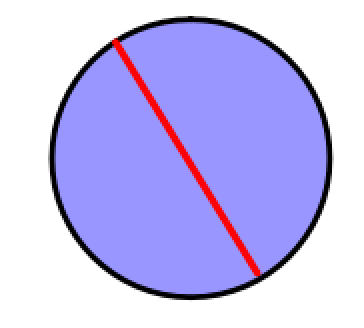
Is the red line a radius or diameter of the circle?
a)
Radius
b)
Diameter
43.
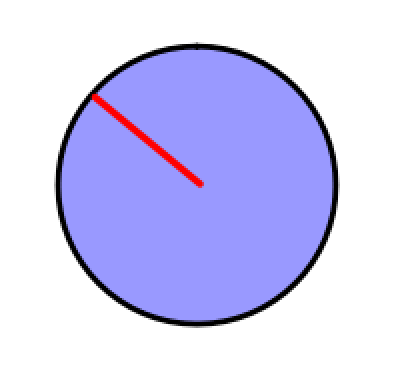
Is the red line a radius or diameter of the circle?
a)
Radius
b)
Diameter
44.
What is π ? (Best Choice)
a)
The ratio of the circumference of any circle to its diameter.
b)
Exactly 3.14
c)
Exactly 3.1415
d)
Exactly 3.141593
45.
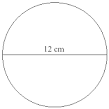
what is the circumference of this circle ?
a)
3.14 cm 
b)
37.68 cm
c)
24 cm
d)
68.4 cm
46.
If my radius is 10ft, what is my diameter?
a)
20ft
b)
5ft
c)
31.4ft
d)
62.8ft
47.
What is the diameter of this circle?
a)
3.5
b)
3
c)
5
d)
7
48.
A Circle has a radius of 4.  What is the area of the circle? (Best Choice) (note: units are squared)
a)
4π or about 12.56
b)
16π or about 50.24
c)
2π or about 6.28
d)
8π or about 25.12
49.
A Circle has a diameter of 10 centimeters.  What is the area of the circle? (Best Choice)
a)
5π or about 15.7 cm2
b)
10π or about 31.4 cm2
c)
25π or about 78.5 cm2
d)
100π or about 314 cm2 
50.
What is the diameter?
a)
8
b)
16
c)
10
d)
4
51.
A bicycle tire has a diameter of 27 inches. What is the radius?
a)
27π
b)
13.5
c)
81
d)
25π
52.
If my radius is 10ft, what is my diameter?
a)
20ft
b)
5ft
c)
31.4ft
d)
62.8ft
53.
The diameter of a circle is:
a)
The measurement around the circle.
b)
The distance from an edge of a circle to another edge.
c)
The distance from the center of the circle to an edge of a circle
d)
The distance from an edge of a circle to another edge through the center. 
54.
The circumference of a circle is
a)
The measurement from an edge of a circle to another edge.
b)
The measurement around the circle
c)
The measurement from an edge of a circle to another edge going through the center
d)
The measurement from the center of the circle to an edge of the circle
55.
The radius of a circle is
a)
The measurement from the center of a circle to an edge of the circle.
b)
The measurement around the circle
c)
The measurement from and edge of the circle to another edge through the center
d)
A line perpendicular to the diameter of the circle
56.
What formula is this used for:
πd
a)
Area
b)
Circumference 
c)
Surface Area
d)
Volume 
57.
Other than the formula C=πd what is another formula for circumference of a circle?
a)
C=2π
b)
C=2πr
c)
C=πr²
d)
C=πd²
58.
Meg swam from one side of her circular pool to the other side going through the center.  If Meg swam 8 feet, what is the approximate circumference of Meg's pool?
a)
16 feet
b)
25.12 feet
c)
251.2 feet
d)
4 feet
59.

What is the perimeter of the Square?

a)

17

b)

18

c)

16

d)

19

60.

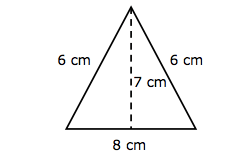
What is the perimeter of the equilateral triangle

a)

23

b)

24

c)

25

d)

7710

61.

What is the area of the rectangle?

a)

195

b)

70

c)

196

d)

728728

62.
What is the area of this figure?
a)
40 square units
b)
45 units
c)
13
63.
The distance around an object is called the 
a)
area
b)
perimeter
64.
How do you find the area of a rectangle?
a)
Length + Length + Length + Length
b)
Length + Width
c)
Length x Width
d)
Width x Width
65.
Adam was painting a wall in his room. The wall was 4 feet wide and 4 feet tall. What is the area of the wall he has to paint?
a)
16ft
b)
8ft
c)
12ft
d)
4ft
66.
Area represents the
a)
The number of square units inside a figure
b)
The number of units around a figure
67.
What is the perimeter?
a)
3 ft. 
b)
6 ft. 
c)
12 ft. 
d)
18 ft. 
68.
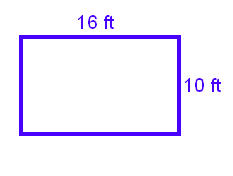
Find the AREA of this figure.
a)
160 square feet
b)
160 feet
c)
160
d)
1600 feet
69.
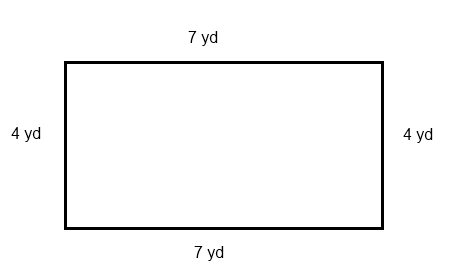
What is the PERIMETER of this rectangle?
a)
22 sq. yd.
b)
22
c)
22 cm
d)
22 yd.
70.

Perimeter = length + length + width + width

What is the perimeter of this rectangle?

a)

12 units

b)

16 units

c)

18 units

d)

14 units

71.

Area = length x width

What is the AREA of this rectangle?

a)

26

b)

36

c)

20

d)

13

72.
What is the area?
a)
12 cm2
b)
14
c)
14 cm2
d)
24 cm2
73.

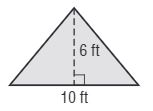
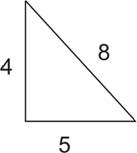
Find the area of the triangle.

a)

20 cm2

b)

56 cm2

c)

28 cm2

d)

27 cm2

74.
Find the area of the figure:
a)
30 ft2
b)
60 ft2
c)
16 ft2
d)
36 ft2
75.

What is the area of this figure?

a)

48

b)

24

c)

60

d)

30

76.

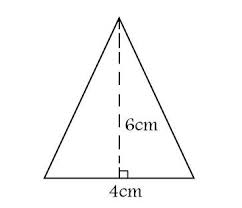
What is the area of this triangle?

a)
4 km2
b)
16 km2
c)
64 km2
d)
8 km2
77.

Find the area of the triangle?

a)
17 units2
b)
20 units2
c)
10 units2
d)
16 units2
78.

A bookmark is 3 centimeters wide and 9 centimeters tall. What is its area?

a)

27cm2

b)

24cm2

c)

28cm

d)

28cm2

79.

Each side of a square piece of construction paper is 7 inches long. What is the piece of paper's area?

a)

49in2

b)

49in

c)

14in2

d)

28in

80.

Find the volume, use 3.14 for pi.

V=πr2hV=\pi r^2h  

a)

A

b)

B

c)

C

d)

D

81.

Find the volume, use 3.14 for pi.

V=πr2hV=\pi r^2h

a)

A

b)

B

c)

C

d)

D

82.

Find the volume, use 3.14 for pi.

V=πr2hV=\pi r^2h

a)

A

b)

B

c)

C

d)

D

83.

Find the volume, use 3.14 for pi.

V=πr2hV=\pi r^2h

a)

A

b)

B

c)

C

d)

D

84.

Find the volume, use 3.14 for pi.

V=πr2hV=\pi r^2h

a)

A

b)

B

c)

C

d)

D

85.

Find the volume, use 3.14 for pi.

V=πr2hV=\pi r^2h

a)

A

b)

B

c)

C

d)

D

86.

Find the volume, use 3.14 for pi.

V=πr2hV=\pi r^2h

a)

A

b)

B

c)

C

d)

D

87.

Find the volume, use 3.14 for pi.

V=πr2hV=\pi r^2h

a)

A

b)

B

c)

C

d)

D

88.

Find the volume, use 3.14 for pi.

V=πr2hV=\pi r^2h

a)

A

b)

B

c)

C

d)

D

89.

Find the volume, use 3.14 for pi.

V=πr2hV=\pi r^2h

a)

A

b)

B

c)

C

d)

D

90.
Julie uses a tent like the one shown to go camping with friends. The tent is 7 feet tall, 10 feet wide and 12 feet long. 
a)
840 cubic feet
b)
84 cubic feet
c)
420 cubic feet
d)
120 cubic feet
91.
What is volume?
a)
The amount of space of a 2-D object
b)
The amount of space in a 3-D object
c)
Water
d)
Area
92.
What does the "B" in the volume formula V = B x h stand for?
a)
Bottom of the object
b)
Box
c)
Between
d)
Area of the base
93.
Robert is buying trash bags for his trashcan, but first needs to find the volume of his trashcan to decide on what size bags he needs. His trashcan is 2 feet wide and 3 feet long and has a height of 4 feet. What is the volume? 
a)
Medium trash bags
b)
24 ft³
c)
9 ft³
d)
20 ft³
94.
a)
47520 m3
b)
47521 m3
c)
47522 m3
d)
47523 m3
95.
a)
5940 cm3
b)
5939 cm3
c)
5938 cm3
d)
5941 cm3
96.
a)
50.2 ft³
b)
51.2 ft³
c)
49.2 ft³
d)
52.2 ft³
97.
If a rectangular prism has a base that is 5 inches by 6 inches and height of 13 inches, what is the volume?
a)
24 in³
b)
390 in³
c)
143 in³
d)
24 in²
98.
Tonya and her friend are going camping. The entry way to get into the tent is 5 feet tall and 4 feet wide. If the lenght of the tent is 8 feet, how much room will they have inside?
a)
28 ft³
b)
160 ft³
c)
80 ft³
d)
44 ft³
99.
a)
40 cm³
b)
11 cm
20 cm²
c)
20 cm³
d)
30 cm³
100.
Calculate the Volume
a)
410 cm3
b)
420 cm3
c)
402 cm3
d)
401 cm3
101.
What is the volume of the following triangular prism?
a)
45 cubic in
b)
36 cubic in
c)
108 cubic in
d)
54 cubic in
102.
Which label would NOT be appropriate for volume.
a)
square miles
b)
inches3
c)
cm3
d)
cubic feet
103.
If the volume of the cereal box is 108 in3, how would the volume change if you changed the width from 2 to 4 inches?
a)
The volume increases by one half.
b)
The volume doubles.
c)
The volume triples.
d)
The volume quadruples.
104.
Find the height of the triangular prism.
a)
5 m
b)
7 m
c)
10 m
d)
6.4 m
105.
Find the height of the rectangular prism.
a)
9 m
b)
11 m
c)
15.75 m
d)
22.91 m
106.
Find the volume of the triangular prism.
a)
147.9 mi3
b)
172 mi3
c)
295.8 mi3
d)
239.6 mi3
107.
What is volume?
a)
The amount of space of a 2-D object
b)
The amount of space in a 3-D object
c)
Water
d)
Area
108.
Julie uses a tent like the one shown to go camping with friends. The tent is 7 feet tall, 10 feet wide and 12 feet long. 
a)
840 cubic feet
b)
84 cubic feet
c)
420 cubic feet
d)
120 cubic feet
109.

What is the inverse of multiplication?

a)

Addition

b)

Subtraction

c)

Multiplication

d)

Division

110.

12g - 5 = 19


Which is the correct 1st step?

a)

Add 12 to both sides

b)

Add 5 to both sides

c)

Add 19 to both sides

111.


12g5=1912g-5=19  

       +5    +5        \ \ \ \ \ \ \ +5\ \ \ \ +5\ \ \ \ \ \ \ \  
12g       = 2412g\ \ \ \ \ \ \ =\ 24  
What is the next step?

a)

Multiply both sides by 12

b)

Divide both sides by 12

c)

Multiply both sides by 24

d)

Divide both sides by 24

112.

2t -7 = 3


Find the value of t

a)

-2

b)

2

c)

5

d)

20

113.

whats the cutest animal you can think of ?

a)

A. elephant

b)

B. racoon

c)

C. cat

d)

D.Llama

114.

25 h + 6 = 8\frac{2}{5}\ h\ +\ 6\ =\ 8  


What is the first step that should be done to both sides?

a)

+6

b)

-6

c)

+8

d)

-8

115.

10 = 2d - 5


What is the value of d?

a)

2.5

b)

7.5

c)

15

d)

20

116.

To undo an operation, you must do its opposite or inverse to both sides of the equation. Match each operation to its inverse.

a)

Addition

1.

Subtraction

b)

Subtraction

2.

Addition

c)

Multiplication

3.

Division

d)

Division

4.

Multiplication

117.

Solve

5=t235=\frac{t}{2}-3  


(a)  

118.

Solve. Check your answer.


5x+12=135x+12=-13  


(a)  

119.

3x+2 = 253x+2\ =\ -25  


a)

x = 8x\ =\ -8  

b)

x = 9x\ =\ -9  

c)

x = 9x\ =\ 9  

d)

x = 24x\ =\ 24  

120.

-8x + 9 = 33

a)

3

b)

50

c)

16

d)

-3

121.

What is the FIRST step in solving this equation?

a)

subtract 3 from each side

b)

add three to each side

c)

subtract 2 from each side

d)

add 2 to each side

122.
4x + 7 = 23
a)
x = 16
b)
x = 4
c)
x = 9
d)
x = 12
123.

Solve for a

a)

a= -2

b)

a= -6

c)

a= 3

d)

a= 15

124.

Which two operations are in this equation?

5x+4=165x+4=-16  

a)

addition

b)

subtraction

c)

multiplication

d)

division

125.

What is the first step to solve this equation:

11 - 3x = 44

a)

Add 3 to both sides

b)

Subtract 11 from both sides

c)

Add 11 to both sides

d)

Divide 3 on both sides.

126.
What is the first step in solving the following equation?
3x - 5 = 20
a)
multiply both sides by 5
b)
add 5 to both sides
c)
divide both sides by 5
d)
subtract both sides by 5
127.

-9x + 1 = -80

a)

-9

b)

9

c)

6

128.
Valentine's Day is on__________.
a)
December 25
b)
January 1
c)
February 14
d)
July 4
129.
a)

x > 3

b)

x ≤ ⅕

c)

x ≥ 3

d)

x ≤ ⅕

130.
-4x + 14 ≤ 54
a)
x ≥ - 10
b)
x ≤ -10
c)
x ≥ 10
d)
x ≤ 10
131.
Solve for k.
2k - 9≤ -19
a)
k ≤ -5
b)
k ≤ 5
c)
k < -5
d)
k < 5
132.

-3x − 4 < 5

a)

x > -3

b)

x < -3

c)

x < 3

d)

x > 3

133.
Do I need to flip my sign?
-3x  ≥ 12
a)
Yes, because I'll be dividing by a negative number
b)
No, because you never flip the sign. 
134.
Solve and graph the inequality.
7n - 1 > 76
a)
A
b)
B
c)
C
d)
D
135.
Match the graph with its inequality.
a)
b > –2
b)
b < –2
c)
b ≥ –2
d)
b ≤ –2
136.

When graphing b<6b<6 , would you use an open circle or a filled-in/closed dot?

a)

open circle

b)

filled-in/closed dot

137.

When graphing d12d\ge12 , would you use an open circle or a filled-in/closed dot?

a)

open circle

b)

filled-in/closed dot

138.
a)

x < -20

b)

x > -20

c)

x > 20

d)

x < 20

139.
25 < X - 10
a)
X > 35
b)
X < 35
c)
X > -35
d)
X < -35
140.
x/3 - 2  < 8
a)
x > 30 
b)
x < 30
c)
x < 18
d)
x > 18
141.
a)

A

b)

B

c)

C

d)

D

142.
a)

A

b)

B

c)

C

d)

D

143.

What is the name of this symbol? 
\le  

a)

less than

b)

greater than

c)

less than or equal to

d)

greater than or equal to

144.

The variable, k, is being divided by 11. How should you isolate the variable?

 16=k1116=\frac{k}{11}  

a)

Divide both sides by 11

b)

Multiply both sides by 11.

c)

Add 11 to both sides.

d)

Subtract 11 to both sides.

145.

Choose the correct expression that represents 7 is less than a number.

a)

x > 7

b)

x < 7

c)

x ≤ 7

d)

x ≥ 7

146.

2 + 3x ≤ 20

a)

x ≤ 6

b)

x ≥ -6

c)

x ≤ 7

d)

x ≥ -7

147.
The steps in solving 5b - 6 = 24 are: 
a)
Add 6 to both sides and divide both sides by 5
b)
Add 6 to both sides and multiply both sides by 5
c)
Subtract 6 from both sides then multiply both sides by 5
d)
Subtract 6 from both sides then divide both sides by 5
148.

Keep or Flip: 4m<4-4m<4  

a)

Keep

b)

Flip

149.
You flip an inequality symbol when you...
a)
subtract
b)
multiply and divide only
c)
multiple by a negative number
d)
multiple or divide by a negative number