
 Worksheets
Organisms & Environments STAAR Prep 1
Total questions: 14
Worksheet time: 7mins
Which of the following statements describes how an armadillo interacts with both biotic and abiotic factors in its environment?
A. Armadillos can hold their breath for long periods of time and can walk short distances underwater.
B. Armadillos burrow in moist soil looking for grubs and termites to eat.
C. Armadillos escape predators by rolling into a ball or burrowing underground.
D. Armadillos eat small insects or soft plants.
Which is NOT a way that rattlesnakes interact with biotic factors in their environment?
A. Rattlesnakes inject their prey with venom.
B. Rattlesnakes will often hibernate in a den with hundreds of other snakes.
C. Rattlesnakes burrow underground to avoid extreme temperatures.
D. Rattlesnakes prey on small mammals and lizards.
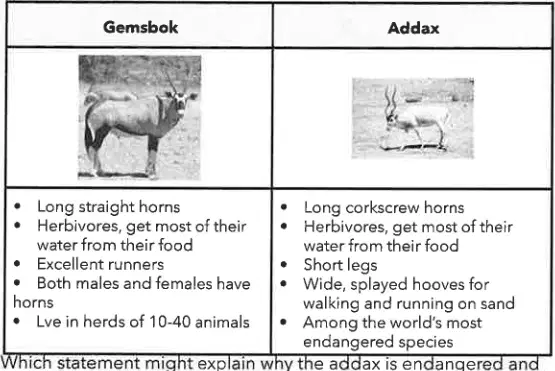
Which statement might explain why the addax is endangered and the gemsbok is not?
The addax are not fast enough to escape predators, and the gemsbok can escape quickly.
The addax are unable to protect themselves, since their horns are not straight.
The addax and the gemsbok are not able to find water in their environment.
Only the addax has hooves that help it walk on sand.
The walrus and the sea lion are marine animals. The walrus lives in cold, icy waters and the sea lion can be found in warm, tropical waters. Both of them have long whiskers on their snout. How do whiskers benefit both the Walrus and the Sea Lion?
Whiskers allow the animals to stay warm in cold waters.
Whiskers help protect the animals from predators.
Whiskers help the animals move through their environment.
Whiskers help the animals sense its surroundings to find prey and avoid predators.
How do dolphins survive in their ocean environment?
By burrowing underground
By hibernating during the winter
By using echolocation to find food
By flying to warmer climates
Which adaptation helps a hawk survive in a forest environment?
Webbed feet for swimming
Sharp talons for catching prey
Large ears for hearing in the dark
Scales for protection from predators
What adaptation helps a rabbit survive in a grassland environment?
Sharp teeth for chewing meat
Webbed feet for swimming
Fast running speed to escape predators
Scales for protection from the sun
What physical trait of armadillos help armadillos from being preyed upon?
Their armored shell
Their speed
Their ability to climb trees
Their sharp claws
What feature helps a cactus survive in a hot desert environment?
Large leaves for capturing sunlight
Brightly colored flowers for attracting insects
Long, flowing branches for climbing trees
Thick, waxy skin to prevent water loss
What physical characteristic of a rain forest ecosystem supports a diverse population of plants and animals?
Dry climate
Cold temperatures
High humidity
Sparse vegetation
What adaptation helps a polar bear survive in the Arctic?
A) Long legs for running fast
B) Sharp claws for climbing trees
C) Large ears for hearing predators
D) White fur for camouflage
How do plants benefit from abiotic factors in their environment?
They absorb sunlight and water for energy.
They consume nutrients from the soil.
They rely on other organisms for food.
They migrate to different habitats.
What is a fossil?
A living plant or animal
A preserved trace of a past living organism
A type of rock found in caves
A type of cloud formation
What adaptation helps a maple tree survive in a forest environment?
Large thorns for protection
Deep roots to absorb water
Wings to fly to new locations
Fins for swimming in rivers

