
NEW
Font size
 Worksheets
Rev Quest_Weathering-Erosion-Deposition_2024-2025
Total questions: 25
Worksheet time: 13mins
Which agent of erosion is most likely responsible for the deposition of sandbars along ocean shorelines?
glaciers
mass movement
wave action
wind action
Which property of water makes frost action a common and effective form of weathering?
Water dissolves many earth materials.
Water expands when it freezes.
Water cools the surroundings when it evaporates.
Water loses 334 Joules of heat per gram when it freezes.
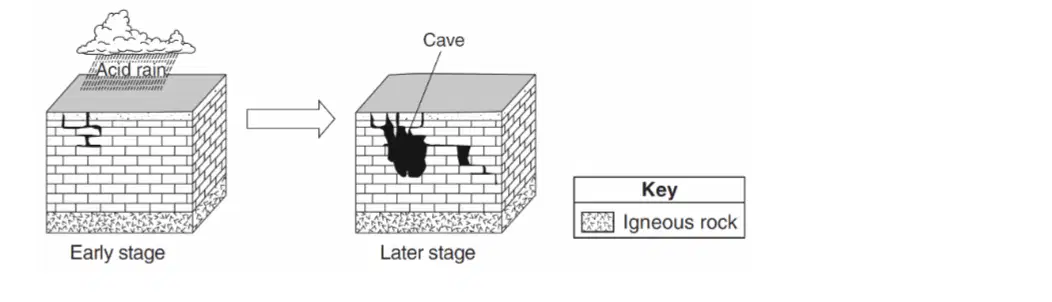
The two block diagrams below represent the formation of caves. Which types of weathering and erosion are primarily responsible for the formation of caves?
A) chemical weathering and groundwater flow
B) chemical weathering and runoff
C) physical weathering and groundwater flow
D) physical weathering and runoff
Landscapes will undergo the most chemical weathering if the climate is
cool and dry
cool and wet
warm and dry
warm and wet
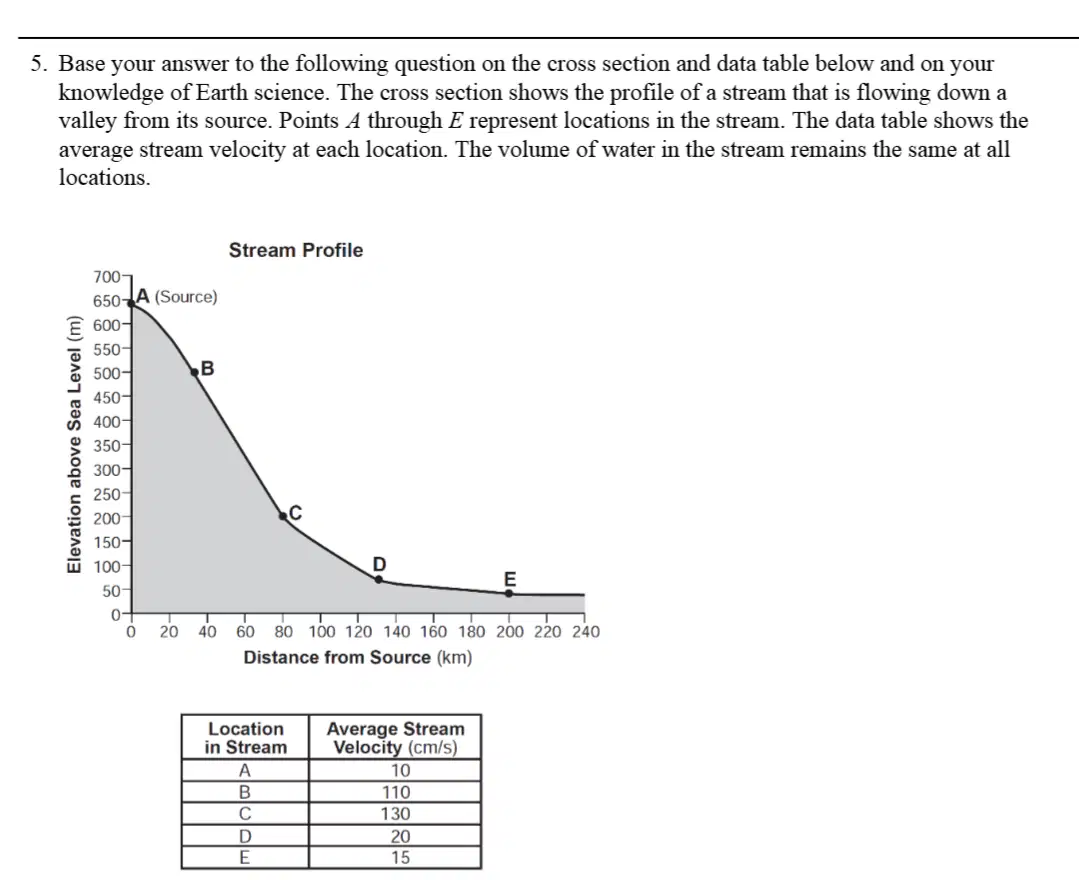
What is the largest type of sediment that could be transported at location B?
silt
sand
pebbles
cobbles
Sediments found in glacial moraines are best described as
sorted and layered
sorted and not layered
unsorted and layered
unsorted and not layered
Particles of soil often differ greatly from the underlying bedrock in color, mineral composition, and organic content. Which conclusion about these soil particles is best made from this evidence?
They are residual sediments.
They are transported sediments.
They are uniformly large-grained.
They are soluble in water.
As a quartz pebble is transported by a stream, the pebble will become more rounded as a result of
dissolving as water is running over the rock
abrasion by colliding with other rocks
deposition in well-sorted layers
resistance to weathering and erosion
What change will a pebble usually undergo when it is transported a great distance by streams?
It will become jagged and its mass will decrease.
It will become jagged and its volume will increase.
It will become rounded and its mass will increase.
It will become rounded and its volume will decrease.
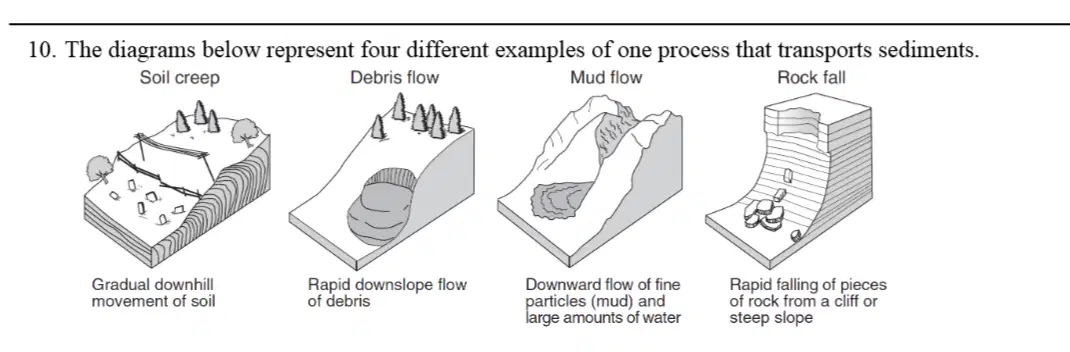
Which process is shown in these diagrams?
A) chemical weathering
B) wind action
C) mass movement
D) rock abrasion
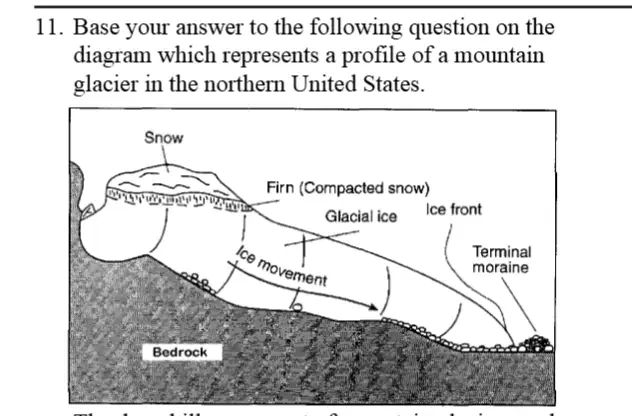
The downhill movement of mountain glaciers such as the one shown in the diagram is primarily caused by
evaporation of ice directly from the glacier
snow blowing across the top of the glacier
the force of gravity pulling on the glacier
water flowing over the glacier
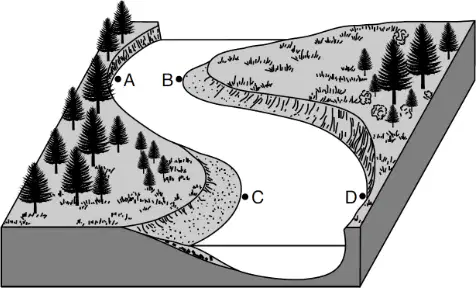
The block diagram below represents a meandering river. Points A, B, C, and D represent locations near the edge of the river. The greatest amount of erosion is most likely occurring at locations.
A and B
B and C
C and D
D and A
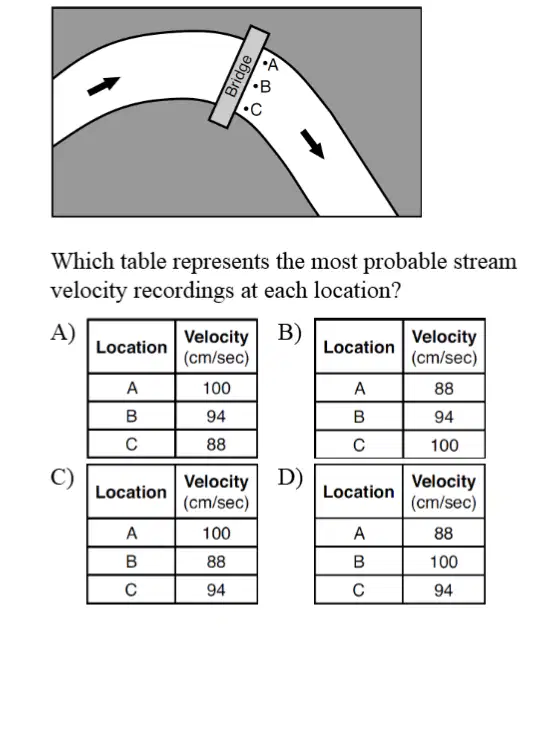
The map below represents a bridge over the meander of a stream. From the bridge, a student measures the stream velocity at locations A, B, and C. Which table represents the most probable stream velocity recordings at each location?
Choice A
Choice B
Choice C
Choice D
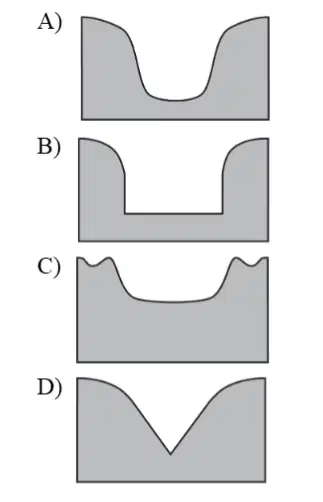
Which cross section best represents the valley shape where a rapidly flowing stream is cutting into the bedrock in a mountainous area?
Choice A
Choice B
Choice C
Choice D
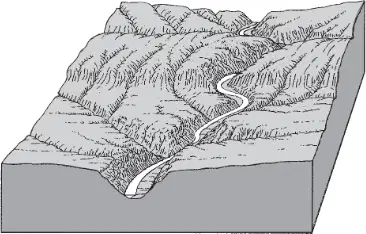
The block diagram below represents a stream flowing from a mountain region. A brief, heavy rainstorm occurs in the mountains. How will the volume of water and the rate of erosion in the stream change shortly after the rainstorm?
The volume of water will decrease and the rate of erosion will increase.
The volume of water will increase and the rate of erosion will decrease.
Both the volume of water and the rate of erosion will decrease.
Both the volume of water and the rate of erosion will increase.
The greater the time that stream sediment is transported, the greater the probability that the sediment will become more
angular and smaller
angular and larger
rounded and smaller
rounded and larger
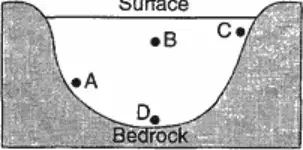
The diagram below shows a cross section of a river. Letters A, B, C, and D represent points in the river. At which point is the water most likely to have the greatest velocity?
A) A
B) B
C) C
D) D
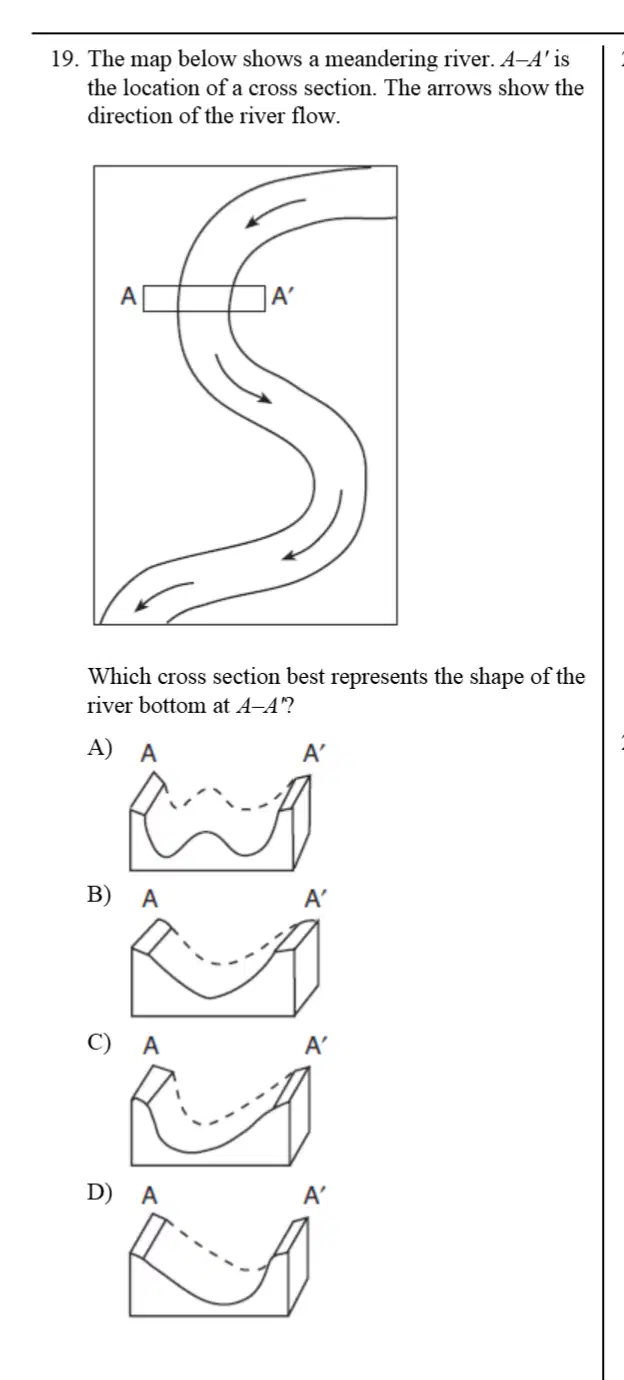
The map below shows a meandering river. A–A' is the location of a cross section. The arrows show the direction of the river flow. Which cross section best represents the shape of the river bottom at A–A'?
A
B
C
D
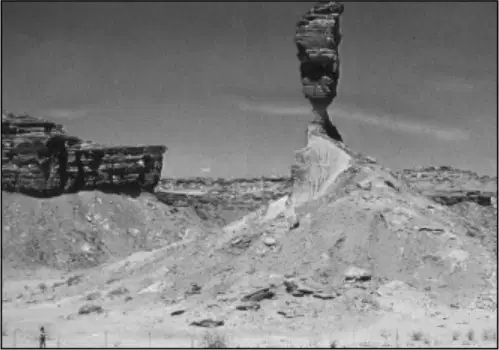
The picture below shows a geological feature in the Kalahari Desert of southwestern Africa. Which process most likely produced the present appearance of this feature?
A) wind erosion
B) volcanic eruption
C) earthquake vibrations
D) plate tectonics
Sharp-edged, irregularly shaped sediment particles found at the base of a rock cliff were probably transported by
gravity
wind
ocean waves
running water
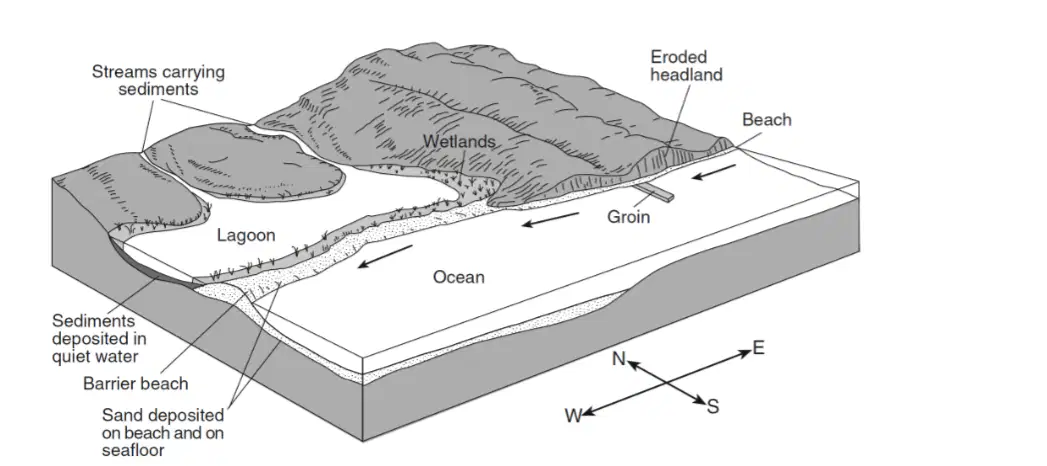
Base your answer to the following question on the diagram below. The arrows show the direction in which sediment is being transported along the shoreline. A barrier beach has formed, creating a lagoon (a shallow body of water in which sediments are being deposited). The eroded headlands are composed of diorite bedrock. A groin has recently been constructed. Groins are wall-like structures built into the water perpendicular to the shoreline to trap beach sand. The groin structure will change the pattern of deposition along the shoreline, initially causing the beach to become
wider on the western side of the groin
wider on the eastern side of the groin
narrower on both sides of the groin
wider on both sides of the groin
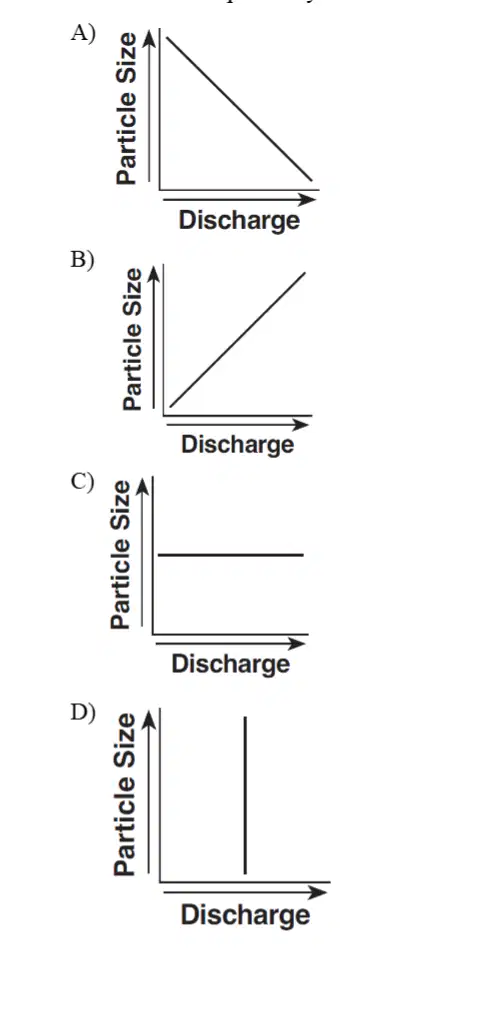
Which graph best represents the correct relationship between the discharge of a river and the particle size that can be transported by that river?
Choice A
Choice B
Choice C
Choice D
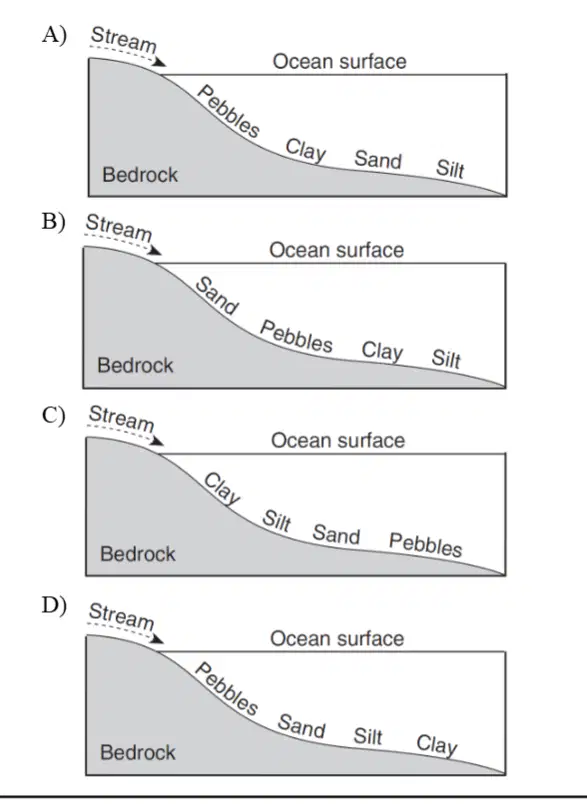
Which profile best shows the general depositional pattern that occurs when water from a stream enters the ocean?
Choice A
Choice B
Choice C
Choice D
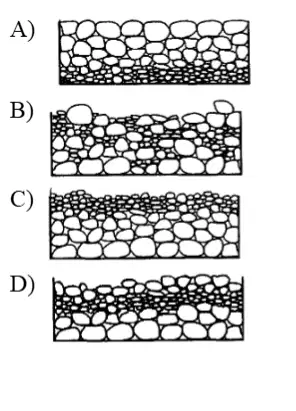
Quartz particles of varying sizes are dropped at the same time into deep, calm water. Which cross section best represents the settling pattern of these particles?
Choice A
Choice B
Choice C
Choice D
Which particles most likely will be deposited first as the velocity of a stream carrying a mixture of particles decreases?
small, flat, low-density particles
small, round, low-density particles
large, flat, high-density particles
large, round, high-density particles

