
 Worksheets
[CHEM 09] Acids and Bases Review
Total questions: 67
Worksheet time: 2hrs 39mins



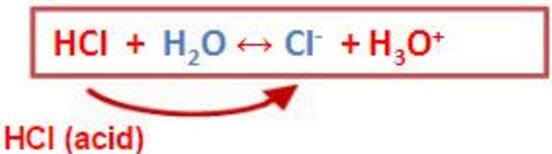
Given the reaction above, which compound is the bronsted-Lowry Acid?
NH3
HCl
NH4+
Cl-

Given the reaction above, which compound is the bronsted-Lowry Conjugate base, if HCl is the acid?
NH3
NH4+
Cl-
An Arrhenius base:
donates H+
accepts H+
produces H+
produces OH-
An Arrhenius acid:
donates H+ to another substance
accepts H+ from another substance
produces H+
produces OH-
A Bronsted Lowry base:
donates H+ to another substance
accepts H+ from another substance
produces H+
produces OH-
A Bronsted Lowry acid:
donates H+ to another substance
accepts H+ from another substance
produces H+
produces OH-
According to the Bronsted-Lowry acid-base theory, H2O is considered to be a base when it...
donates an electron
donates a proton
accepts a proton
accepts an electron

NH3 + H2O → NH4+ + OH-
NH3 is a Bronsted Lowry
Acid
Base
conjugate acid
conjugate base
HNO3 + H2O → H3O+ + NO31-
NO31- is the conjugate base of
H2O
HNO3
H3O+
none of the above
HCO3- + H2O → H3O+ + CO32-
Water is acting as
a Bronsted Lowry base
a Bronsted Lowry acid
a strong acid
a weak acid
HC2H3O2 + H2O → H3O+ + C2H3O21-
HC2H3O2 is acting as
a conjugate base
a Bronsted Lowry base
a Bronsted Lowry acid
none of the above
What is the conjugate base of H2SO4?
SO42-
H2SO3
HSO31-
HSO41-
In the equation below, what is the Bronsted Lowry acid (donates H+)?
HCl + NH3 → Cl- + NH4+
HCl
NH3
Cl-
NH4+
Which reactant in the following equation is a Bronsted Lowry acid?
H2O + HCl → H3O+ + Cl-
Water
Hydrogen chloride
Hydronium
Chloride
What is the conjugate acid in the following equation?
PO4-3 + HNO3 → NO3- + HPO4-2
PO43-
HNO3
NO3-
HPO42-
CO32- + H2O → HCO3- + OH-
Using the above reaction, which compound is the conjugate base?
CO32-
H2O
HCO3-
OH-
HSO4- + H2O → H3O+ +SO42-
Identify the Bronsted Lowry Acid in the above reaction.
HSO4-
H2O
H3O+
SO42-
What is the conjugate base in the following reaction?
HCO3- + HCl → H2CO3 + Cl-
HCO3-
HCl
H2CO3
Cl-
Given the equation representing a reaction:
H2CO3 + NH3 → NH4+ + HCO3-
According to one acid-base theory, the compound NH3 acts as a base because it
accepts a hydrogen ion
donates a hydrogen ion
accepts a hydroxide ion
donates a hydroxide ion
Label the acid, base, conjugate acid and conjugate base.
Click on the acid.
Click on the base.
Click on the conjugate base.
Click on the conjugate acid.
According to Bronsted-Lowry, what does an acid do?
It donates a proton (H+).
It accepts a proton (H+)
It produces H+ in water.
It produces OH- in water.
According to Bronsted-Lowry, what does a base do?
It donates a proton (H+).
It accepts a proton (H+)
It produces H+ in water.
It produces OH- in water.
Binary acids start with "____________"
acid
nitric
hydraulic
hydro
Always add the word "________" to the end when naming acids
base
hydro
acid
Baumstark
What is the formula for phosphorous acid?
H3PO4
H2PO4
H3P
H3PO3
Name the Acid: H2S
Sulfuric Acid
Sulfurous Acid
Hydrosulfuric Acid
Hydrosulfurous Acid
Name the acid: HC2H3O2
Acetic Acid
Acetous Acid
Hydrogen Acetate
Hydrogen Dicarbon Trihydrogen Dioxygen
chlorous acid
HClO3
HClO2
HClO
HCl
A type of chemical that forms solutions that taste sour, due to high concentrations of positive hydrogen ions
acid
base
salt
pH
What is considered to be in the middle of the pH scale
acidic
neutral
basic
indicator
Zn(OH)2 + HNO3 ---> H2O + Zn(NO3)2
Complete the following reaction:
HCl + Mg(OH)2 -->
MgCl2 + H2O
Mg +H2O
MgCl2 + H2
MgCl2 + H2O + CO2
Complete the following reaction:
H3PO4 + NaOH -->
Na3PO4 + H2O
Na +H2O
Na3PO4 + H2
Na3PO4 + H2O + CO2
Complete the following reaction:
HNO3 + Ca(OH)2 -->
Ca(NO3)2 + H2O
Ca +H2O
Ca(NO3)2 + H2
Ca(NO3)2 + H2O + CO2
If a solution has a [H+] of 9.3x10⁻¹¹, what is the pH?
10.0
4.0
3.5
8.2
If a solution has a [OH-] of 2.3x10⁻⁴, it must be a(n)...
Acid
Base
Neutral
What is the equation for calculating pH?
pH = [H+]
pH = log [H+]
pH = -log[OH-]
pH = -log [H+]
If we dissolve 20.0 grams of HCl in 1.2 L of water, what is the pH of that solution?
0.34
4.21
7.20
10.34
If the hydronium ion H3O+ concentration is equal to the hydroxide ion OH- concentration, the solution is a(n)
acid
base
salt
neutral solution
The pH of a solution is 8.43. What is the hydronium ion H3O+ concentration?
3.7 x 10⁻⁹ M
2.7 x 10⁻⁶ M
1.0 x 10-8.43 M
1.0 x 10⁻¹⁴
The pH of a solution is 8.43. What is the hydroxide ion OH- concentration?
3.7 x 10⁻⁹ M
2.7 x 10⁻⁶ M
antilog (-pH)
1.0 x 10⁻¹⁴/-pH

carbonic acid
H2CO3
H2CrO4
H2C2O4
HCO3

