
 Worksheets
Chemical Reactions Test
Total questions: 25
Worksheet time: 1hrs 27mins
What reaction has the following general formula:
AB --> A + B
Synthesis
Decomposition
Single Replacement
Double Replacement
Combustion
Is this chemical equation balanced?
Al + O2 → 2Al2O3
Mg → Mg2+ + 2e–
What is the oxidation number of nitrogen in N2?
-3
0
+4
-1
Balance this equation (a) N2 + (b) H2 --> (c) NH3
What does the law of conservation of mass state?
Matter can transform into energy
Matter can be created and destroyed
Matter can neither be created nor destroyed
Only energy can be conserved, not matter

When the switch is closed, which group of letters correctly represents the direction of electron flow?
A) A → B → C → D
B) A → F → E → D
C) D → C → B → A
D) D → F → E → A
Label these terms.

What is the role of the salt bridge in a voltaic cell? (Check all that apply)
To allow the movement of water molecules between the two half cells
To allow the movement of electrons between the half cells
To allow the movement of ions to maintain charge neutrality
What is an anode?
It is the electrode where oxidation takes place.
It is the electrode where reduction takes place.
It is an aqueous solution containing an electrode.
It is the salt bridge that connects half-cells.
What is a cathode?
It is the electrode where oxidation takes place.
It is the electrode where reduction takes place.
It is an aqueous solution containing an electrode.
It is the salt bridge that connects half-cells.
Match the following symbol to the correct definition
(s)
solid
(𝑙)
liquid
(g)
gas
(aq)
aqueous (dissolved in water)

What are the reactants of this equation?
N2+H2
2NH3
2Al +(SO4) → Al2(SO4)3
What are the products of this equation?
2Al +(SO4)
Al2(SO4)3
Which change in oxidation number represents reduction?
–1 to +1
–1 to –2
–1 to +2
–1 to 0

Galvanic cells convert
mechanical energy into electrical energy
potential energy into electrical energy
electrical energy into chemical energy
chemical energy into electrical energy
What is a reducing agent?
It is the species that gets reduced -- gains electrons.
It is the species that gets oxidized -- loses electrons.
It is the species that creates electrons.
It is the species that destroys electrons.
What is an oxidizing agent?
It is the species that gets reduced -- gains electrons.
It is the species that gets oxidized -- loses electrons.
It is the species that creates electrons.
It is the species that loses electrons.
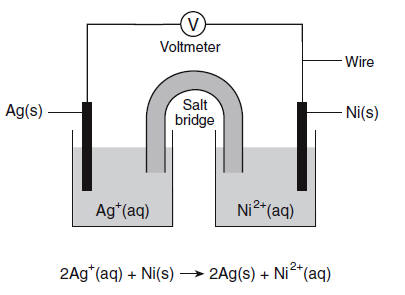
Electrons always flow from
cathode to anode
anode to cathode
What is reduction?
It is the gain of electrons.
It is the loss of electrons.
It is the creation of electrons.
It is the destruction of electrons.
What is oxidation?
It is the gain of electrons.
It is the loss of electrons.
It is the creation of electrons.
It is the destruction of electrons.

