
 Worksheets
P5 DRAMA REVISION
Total questions: 27
Worksheet time: 14mins
These are the visual elements of a performance which add the physical, sensory experience that complements the narrative and enhances the emotional and thematic impact of the play.
Lights
Sounds
Theatre Spectacles
Stage Effects
What is the main purpose of a set design?
To create the environment and atmosphere where the action takes place
To define the characters, their roles, and their personalities visually
To create illusions, surprise the audience, or intensify dramatic moments
To signal change in time or location
What is the main purpose of the stage effects (pyrotechnics, smoke machines, or projections)?
To create the environment and atmosphere where the action takes place
To define the characters, their roles, and their personalities visually
To create illusions, surprise the audience, or intensify dramatic moments
To signal change in time or location
What is the main purpose of costumes?
To create the environment and atmosphere where the action takes place
To define the characters, their roles, and their personalities visually
To create illusions, surprise the audience, or intensify dramatic moments
To signal change in time or location
What is the main purpose of stage lights?
To assist the performers act realistically with the use of movable objects
To provide emotional cues and enrich the atmosphere through auditory
To create illusions, surprise the audience, or intensify dramatic moments
To visually highlight particular moments, set moods, and guide the audience’s attention
What is the main purpose of sound effects?
To assist the performers act realistically with the use of movable objects
To provide emotional cues and enrich the atmosphere through auditory
To create illusions, surprise the audience, or intensify dramatic moments
To visually highlight particular moments, set moods, and guide the audience’s attention
What is the main purpose of props?
To assist the performers act realistically with the use of movable objects
To provide emotional cues and enrich the atmosphere through auditory
To create illusions, surprise the audience, or intensify dramatic moments
To visually highlight particular moments, set moods, and guide the audience’s attention
This is a form of live theatre performance where performers make up their lines and scene in the moment.
Dramatisation
Visualisation
Improvisation
Imagination
This kind of theater technique was used in the 'Slow Motion Race' mini-drama task.
Improvisation
Mime
Skit
Play
This is the ability to remember and almost feel again a particular sensory experience.
Dramatisation
Role Playing
Visualisation
Sensory recall
This is the formation of a mental image or picture in mind which a performer uses to imagine a scene.
Dramatisation
Role Playing
Visualisation
Sensory recall
This is the story, which includes lines and stage directions, that has been written for actors to perform.
Scene
Act
Storytelling
Playscript
This is the writer of the playscript.
Playwright
Music Director
Director
Playscripter
This is a live show where actors perform a story in front of an audience.
Stage
Stage play
Skit
Slow-Mo Race
This is a kind of a play that tells a complete story from beginning to end in a shorter time consisting of only one act.
Talent Show
Stage Play
One-Act Play
Musical
This is showing what happens in the story through acting and performance.
Characterisation
Dramatisation
Sensory Recall
Visualisation
This the activity in drama refers to the preparation for a live performance.
Skit
Rehearsal
Mini-drama
Stage
When you do improvisation, you only follow what is written in the script.
TRUE
FALSE
Improvisation helps the actors be more flexible in reacting to unforeseen situations in which they don't have much control.
TRUE
FALSE
Stage directions are read out loud by actors on stage.
TRUE
FALSE
Blocking is the location of actors on the stage and the movements that they make.
TRUE
FALSE

What element of script is pointed by the red arrow?
STAGE DIRECTIONS
HEADING
SPEAKER'S NAME
DIALOGUE
What element of script is pointed by the blue arrow?
STAGE DIRECTIONS
HEADING
SPEAKER'S NAME
DIALOGUE
What element of script is pointed by the yellow arrow?
STAGE DIRECTIONS
HEADING
SPEAKER'S NAME
DIALOGUE
What element of script is pointed by the green arrow?
STAGE DIRECTIONS
HEADING
SPEAKER'S NAME
DIALOGUE
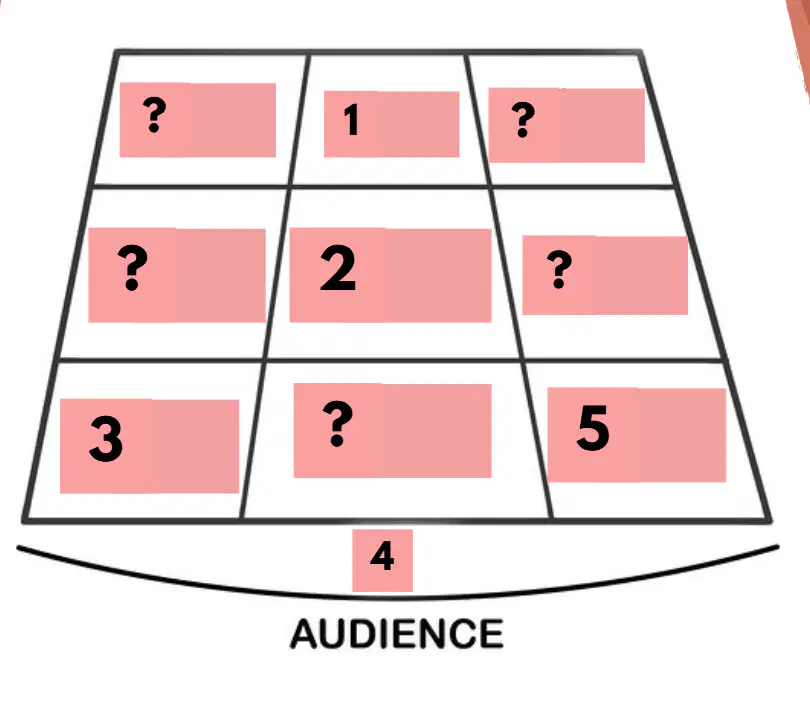
What is the stage direction for number 1?
APRON
CENTRE STAGE
UPSTAGE CENTRE
DOWNSTAGE RIGHT
What is the stage direction for number 4?
APRON
CENTRE STAGE
UPSTAGE CENTRE
DOWNSTAGE RIGHT

