
 Worksheets
Unit 4 Test WH FIP
Total questions: 14
Worksheet time: 7mins
The decline in economic production in Europe during the 1300s was caused by
an increase in malnutrition.
a decrease in population.
an increase in nationalism.
a decrease in religious faith.
During the Hundred Years’ War, monarchies fought over a throne and
labor shortages.
control of peasants.
food shortages.
control of territory.
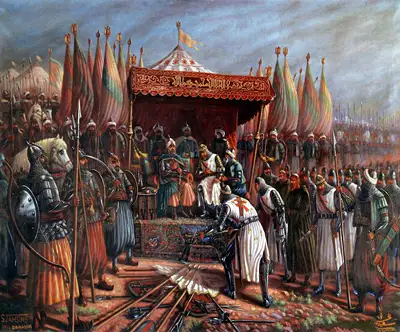
This painting shows a key event from the First Crusade.
by their weapons and horses
by their armor
How are the Crusaders identified in the painting?
Painting of the blood and iron policy of the balban event during the First Crusade.
by the red crosses on their backs
What effect did the Crusades have on trade?
Trade throughout the Mediterranean was destroyed.
Trading cities became more important.
Italian merchants saw their fortunes ruined.
Europeans began to sell their own spices.
Why might breaking a canon law during the Middle Ages be worse for an individual than breaking a law written by the government?
The Church could leverage their political influence in every country.
The Church could authorize severe punishment if necessary.
The Church had its own court system, which decided on appropriate punishment.
The Church had the power to banish a person from the religious community.
What was the impact of the Concordat of Worms?
The pope and Henry’s son became friends.
Henry V apologized for his father’s actions.
The pope recognized Henry V as the lawful emperor.
Henry V was forced to agree the pope was more powerful.
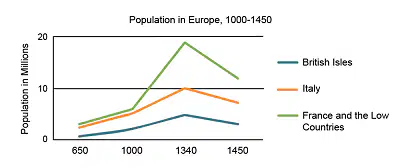
According to the line graph, by 1450, the population of France and the Low Countries had fallen to
about 8 million.
10 million.
about 12 million.
15 million.
Based on courtly love songs and heroic legends, which attribute was most important for a knight?
loyalty
courage
courtesy
truthfulness
Which of these behaviors is an example of chivalry?
farming the land in return for protection
rescuing someone who is in danger
taking an oath of loyalty to a lord
serving in the clergy
Unlike her husband, a peasant woman worked
in her family’s home as well as in the field.
at least six days a week.
only after her children were grown.
from dawn until dusk.
The feudal system probably would not have developed if the Roman Empire continued. Why?
Europe would not have been considered worthy of attack by invaders.
The emperor would have kept peace, so there would have been no threat of invasion.
A strong military would have been in place to protect people from invaders.
The emperor did not believe the feudal system could protect people from danger.
What was one significant indication that the European feudal system was effective?
Similar systems developed in China and Japan.
European peasants voted to keep the system in place.
Invaders did not manage to attack Europe.
The system put an end to the Roman Empire.
Under the Roman Empire, citizenship and loyalty to the empire governed society. What governed society after the empire fell?
a strong professional military
a bond of language and culture
centralized rule
personal ties and relationships
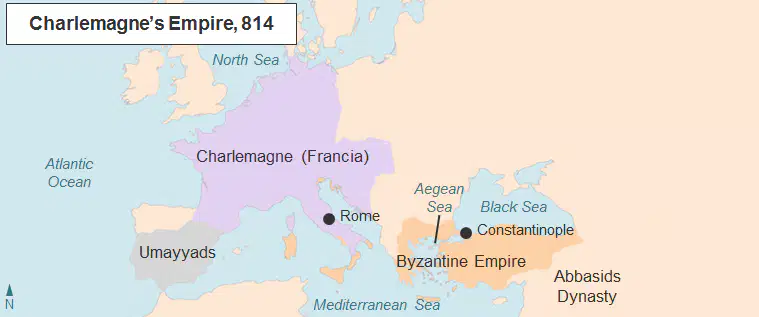
Charlemagne was known as the "father of Europe.” How does this map help to explain that title?
It shows that Charlemagne united eastern and western Europe.
It shows that Charlemagne’s empire was as large as that of the Franks.
It shows that Charlemagne’s empire was more powerful than the Roman Empire.
It shows that Charlemagne conquered a huge part of Europe.

