
 Worksheets
APWH Imperialism and Industrialization Mastery Check Review
Total questions: 24
Worksheet time: 12mins
Name
Class
Date
1.
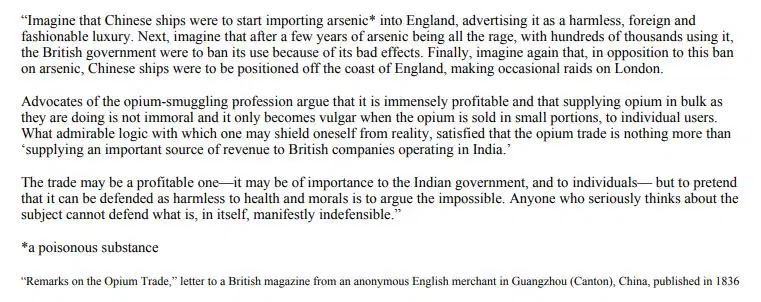
The trade described in the passage is best seen as an early example of which of the following?
a)
(A) The economic decline of Asian states resulting from the importation of cheap consumer goods from Europe
b)
(B) The growing economic influence of European immigrants in China
c)
(C) The declining political power of European joint-stock companies in Asia because of states assuming direct imperial control
d)
(D) The use of economic imperialism by European merchants and states
2.
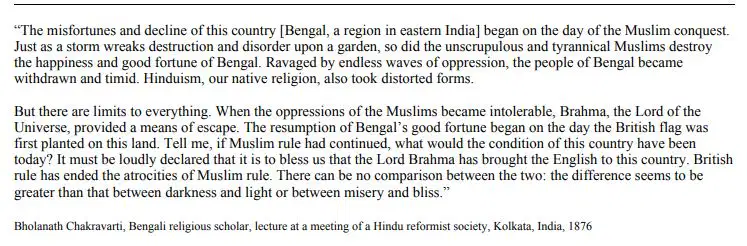
The author’s political point of view can be most clearly seen in the way in which the passage
a)
(A) neglects to mention that South Asian migrants were a key source of labor for Western transnational corporations
b)
(B) disparages the development of contemporary Hinduism
c)
(C) omits any mention of the economic exploitation and resource extraction practiced by the British in India
d)
(D) attributes historical events to divine intervention
3.
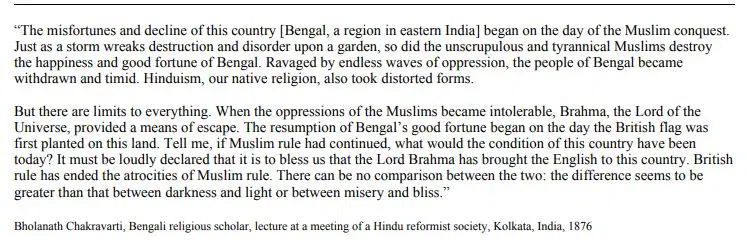
The arguments expressed in the passage are significant because they help explain why
a)
(A) social divisions within colonial societies often hindered the efforts of anticolonial movements to overthrow imperial rule
b)
(B) syncretic religious movements frequently emerged from cultural differences in colonial societies
c)
(C) nationalist movements against imperial rule often sought to bridge ethnic and religious differences by appealing to popular Enlightenment ideals
d)
(D) settler colonies frequently exacerbated differences between religious groups in colonial societies
4.
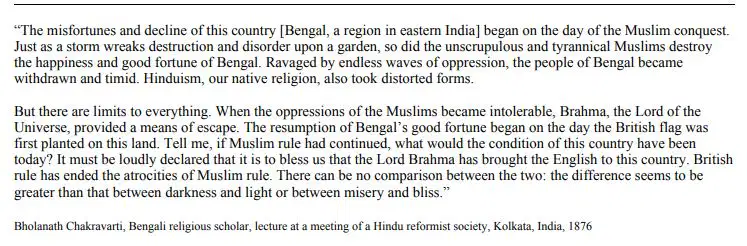
A historian analyzing the lecture would most likely argue that the audience of Chakravarti’s lecture is significantbecause it shows the most direct contrast with which of the following developments in the nineteenth century?
a)
(A) Religious differences in colonial societies often led to communal violence.
b)
(B) Imperial states often granted preference to religious groups that they felt were less of a threat to their power.
c)
(C) Religious movements often inspired rebellions against imperial rule.
d)
(D) Imperial governments often consulted local religious leaders before issuing important decrees.
5.

The changes in the distribution of cities in the period 1800 to 1900 C.E. best illustrate the impact of
a)
(A) the Atlantic revolutions
b)
(B) the Industrial Revolution
c)
(C) he abolition of slavery
d)
(D) improvements in urban policing and public safety
6.
Which of the following scientific concepts had the greatest role in providing a justification for imperialism in thelate nineteenth and early twentieth centuries?
a)
(A) Louis Pasteur’s germ theory of disease
b)
(B) Charles Darwin’s theory of evolution
c)
(C) Albert Einstein’s theory of relativity
d)
(D) Marie Curie’s theory of radioactivity
7.
Which of the following was a major unintended effect of the publication of Charles Darwin’s 1859 work On theOrigin of Species?
a)
(A) It became the basis for scientific research of human development.
b)
(B) It provided a scientific explanation of the evolution of animals and plants.
c)
(C) It became the basis for all subsequent scientific research on species extinction.
d)
(D) It became the basis of various theories asserting that Europeans were naturally superior to other peoples
8.
Which of the following most accurately describes the interactions between China and Europe in the nineteenthcentury?
a)
(A) China became isolated politically in part because of its suppression of pro-Western Chinese dissidents.
b)
(B) China effectively lost its economic independence to Europe as a result of military losses to European forces.
c)
(C) China became a major exporter of manufactured goods to Europe.
9.
Which of the following facilitated the creation of European empires in Africa during the late nineteenth century?
a)
(A) Africans’ unified resistance to European intervention
b)
(B) Europeans’ desire to develop industry in Africa
c)
(C) Europeans’ use of both warfare and diplomacy
d)
(D) Africans’ widespread acceptance of European laws
10.
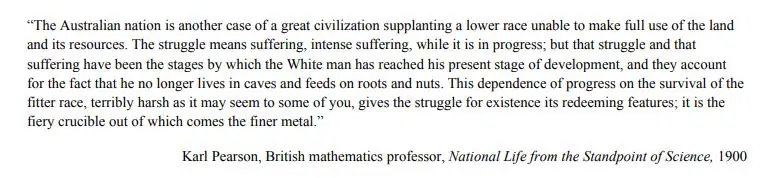
Based on the passage, the author would most likely have agreed with which of the following statements?
a)
(A) Britain’s founding of Australia followed God’s command to convert non-Whites.
b)
(B) All peoples of the world have the right to determine their own government.
c)
(C) Britain had contributed to human progress by taking over new colonies in Africa.
d)
(D) Nations go to war with each other mainly to gain precious metals.
11.
In the late 1800s, attitudes such as the one expressed in the passage had contributed most directly to which of thefollowing?
a)
(A) European states’ competition to acquire overseas colonies
b)
(B) The abolitionist movement to end slavery
c)
(C) The creation of industrialized economies in Europe
d)
(D) Efforts by European missionaries to convert non-Europeans to Christianity for their spiritual salvation
12.
“Extraterritoriality” can best be described as which of the following?
a)
(A) Exemption of foreigners from the laws of the country in which they live
b)
(B) Expansion of a country’s international borders to natural boundaries
c)
(C) Extension of dual citizenship to immigrants
d)
(D) Acquisition of new colonies or territories
e)
(E) Establishment of a government in exile
13.
Which of the following facilitated European expansion in Asia in the nineteenth century?
a)
(A) The popularity of democratic values among Asians
b)
(B) A general easing of tensions and cooperative expeditions among European powers
c)
(C) Europe’s development of new military technologies
d)
(D) Asians’ lack of resistance to European diseases
14.
Which of the following statements is true of global migration patterns during the nineteenth century?
a)
(A) Most migrants rejected their culture in favor of total assimilation.
b)
(B) Migrants increasingly relocated from rural areas to cities.
c)
(C) Most migrants traveled seasonally as agricultural laborers.
d)
(D) Migrants were primarily women seeking employment as factory workers.
15.
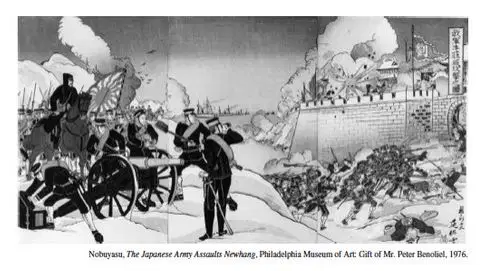
In the Japanese print above of the war between China and Japan (1894-1895), the artist suggests that the
a)
(A) Chinese were brave and honorable opponents
b)
(B) Japanese fought by using time-honored samurai tactics and weapons
c)
(C) Japanese showed their mastery of Western technology, dress and military bearing
d)
(D) Chinese actively sought foreign help against the Japanese
16.
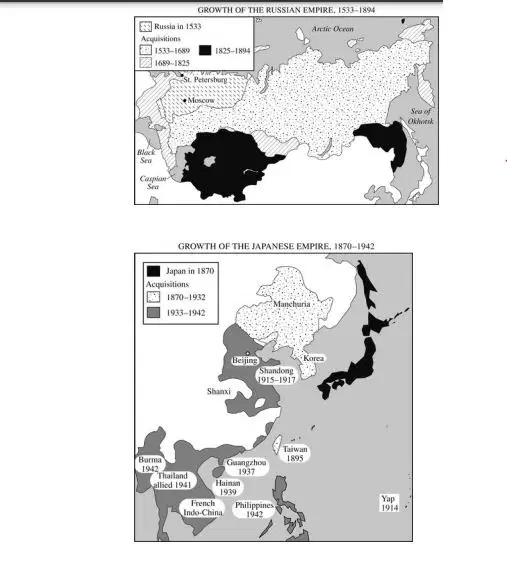
The primary rationale for Japan’s territorial acquisitions in Southeast Asia during the period 1933–1942, asreflected in the Japan Map (bottom map), was most similar to the primary rationale for which of the following?
a)
(A) The Ottoman Empire’s conquest of the Middle East and North Africa
b)
(B) France’s conquests in central and southern Europe under Napoleon
c)
(C) The British East India Company’s takeover of other European states’ colonial possessions in India
d)
(D) The Qing dynasty’s expansion into Central Asia
17.
Which of the following countries or regions led the world in the production of cotton cloth in 1700?
a)
(A) China
b)
(B) Egypt
c)
(C) West Africa
d)
(D) England
e)
(E) India
18.
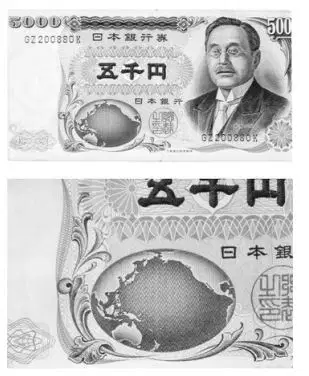
Based on an analysis of the Japanese currency used during the Meiji period (1868—1912) shown above, which ofthe following is the primary message conveyed by the engraving?
a)
(A) The Japanese government considered its geographical proximity to China to be of primary importance.
b)
(B) The Japanese government focused its expansionist policy on Australia and New Zealand.
c)
(C) The Japanese government saw itself as a major Pacific power.
d)
(D) The Japanese government was eager to develop trade ties with the United States.
19.
Social Darwinism was used to justify which of the following during the nineteenth century?
a)
(A) Latin American independence movements
b)
(B) Domestic reforms in Meiji Japan
c)
(C) British colonization of India
d)
(D) Russian utilization of coerced peasant labor
20.
Which of the following best characterizes Western imperialist expansion in the late nineteenth century?
a)
(A) Western fears of the spread of Japanese influence
b)
(B) Western investment to create self-sufficient economies in the new colonies
c)
(C) An unprecedented amount of territory colonized in a short period of time
d)
(D) The establishment of political institutions to resolve ethnic and religious conflicts within colonies
21.
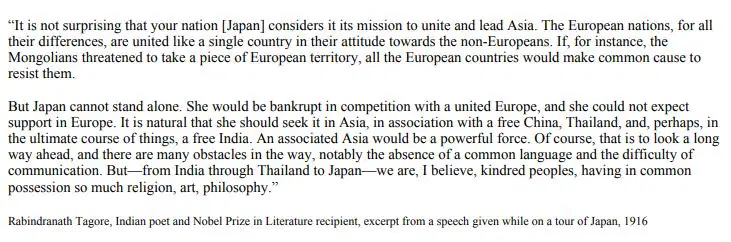
Which of the following developments in the late 1800s and early 1900s most directly challenges the author’sargument regarding the role of Japan in Asia?
a)
(A) Japanese imperial expansion into Asian territories such as Taiwan and Korea
b)
(B) Resistance to modernization by traditional Japanese elites
c)
(C) Meiji Japan’s success in developing an industrial economy
d)
(D) The adoption of a parliamentary political system
22.
During European Imperialism, various European leaders met to discuss plans for dividing Africa peacefully what was this event?
(a)
23.
The (a) resulted in the dissolution of the British East India Company's control of India and the British Government taking overruling India.
24.
An uprising in northern China against the spread of Western and Japanese influence there.
(a)
100 %

